GUANGDONG, 18 September 2026. Guangdong Jiateng Robotics, a veteran mobile-robot company, has closed a tens-of-millions strategic round after a 12-year gap, led by Het (Guangdong HET), with Daohe Fund and Jinmu Capital following. Orient (Dongfang Precision) has held about 19.84 per cent since 2014 and remains the second-largest shareholder.
The capital line-up is strikingly industrial. Lead investor Het is a listed leader in smart control, the “control brain” of terminal devices, focused on core robot components such as servo motors and joint control, and has built deep positions across the robot value chain via joint ventures and strategic investment. Daohe’s limited partners include Orient, Leju Robot and Daohe’s own capital. The three had already founded Shenzhen Heju Zhikong in 2025 to develop and produce humanoid robot control systems, so this Jiateng investment is their next “meeting point” on the robot track.
Founded in 2002, Jiateng is among China’s earliest mobile-robot entrants, holding 700-plus patents and software copyrights, focused on AGV autonomous guided vehicles with full smart-logistics plant solutions. It has rolled out six generations of AGVs across more than 500 models covering traction, lifting, side-fork and omnidirectional forklifts, loads from 5 kg to 220 tonnes, with annual AGV capacity of 10,000 units. In October 2025 it won a 1,000-plus AGV order from two new-energy giants.
Unlike ordinary mobile-robot firms, Jiateng’s edge is deep industrial-scenario experience. Across more than two decades it has delivered over 2,000 industrial projects and accumulated 270 million hours of field-operation data. In embodied-AI deployment, device research alone is never enough. Only by combining massive industrial data, scenario experience, control systems and chassis technology can a device run stably in a factory, and Jiateng’s scenario data and field experience are precisely its moat into industrial embodied AI.
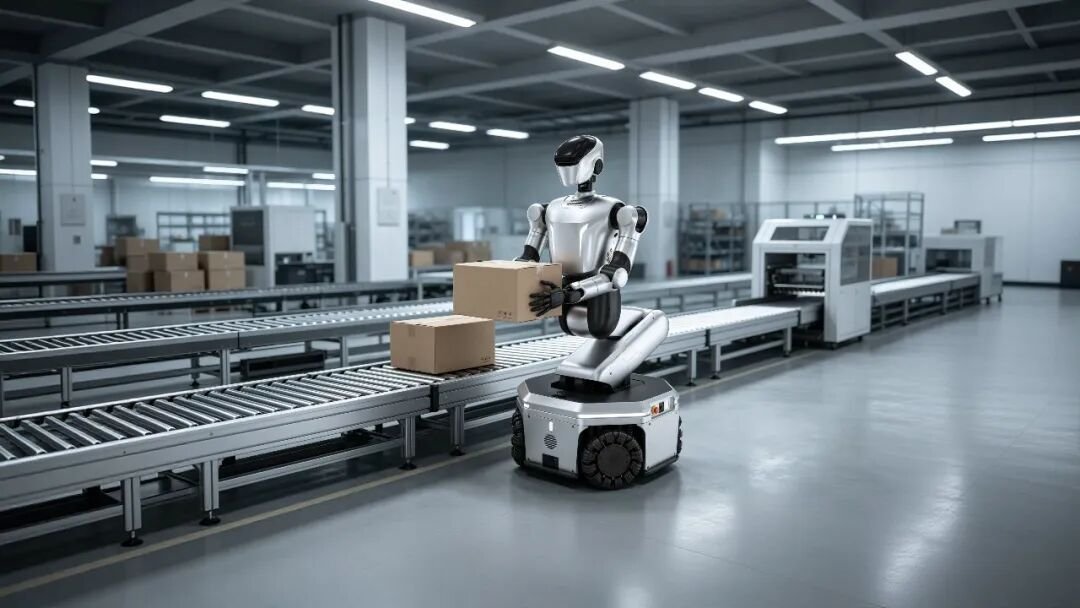
As humanoid and embodied-AI hype runs hot, factory-floor deployment remains the hard part, and bridging robot bodies with complex industrial sites is key. Jiateng has precisely positioned itself at the “physical base” of industrial embodied AI, developing the iCORE embodied-intelligence chassis, a core supplier of mobile chassis for the field and one of very few chassis suppliers able to meet embodied-robot makers’ export requirements. The chassis supports 360-degree in-place omnidirectional steering, a 100 kg maximum load, and precise control via VLA and VLM models, adapting to material handling, line feeding and sorting across humanoids, AGVs, AMRs and unmanned forklifts.
Jiateng’s embodied chassis has entered volume shipment at 150 to 200 units a month, with future annual capacity potentially exceeding 100,000 units. Together with Leju Robot and others it is advancing proof-of-concept validation of a 15 kg dual-arm humanoid in industrial scenarios. With stable products and mature solutions, Jiateng has gone global: its products ship to more than 30 countries and regions, with over 20,000 AGVs deployed worldwide, overseas revenue above 60 per cent, and a client roster spanning GAC, Toyota, Volkswagen, Huawei and Midea across transport, manufacturing and power.
Editor’s note: This is an adapted translation of the original OFweek Robotics report. It has been trimmed and restructured for readability for an international business audience.