SHENZHEN, 13 August 2026. When investor Zhu Xiaohu exited humanoid-robot projects and backed Shihang Intelligence, a Harbin Engineering University offshoot, deep-sea robots returned to the venture spotlight. Another HEU offspring, DeepSea Pioneer, is taking a different route: industrial deep sea, where it claims faster commercialisation than its peer.
Harbin Engineering University is the cradle of China’s marine-equipment talent, and DeepSea Pioneer’s founder Ma Yiming is among its standouts, a ship-and-ocean engineering graduate who became the first Chinese engineer at SMD, the world’s second-largest deep-sea robot supplier (since acquired by CRRC Times), and the first to systematically import Western deep-sea robotics core technology. He led and joined world-class marine-robot projects including the world’s first commercial deep-sea mining robot Nautilus and China’s first heavy-duty seabed operation robot.
On 13 August, DeepSea Pioneer announced an over-RMB 500 million Series A, a line-up spanning top market funds and multiple state players: Photosynthesis Ventures, Dachen Capital, GGV, Fortune Capital, Cathay’s TotalEnergies fund, CIC Capital and CETC Investment, plus large pro-rata top-ups from existing shareholders. Earlier rounds brought in Guangzhou Jinrong, Shenzhen Hi-Tech Investment and Kejin Holdings, and BYD sits among its shareholders.
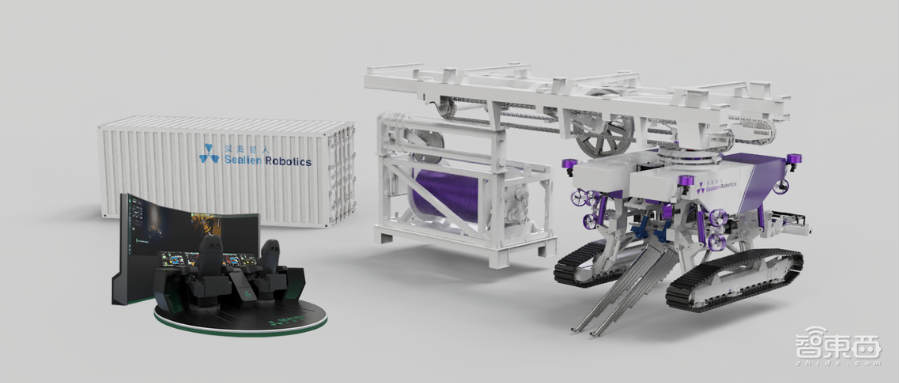
Since formally operating in 2023, DeepSea Pioneer has targeted industrial deep-sea scenarios such as offshore oil and gas, subsea communications, offshore wind and deep-sea mining, while pushing underwater embodied intelligence and multi-robot cluster coordination. Its product lines span light submerged ROVs and heavy-duty seabed work robots, including the 6,000-metre work-class Singularity, the Phoenix suspended cable-burying robot, the Taurus (Asia’s most powerful seabed cable-burying unit), the Auriga heavy-duty seabed robot, and general marine robots such as Pisces (ballast inspection), Scorpio (hull cleaning), and Sagittarius (deck inspection).
On software, DeepSea Pioneer released Haiwei I, its first universal marine-robot control core, and in May 2026 launched SEAgent, described as the world’s first deep-sea robot task-decision model. Its hardware-software moat rests on an integrated engineering system covering mechanical, electrical, hydraulic, control and intelligent systems, with more than 500 intellectual-property assets, over 30 per cent high-value invention patents, and 400-plus industry standards and operating norms.
In under three years, with fully autonomous heavy-load deep-sea equipment, DeepSea Pioneer covered almost all of China’s offshore-wind seabed-robot supply over the past one to two years and became the first Chinese company to commercially export deep-sea robots, breaking a long Western monopoly. In 2025 it signed a near-US$10 million order with a subsea-cable contractor under the UAE telecom group, China’s first deep-sea robot export, completed with installation and sea trials in May. Months later it won a RMB 130 million Phoenix 600, 3,000-metre-class suspended cable-burying robot order. By July, new robot contracts reached hundreds of millions of RMB, with tens of millions more locked and a RMB 1 billion potential pipeline in discussion.
Its operations now reach Britain, Egypt, the UAE and Australia across oil and gas, subsea communications and offshore wind. This year it launched DeepMatrix, aiming for the world’s first fully autonomous seabed robot cluster, permanently deploying intelligent robots on the seabed for long-stay, all-weather autonomous operation. Per QYResearch, the global tethered-ROV market was about US$2.132 billion in 2025 and is projected to reach US$3.143 billion by 2032, a 5.7 per cent compound rate, a golden window for domestic players.
Editor’s note: This is an adapted translation of the original OFweek Robotics report. It has been trimmed and restructured for readability for an international business audience.