BEIJING, 18 September 2026. Beijing Zhongke Yuandongli has completed a hundreds-of-millions B2 round led by Chery Intelligent Technology, under Chery Holdings. The proceeds will fund R&D of new-energy smart farm machinery and embodied-agriculture robots, scaled delivery and faster overseas expansion. Per business records the company has now raised eight rounds, backed by a mix of state forces including CAS-affiliated Guoke, Zhongguancun, Beijing Kewei, Jilin Zhongke and Hubei Gaotou, plus market investors Haiyi, CICC Capital, CCV, InnoAngel and Vertex.
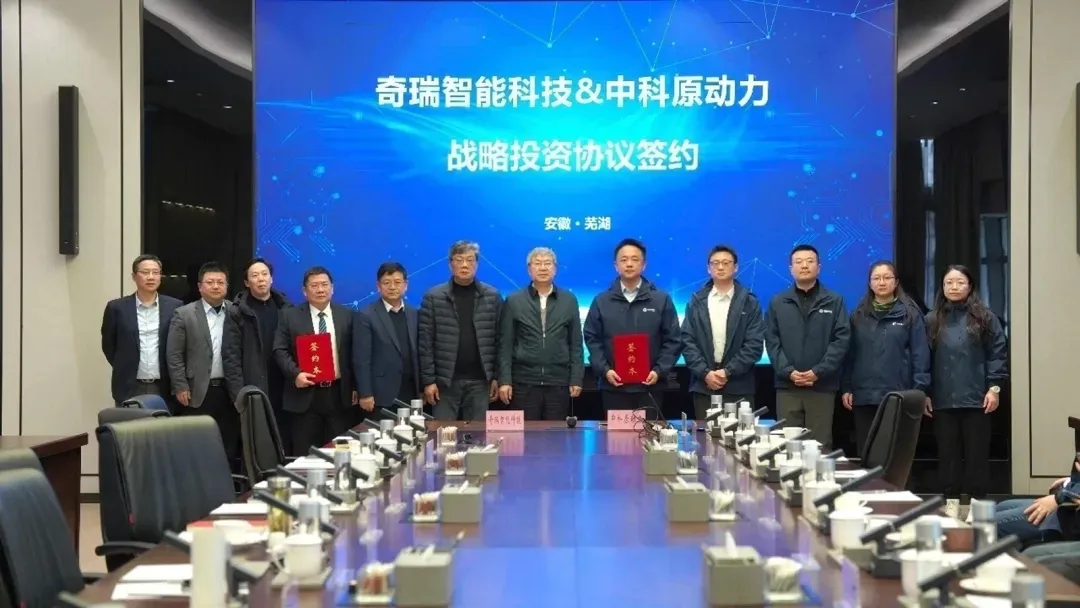
Chery’s entry is not just capital. As a top Chinese carmaker with deep automotive know-how, it will collaborate across R&D, engineering validation, supply chain, production quality control and global channels to speed the productisation, scaling and internationalisation of new-energy smart farm machinery and embodied-agriculture robots.
Zhongke Yuandongli was incubated by the CAS Institute of Microelectronics and is a national “little giant” specialised SME in agricultural robots. Its scientific pedigree is rare: led by Li Deyi, a CAE academician and honorary chairman of the Chinese Association for Artificial Intelligence, who proposed the “driving brain” concept, as chief scientist. Founder, chairman and CEO Han Wei, a Li student and Tsinghua computer graduate, is a CAS senior engineer with years in agricultural robotics. The core team comes from Tsinghua, UC Berkeley and others.
Li Deyi framed the future farm machine as a learning robot that farms: the yellow ox retires, the iron ox ploughs, farmers move to the city, and experts till the land. Replacing brute field labour with standardised, intelligent farming changes theextensive model built on people and experience. On a “new-energy plus intelligence” route, Zhongke Yuandongli built the world’s first 25 to 340 horsepower full-coverage new-energy smart-machinery line, breaking a key bottleneck.
It has built unmanned capability across tillage, management, harvest and transport, with a matrix of unmanned operation systems, new-energy smart-machinery bodies, embodied-agriculture robots and smart implements: the Wantu electric tractors, Zhiniu unmanned machinery, Zhinong tomato-picking robot, multi-function transport robot and spray robot, and the Zhiyun unmanned operation system, all with all-day, automated, precise operation. While most unmanned farm machines sit at L1 navigation, its products reach L4 and are commercially deployed at scale.
In April, in a Xinjiang cotton field, its unmanned smart machinery ran a “wide-early-optimal” seeder with no manual control, achieving centimetre-level straight-line error and uniform depth and spacing. Overseas, in May its Zhiyun system was adapted to Belarus’s Minsk Tractor Works models and put into spring tillage. The company has logged over 1 million mu of unmanned standard operations across more than 20 provincial regions, and is validating products abroad.
Agricultural intelligence is irreversible. Per MarketsandMarkets, the global agricultural-robot market is set to grow from US$17.73 billion in 2025 to US$56.26 billion by 2030, a 26.0 per cent compound rate. The US leans on Carbon Robotics for field laser weeding; ageing Japan pushes unmanned farm machines via Kubota, Yanmar and Iseki; Germany’s BoniRob serves field detection; Britain targets fruit and mushroom sorting with machine vision and arms. China, the world’s largest agricultural-drone country with over 300,000 drones and 460 million mu of annual operations, brought drones into its national agricultural strategy in 2026, and policy keeps driving “machines replacing people”.
Editor’s note: This is an adapted translation of the original OFweek Robotics report. It has been trimmed and restructured for readability for an international business audience.