An angel round led by a Xi’an state fund
Lanchong Embodied, a full-stack embodied-intelligence company, has closed an angel round in the tens of millions of yuan. The round was led by Xi’an High-Tech Industry Venture Capital and will fund production line construction, product development, new deployment scenes and team expansion.
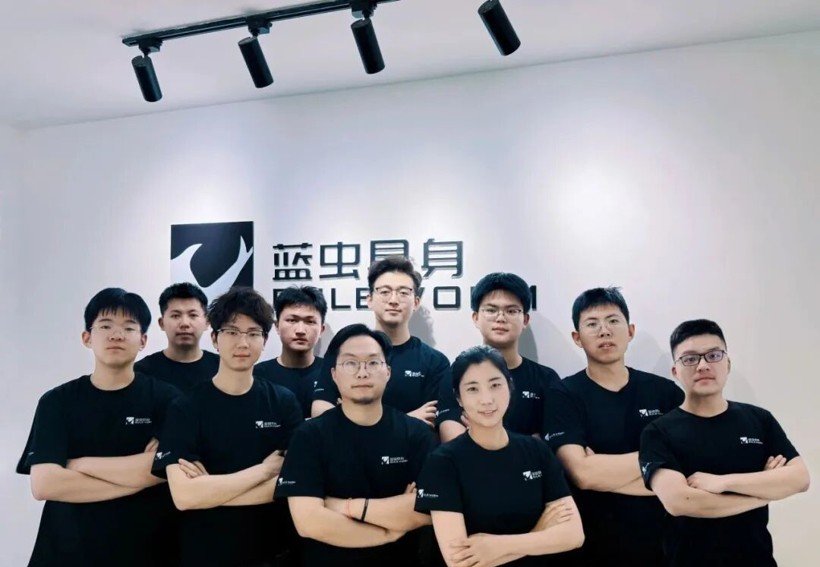
The company was incorporated in March 2025 with support from Xi’an Jiaotong University, set up to commercialise research results. Its core team combines graduate and doctoral researchers from the university with experienced robotics engineers. Founder and chief executive Cong Yao is a serial entrepreneur with more than a decade in the robotics industry.
Four platforms, one brain
The company has built four in-house platforms covering the whole stack from body to teleoperation to model to cloud.
The Chunjian robot architecture platform uses platform-based development, family design and modular functions to reuse about 70 per cent of its underlying technology across mechanics, electronic control, algorithms and embedded systems, and contains six core technologies including the Hujia chassis and the Tanglang electronic control unit.
The Quantum teleoperation platform uses a self-developed communications protocol to hold latency at 10 milliseconds, pairs a mixed-reality interface with an atomic skill library to lower operating difficulty, and supports both 5G and worldwide broadband connections.
The Wormhole model platform carries the Wormhole series of foundation models on the in-house BW-Brain, iterating on real, imitation and synthetic data.
The Hive cloud platform connects body, teleoperation and model, running the loop from collection to training to inference and covering data processing, model training and device scheduling, with commercial features such as cloud labour and data trading built on top.
On 14 September the company released the next generation of its modular humanoid, the Mantis Standard, priced from RMB 9,800 as an out-of-the-box embodied-intelligence development platform.
Rather than the bipedal route built around running and jumping, the Mantis series uses a wheeled structure and concentrates on upper-body work, aiming for faster commercialisation, lower cost and more stable production.
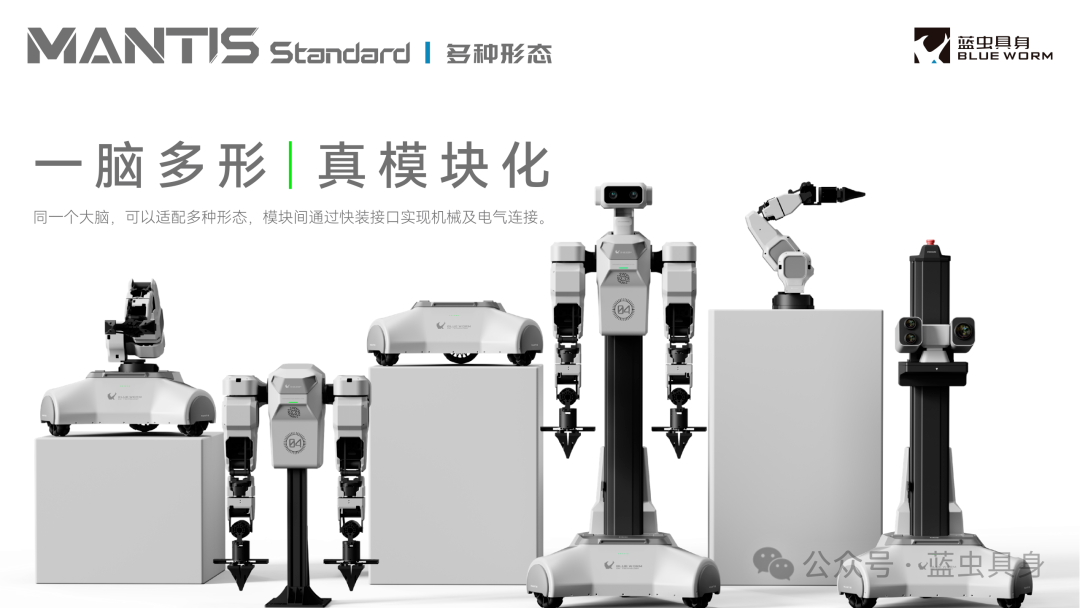
The Standard model stands 1.4 metres tall with 22 degrees of freedom in total, seven in each arm. Each arm carries 7 kilogrammes, repeated positioning accuracy is plus or minus 1 millimetre, and it uses a three-degree-of-freedom omnidirectional base. The waist lifts through a 550 millimetre range and the machine runs for three hours.
It also carries the Quantum teleoperation system of the company with five-dimensional sensing, and the BW-Brain, which builds on a vision-language-action, deep reinforcement learning and world-model architecture so that skills can be sequenced into reusable agents.
The Mantis series comes in three versions graded by payload and scene. Standard is the balanced entry model for research, light payloads and light commercial and industrial service. Pro is the main commercial model, with a 10 kilogramme single-arm payload and a 1.7 metre adult height, aimed at small commercial venues and light industrial work. Ultra is a custom high-end model still in development, with a 15 kilogramme payload, aimed at advanced industrial and specialist sectors.
Selling teleoperation first, collecting data on the way
The commercial route chosen by Lanchong is to sell teleoperation first and treat data as a by-product. Teleoperated robots go into real scenes and earn revenue while data accumulates naturally, forming a loop in which teleoperation earns, data builds up, models iterate, autonomy improves and more scenes open up.
On deployment the company works from commercial venues towards the home. It starts with small business-to-business scenes to validate engineering and supply chain capability, then opens up the home services market, scaling research and commercial service scenes together.
The company has signed a supply agreement for several hundred units a year with a leading self-service coffee machine maker. It has sold robots to Xidian University, Xi’an Jiaotong University and China University of Mining and Technology for embodied-intelligence data collection, and has run deployments in industrial and commercial scenes with Shaanxi Tourism Group, Zhizi Auto and Xingxun Intelligent.
Editor’s note: This is an adapted translation of the original Gasgoo report. It has been trimmed and restructured for readability for an international business audience.