The Yangtze’s new motor city
How Wuhan, a metropolis nearly 1,000 kilometres from the ocean, is reshaping the global trade in automobiles.
To gaze upon the muddy waters of the Yangtze as it winds through Wuhan is to look at the undisputed industrial heartland of inland China. Located roughly 1,000 kilometres from the nearest coastline, this sprawling metropolis has long been a heavyweight in domestic manufacturing but a geographic underdog in the realm of international maritime shipping. Yet, the conventional wisdom of global trade—that export-driven industries must hug the sea—is being spectacularly upended. In both 2024 and 2025, the total roll-on/roll-off (ro-ro) throughput of the Wuhan port group eclipsed one million vehicles, firmly securing its position as the busiest hub in the middle and upper reaches of the Yangtze. At the core Hannan port area alone, total throughput surpassed 700,000 vehicles in 2025. Of these, over 280,000 fully assembled cars from major automakers including Dongfeng, Changan, SAIC, and Geely were shipped outwards to global and domestic markets.
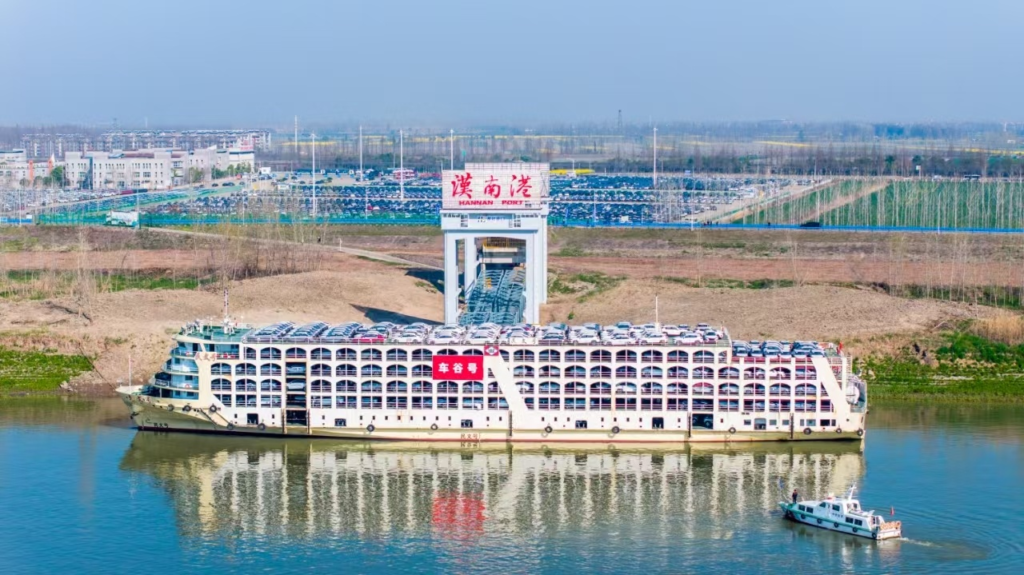
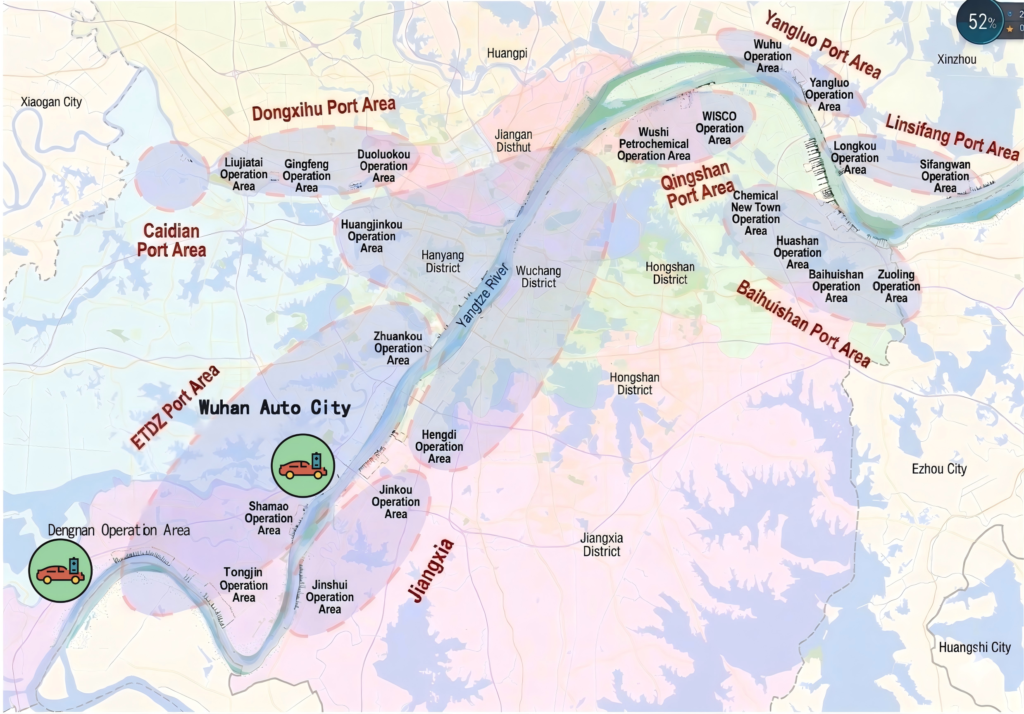
The story of how a city with no sea became a maritime export powerhouse is rooted in immense, state-backed infrastructure development. Wuhan does not rely on a single dock, but rather a formidable cluster of terminals. As of 2026, the port group’s built-up design capacity for ro-ro operations stands at approximately 1.5 million vehicles annually. This includes the Zhuankou and Jinkou terminals operated by the Wuhan Port Group, alongside Hannan’s Dengnan operating area. Although Hannan has a baseline design capacity of 300,000 vehicles, making it the largest single ro-ro port in the upper and middle Yangtze, its operational throughput clearly punches far above its weight. And the ambition does not stop there: while the mid-term planning target for the end of 2025 was set at 1.8 million vehicles , the 2035 master plan envisions a staggering peak capacity exceeding 2.4 million vehicles per year.
To grasp the sheer scale of this ambition, consider the Port of Nagoya, the maritime gateway for Toyota. In 2024, Nagoya exported roughly 1.46 million vehicles, pushing against the upper limits of its design capacity. By contrast, the Wuhan port group’s current built-up capacity of 1.5 million vehicles suggests that this landlocked Chinese city may already possess a theoretical export infrastructure that surpasses Japan’s foremost automotive hub. Should Wuhan realise its 2035 master plan of over 2.4 million vehicles, its capacity would dwarf Nagoya’s 2024 output by nearly a million units, potentially catapulting the inland port into the ranks of the world’s top five global automotive export terminals. There is, however, a crucial caveat. Ports are merely conduits; the realisation of this grand maritime destiny relies entirely on whether Wuhan’s domestic auto industry possesses the manufacturing prowess, commercial viability, and global appeal to actually fill such a colossal capacity.
Historically, geography levied a heavy, unavoidable tax on inland carmakers. To export a vehicle, manufacturers in Hubei province were forced to rely on fleets of diesel-belching lorries to haul their inventory to coastal mega-ports like Shanghai. Upon arrival, the vehicles were offloaded into staggeringly expensive coastal warehousing, where they languished in administrative purgatory awaiting customs clearance and scarce berths on ocean-going ro-ro ships. The analogue process was sluggish—often taking up to two months—plagued by soaring labour costs, and highly susceptible to bottlenecks.
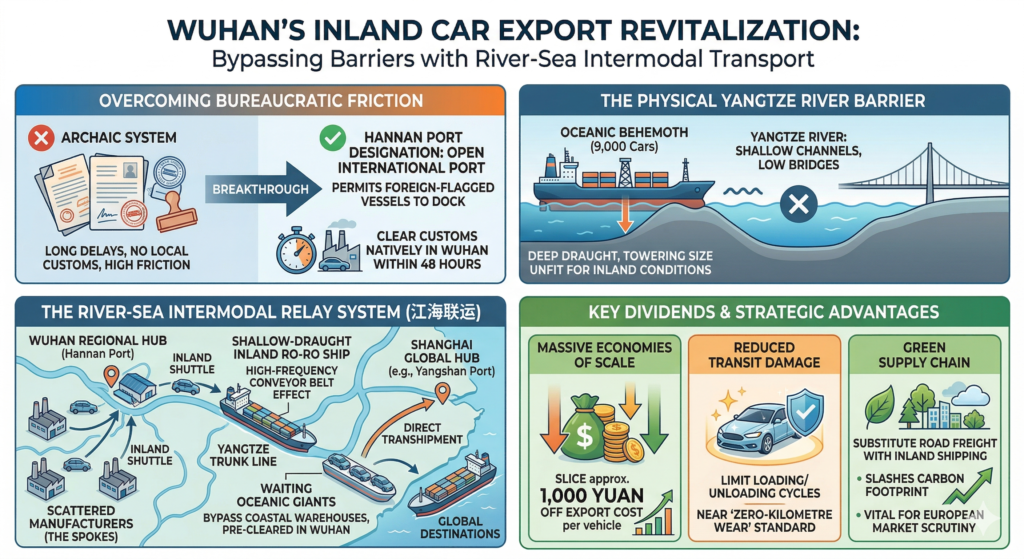
The catalyst for Wuhan’s disruption of this archaic system was as much bureaucratic as it was infrastructural. The breakthrough arrived when Wuhan’s Hannan port secured a coveted designation as an open international port, permitting the docking of foreign-flagged vessels. Crucially, this transformed Wuhan from a mere site of production into a legitimate port of origin. Vehicles can now clear customs natively in Wuhan within 48 hours. The bureaucratic friction that once crippled inland exporters evaporated almost overnight.
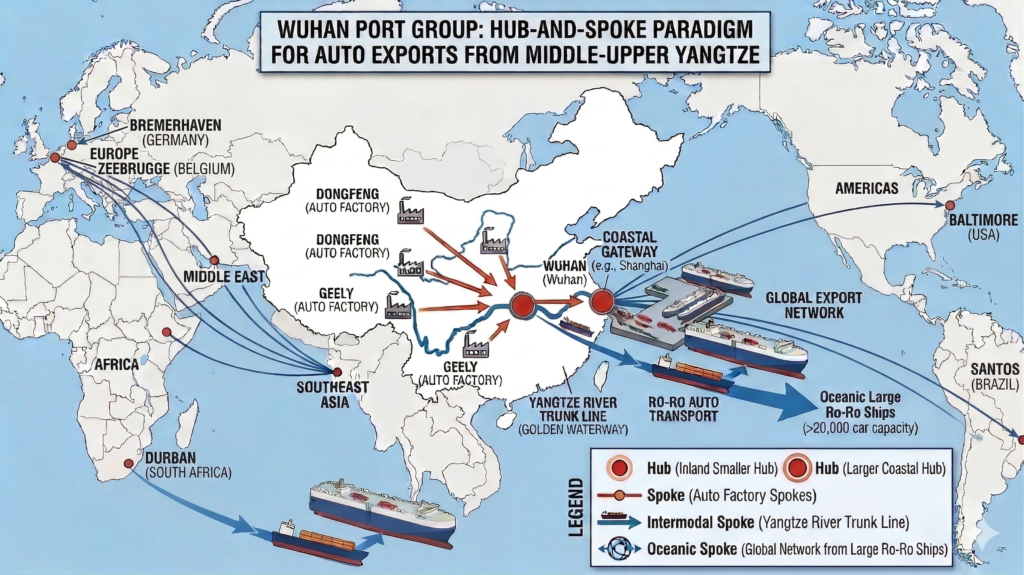
Yet, the physical barrier remained. The Yangtze, despite its majesty, cannot accommodate the deep draught of a 9,000-car oceanic behemoth, nor can such towering ships navigate beneath the low-hanging bridges that span the river. The solution lies in an elegant, rigorous application of a hub-and-spoke logistics network, locally dubbed “river-sea intermodal transport” (江海联运).
At its core, the hub-and-spoke paradigm is a model of network organisation where all traffic moves along spokes connected to a central hub. Instead of inefficient point-to-point transit between every individual location, this system funnels goods into a centralised point for consolidation and sorting before onward distribution. This architecture allows for the maximisation of transport efficiency and significant economies of scale by concentrating flows through a high-capacity gateway.
Rather than attempting to force ocean vessels inland, Wuhan’s planners designed a high-efficiency maritime relay. Wuhan acts as the regional hub, aggregating output from scattered local manufacturers (the spokes). Here, vehicles board shallow-draught inland ro-ro ships. These vessels operate as a high-frequency conveyor belt, moving swiftly down the Yangtze trunk line to the global hub of Shanghai. Upon arrival at ports like Yangshan, the cargo undergoes a seamless transhipment process. Because the cars were pre-cleared by customs in Wuhan, they bypass coastal warehouses entirely, transferring directly from the riverboat to waiting oceanic giants.
The economic and ecological dividends of this model are profound. By centralising transport on the water, Wuhan achieves massive economies of scale that slice approximately 1,000 yuan off the export cost of every single vehicle. Furthermore, limiting the loading and unloading cycles dramatically reduces the risk of transit damage—achieving a near “zero-kilometre wear” standard. Just as importantly, the substitution of inland shipping for road freight slashes the carbon footprint of the supply chain, a vital strategic advantage as European markets tighten their environmental scrutiny on imported goods.
It is tempting for economic historians to draw parallels with Detroit, America’s quintessential motor city. Nestled deep within the North American interior, Detroit similarly leveraged the Great Lakes and the St. Lawrence Seaway to forge a river-sea intermodal link to the Atlantic. Yet, the Chinese model possesses distinct structural advantages. Detroit’s maritime ambitions are annually thwarted by the winter freeze, which halts shipping and severs the continuity of the supply chain. Wuhan’s subtropical climate, by contrast, ensures the Yangtze remains a year-round artery.
Moreover, Detroit’s direct-to-ocean model is permanently constrained by the physical dimensions of the Seaway’s locks, which restrict traffic to smaller “Seawaymax” vessels. By embracing a hub-and-spoke relay rather than a direct-shipping model, Wuhan bypasses this geographical ceiling. It effortlessly links inland production with the world’s largest, most cost-efficient oceanic vessels waiting in the East China Sea, thereby achieving a scale of centralisation that Detroit could never manage.
As global supply chains undergo radical reconfiguration in an era of geopolitical friction and fierce margin pressures, the Wuhan experiment offers a potent lesson. It proves that a perceived geographic deficit can be engineered out of existence. Through a combination of regulatory foresight, formidable capacity expansion, and ruthless network design, the tyranny of distance has been decisively broken. For the world’s car buyers, the next electric vehicle in their driveway may well have begun its oceanic voyage from the very centre of a continent.