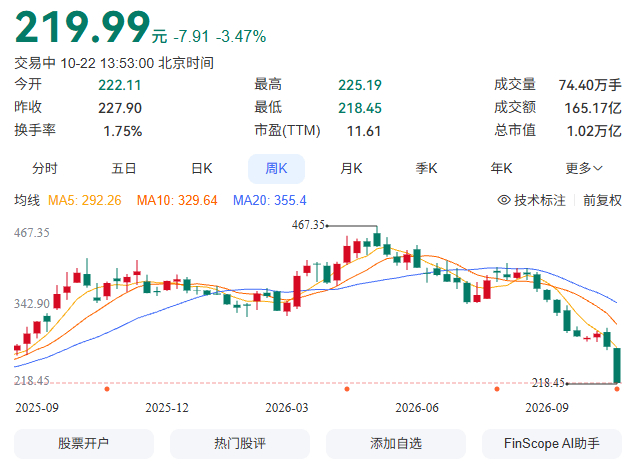
The third-quarter results were published and the shares fell 12 per cent the same day, leaving the stock roughly half its May high. The revenue line, oddly, was excellent: up 58.6 per cent year on year. Net profit attributable to shareholders rose 14.5 per cent.
The arithmetic between those two numbers is where the story lives. Gross margin came in at 20.69 per cent, down 5.1 points. For the nine months, net operating cash flow fell 23.6 per cent year on year. Tax and surcharges rose 92 per cent. CATL is selling more and keeping less.
The storage cell bill comes due
Management gave two explanations at the results briefing: a shift in quarterly product mix, and the effect of consumption tax and export tax rebates.
The mix point is concrete. CATL signed a large number of low-margin storage contracts over the past two years and delivered them in the third quarter, so the revenue arrived with the margin attached. The company did not disclose the contract volumes or how thin the margins were, which is itself the signal. Storage cell gross margin has been eroding for a while, and the largest producer in the world could not avoid it.
The oversupply explains why. Storage cell shipments in China reached 450.5 gigawatt-hours in the first eight months of this year, against 1,200 to 1,500 gigawatt-hours of capacity already built and more than 2,000 gigawatt-hours planned across the industry. The price of a storage cell has fallen from about RMB 1 per watt-hour in 2023 to roughly RMB 0.4.
Storage is not, however, the main business. By volume, power batteries and storage cells run roughly three to one. By revenue, power batteries are 69.4 per cent and storage 19.2 per cent.

The carmakers that stopped buying
From the interim report, storage cells carried a 23.96 per cent gross margin and power batteries 20.63 per cent. Both fell more than 1.5 points year on year, but power batteries fell further. That is the segment doing the damage.
The reason is visible in market share. CATL held 49.8 per cent of China’s battery market in January. In September it held 40.9 per cent. Li Auto’s L8, launched this year, moved every trim to Sunwoda. Xiaomi’s new Pengcheng model sources from Sunwoda and CALB, with no CATL content at all.
What makes this different from ordinary price competition is who is leaving. These are not entry-level vehicles cutting costs. They are premium new-energy brands with loyal customer bases and the negotiating position to say no. They want control over battery technology rather than a purchased pack, and CATL has not been willing to hand that over.
The technology moat still exists. It is no longer wide enough that a serious carmaker treats CATL as non-negotiable.
The tax regime changed direction
Two policy shifts landed in the same year. Under a joint announcement from the Ministry of Finance, the General Administration of Customs and the tax authority, consumption tax on lithium-ion batteries and four other battery categories was restored on 1 September at a transition rate of 2 per cent, rising to 4 per cent on 1 September 2027.
The exemption dates to 2015, when lithium batteries were an emerging industry that needed support. The support has worked. The logic now runs the other way: the sector has capacity in excess of demand, so the exemption has been redirected toward solid-state and sodium-ion technologies.
Export tax treatment moved too. From 1 April to 31 December this year the VAT export rebate on battery products drops from 9 to 6 per cent, and disappears entirely from 1 January 2027. China produces more than 90 per cent of the world’s storage cells and exports 62.7 per cent of them, so the rebate was mostly a transfer to overseas buyers, and one that trading partners had started to notice.
The combination explains a 92 per cent rise in tax and surcharges for the nine months, and it is a permanent change to the cost base rather than a quarterly fluctuation.
What is left
Demand is not the problem. AI data centres, grid expansion and renewable integration all point to more storage, not less. The industry’s problem is the same one solar manufacturing ran into: capacity that arrives faster than demand can absorb, a price war that outlives the weak players, and a policy framework that stops underwriting the overbuild.
CATL is responding on two fronts. It keeps pushing technical thresholds, and it has spent years marketing its brand direct to car buyers so that the end customer asks for the cell. It is also expanding beyond the pack into swapping, charging services and joint technology programmes with automakers.
None of that restores a 26 per cent gross margin quickly. The company is still the lowest-cost producer in a market that no longer pays a premium for being the largest.
Editor’s note: This is an adapted translation of the original Sohu Tech report. It has been trimmed and restructured for readability for an international business audience. The full original (in Chinese) is at https://www.sohu.com/a/1091380261_355019.