In 1848, a shovel in San Francisco cost ten dollars before anyone had proved there was gold in the hills. The people who got rich first were selling the equipment. Deep Robotics is asking the public market to fund shovels on an industrial scale.
The Hangzhou company, which built its reputation on industrial quadruped robots under the Jueying brand, updated its prospectus for a STAR Market listing on 28 September. First-half 2026 revenue was RMB 259 million, up 117.67 per cent year on year. Profit did not follow. Deep Robotics recorded its first annual profit in 2025 at RMB 28.68 million, then a loss of RMB 8.81 million in the following half year.
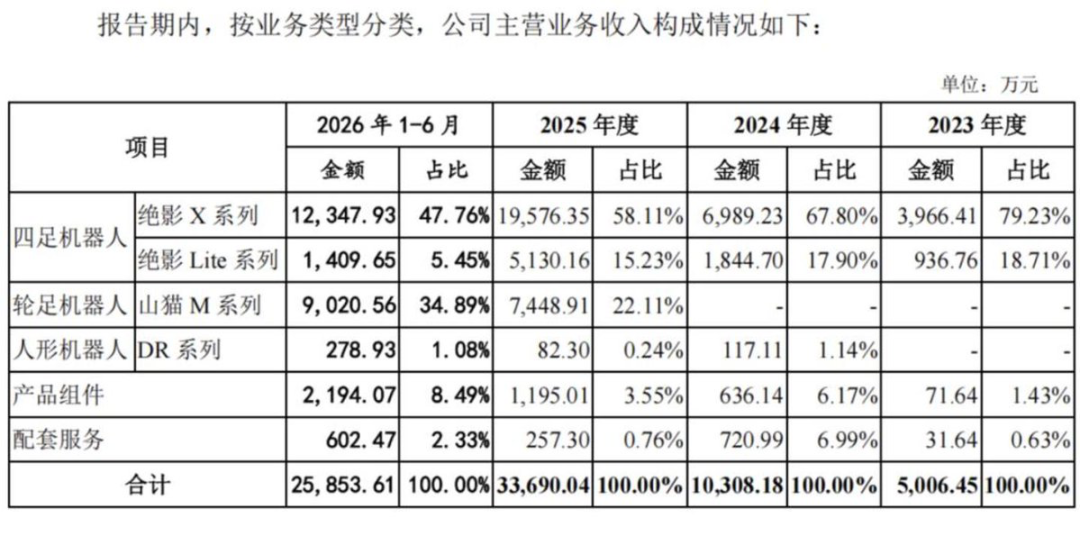
In 2025 it shipped 2,531 quadruped robots, 377 wheeled-legged robots and one humanoid, for 2,909 units in total. The IPO plan projects 56,800 units of added annual capacity once the fifth year of construction reaches full output: 38,800 quadrupeds, 15,000 wheeled-legged robots and 3,000 humanoids.
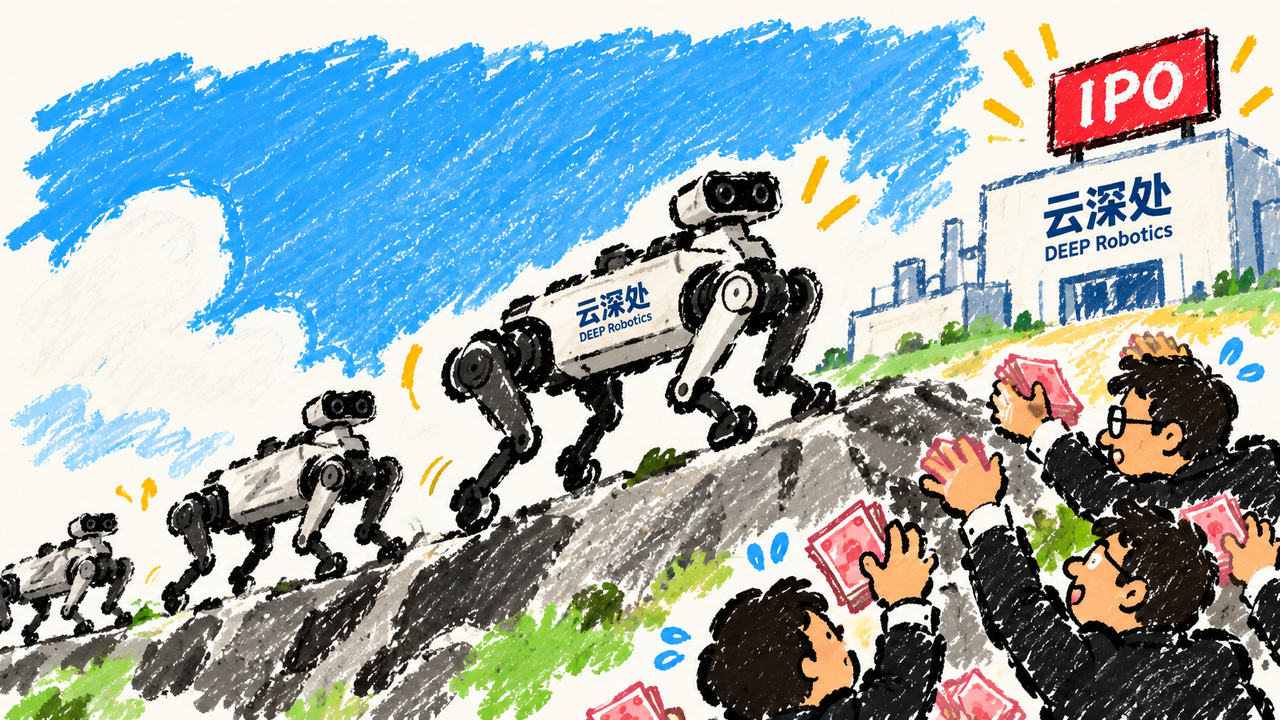
The unit economics are moving the wrong way
The Jueying X is the company’s core industry product. In 2025 it sold 681 units at an average price of RMB 287,500 with a 54.35 per cent gross margin. In the first half of 2026 it sold 541 units at an average price of RMB 228,200 and a 39.75 per cent margin. Gross profit per unit fell from about RMB 156,300 to RMB 90,700, a drop of roughly 42 per cent.
Average unit cost did not fall with the price. It rose from RMB 131,200 to RMB 137,500. The company’s explanation is that the first half included concentrated deliveries of lower-priced subtypes with thinner margins, which dragged the average down. That explains the margin. It does not answer the harder question, which is whether volume will ever bring unit cost down if customers keep choosing the cheaper configurations.
R&D is climbing at the same time. First-half spending reached RMB 79.96 million, close to the RMB 84.3 million spent in all of 2025. Operating cash flow swung from a RMB 63.75 million inflow last year to a RMB 25.31 million outflow in the first half of 2026.
The moat is a customer list that is also a competitor list
Deep Robotics earned its position by getting quadrupeds into substations. Since 2019 it has worked with units of State Grid and China Southern Power Grid on inspection routes where stairs, cable trenches and uneven ground defeat wheeled robots. Its machines now operate in more than 100 substations. Industry applications generated RMB 267 million in 2025, or 79.33 per cent of main business revenue, and the company cites Frost & Sullivan data placing it first globally by quadruped revenue in industrial applications.
Repeat orders are the proof that this is a real business. One consolidated non-end customer bought RMB 5.76 million in 2023, RMB 28.55 million in 2024 and RMB 30.61 million in 2025.
The risk sits inside that relationship. On 14 October, Beijing Business Today reported that the company’s core customer, identified as the subsidiary of a central state-owned enterprise, is developing competing products through in-house research, manufacturing and acquisitions. The prospectus flags the same exposure for several major customers.
Industrial buyers of robot dogs also buy integration, maintenance and long-run cost certainty. The more they purchase, the more sense it makes to build in-house or dual-source. Early entry bought Deep Robotics the relationship, not a permanent franchise.
The humanoid line is the story, and the gap
The company sold three humanoids in 2024, one in 2025 and six in the first half of 2026, generating RMB 2.79 million. The IPO plan builds capacity for 3,000 a year.
Of the RMB 2.503 billion being raised, about RMB 1.169 billion goes to embodied algorithms and models, and RMB 554 million to robot bodies and solutions, for RMB 1.723 billion combined. In its reply to listing review questions, the company acknowledged that it has not yet made large-scale R&D investment in the brain-side models, that its technical position lags global leaders, and that its accumulated real-world training data is limited.
The money is going where the track record is thinnest. That is a defensible choice in a technology that is still moving, and an uncomfortable one in a prospectus.
What the market is already paying for
Deep Robotics was valued at about RMB 1 billion in August 2024. By December 2025 the post-money valuation was RMB 5.25 billion, a 5.25-fold rise in just over a year. Against 2025 revenue of RMB 337 million, that implied roughly 15.6 times sales, for a company whose non-recurring-adjusted net profit that year was RMB 15.12 million.
The financing wave behind that number is broad. China recorded 322 embodied-AI financing deals worth RMB 93.5 billion in the first half of 2026, up 137 per cent in deal count and about five-fold in value. In August alone, 56 deals were disclosed in embodied robots and core components, with five companies, including XPeng Robotics, Sharpa, PaXini, Zhongke Diwuji and Yuanli Wuxian, accounting for about RMB 14 billion between them. Nearly half of all deals remain at seed, angel or Pre-A stage.
Concentration is increasing at the same time. Galbot raised RMB 2.5 billion in March at a valuation above RMB 20 billion. Galaxea disclosed nearly RMB 2 billion in April on top of a RMB 1 billion round in February, putting it in the same valuation tier. Galaxea’s chief financial officer said in April that 2026 is the year of proof of concept, not of volume.
The regulators have started asking what the revenue actually consists of. Reuters reported in September that some humanoid IPO processes had been slowed under informal window guidance, with authorities probing the relationship between high valuations, government project revenue and genuine commercial demand. Private-market marks were cut 30 to 50 per cent in some cases.
The secondary market has already run the experiment. Unitree listed on 19 August at an issue price of RMB 150.80, opened at RMB 1,100 and briefly exceeded RMB 444.9 billion in market value. By 16 October it traded at RMB 426.98, about 61 per cent below the opening price. Its trailing price-earnings ratio at that point was 388 times, against 39.5 times for the general equipment manufacturing sector, and the company published a volatility notice warning investors about valuation risk.
If a company with RMB 1.7 billion of annual revenue and a mature product line cannot hold a stable valuation consensus, a company raising money for a product it has sold six of will find the conversation harder.
The question nobody has answered
Some of the reported demand deserves scrutiny. Data collection centres, exhibition projects and investments by shareholders and ecosystem partners all appear in industry order books. In July 2025, AgiBot won a RMB 12.736 million tender to supply data-collection and demonstration robots to a Zhuhai embodied-AI centre. The buyer, Zhuhai Zhihui Yuanqi, is a joint venture AgiBot holds 30 per cent of.
That is not fraud. It is a sector building its own first customers while the real ones are still deciding. Mech-Mind chief executive Shao Tianlan made the point publicly in September, criticising what he called assembled embodied-AI companies that rely on data centres, leasing firms and related-party transactions to produce unsustainably funded revenue.
Deep Robotics has more right than most to be in this queue. It found paying industrial customers, reached profitability and built a product that works in unpleasant places. It is also asking public investors to fund a market that does not exist yet, at a price that assumes it will.
The founder, Zhu Qiuguo, started the company in 2017 with RMB 300,000 of savings and a plan to survive three months. He now has to explain capacity and revenue five years out. The distance between those two conversations is the distance between a laboratory and a listing committee, and only one of them runs on windows that close.
Editor’s note: This is an adapted translation of the original OFweek report. It has been trimmed and restructured for readability for an international business audience. The full original (in Chinese) is at https://robot.ofweek.com/2026-10/ART-898890-12003-30708378.html.