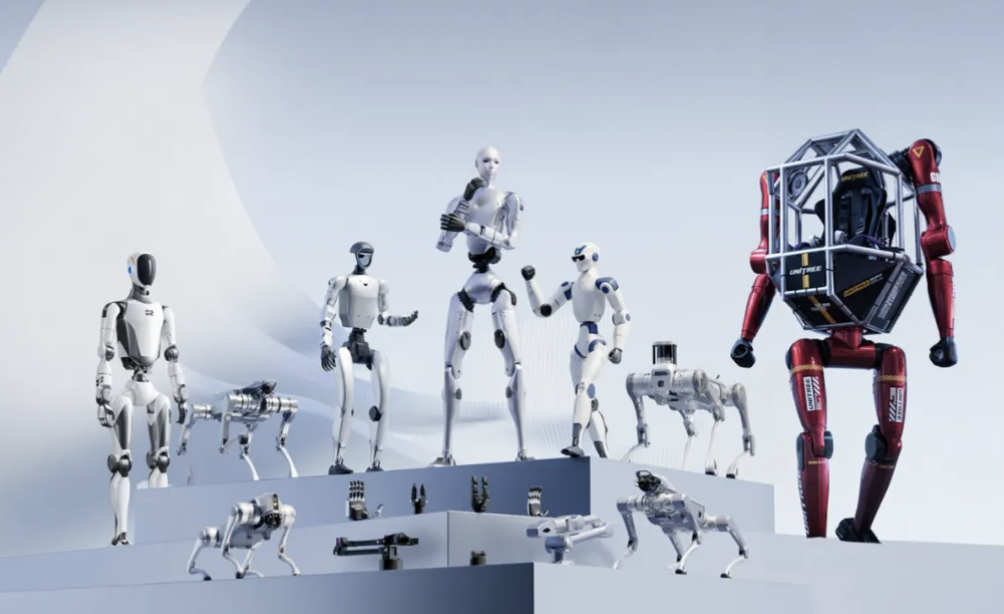
On 28 October Unitree and Sequoia China set up a joint early-stage programme called Shanyu, aimed at embodied intelligence, robot applications, the key technologies upstream and downstream of them, and other frontier hardware. The structure is a top venture firm and a volume manufacturer investing side by side, with what the partners describe as an engineer plus investor view of a deal.
What each side brings
Under the official description, the programme acts as a co-founder for early teams and covers the path from technical development to product application to later funding. Unitree contributes technical judgement and engineering guidance. Sequoia contributes the full capital chain and post-investment services.
The operating rules are five: understand the technology and the industry, find teams early, decide quickly, weigh the people, and stay out of the way. The stated goal is to support founders who start from an idea, a piece of code or a prototype and build something that can scale and compete internationally.
An old relationship, reversed
Sequoia China’s seed fund invested in Unitree’s Pre-A round in 2019 and was among the company’s earliest institutional backers. It added money in Pre-A+, B and C. The joint programme moves the relationship from capital support to industrial coordination.
The pattern, a supply-chain leader teamed with a top investment firm to run early-stage incubation, gives startups more precise access to resources. It also marks a shift among leading robot makers toward building their own ecosystem through capital.
Gasgoo counts several peers doing the same. AgiBot, Galbot, Galaxea and Zhi Bian Liang have all made external investments this year. Galaxea went further with Cathay Capital, launching a programme that plans to commit RMB 1 billion over five years to early teams.
Why manufacturers are writing the cheques
The reasoning is direct. Embodied intelligence is a hard engineering business, and what early teams lack is rarely money. It is supply chain access, mass-production experience and real deployment sites. A manufacturer that has already made the mistakes can teach a young team how to stabilise a prototype, control cost and find product-market fit.
Pure financial investment does not solve the engineering problem that sits between one unit and one hundred thousand.
The part that is not disclosed
Shanyu has not published a fund size or a cheque range. For now it reads more like a cooperation framework and a recruiting front door than a fund. How much it deploys and how fast will be visible only in the deals.
There is also a structural tension. A startup that takes resources from a robot maker may be read as having picked a side, and may find itself in an awkward relationship with other potential customers. For a young team, that is a question to settle before signing. Not grabbing the steering wheel is an attitude. In individual deals, the line between ecosystem coordination and independence has to be walked carefully.
Editor’s note: This is an adapted translation of the original Gasgoo report. It has been trimmed and restructured for readability for an international business audience. The full original (in Chinese) is at https://www.gasgoo.com/apps/e060bad9eca91db7f01403fc7120041f/robot/news/70476156.