The share price of China’s largest domestic industrial robot maker doubled in three months, hit a record, then gave back about 40 per cent in the following three. The round trip is the market repeatedly re-pricing Estun’s ability to convert volume into profit.
On 30 September Estun published an incentive plan priced at half the market, anchored to a target of no less than RMB 200 million in non-recurring net profit for 2026 and RMB 1.1 billion cumulative across three years. Estun’s historical peak in that metric is under RMB 100 million.
Half price, demanding test
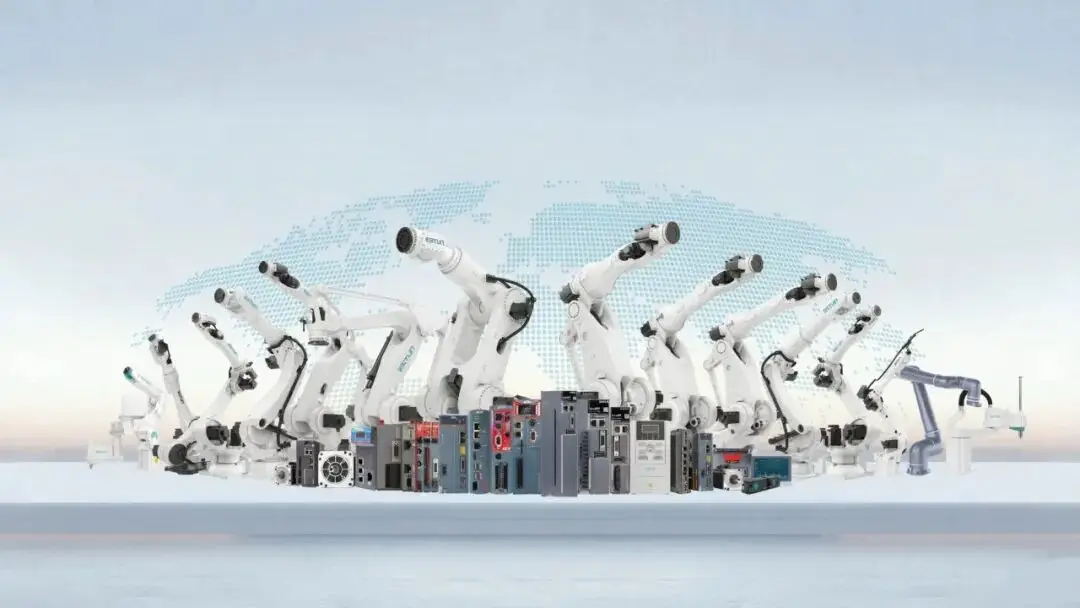
Estun began in numerical control systems and servo motors. Its early trajectory resembled Fanuc’s closely enough that it was called China’s Fanuc. It now ships more industrial robots than any domestic peer and has built a chain from core components through complete machines to smart manufacturing systems. In 2025 it overtook foreign brands on unit shipments for the first time and has led domestic brands for eight consecutive years.
The plan grants 2.99 million restricted shares, about 0.34 per cent of A-share capital and 0.31 per cent of A plus H capital, at RMB 14.92 each against a 30 September close of RMB 28.22. It covers 209 people, mostly mid-level managers and technical staff.
The performance conditions are set on non-recurring profit: at least RMB 200 million for 2026, RMB 520 million cumulative for 2026 and 2027, and RMB 1.1 billion cumulative for 2026 to 2028. Stripped to single years, that is RMB 200 million, RMB 320 million and RMB 580 million.
Against Estun’s own record, the target is steep. Annual non-recurring profit has never exceeded RMB 100 million. Between 2020 and 2023 it drifted between RMB 60 million and RMB 97 million. In 2024 the company lost RMB 836 million. In 2025 and the first half of 2026 it recorded RMB 7 million and RMB 70 million respectively. The recovery is real, but the reported growth of 100.87 per cent and 498.64 per cent rests on a very low base.
A company whose peak in this metric is under RMB 100 million intends to reach RMB 580 million in three years. The gap has to be closed with delivered earnings.
The sector is warming. Estun’s revenue is not
The wider market is genuinely recovering. Demand for intelligent and flexible retrofits continues to flow from automotive, new energy and electronics manufacturing. Domestic brands are taking share, and leading firms are pulling ahead. Since the second half of last year several robot makers including Estun issued price adjustment notices, passing component and material inflation through to complete machines. Estun told institutional investors in September that the industry is entering a phase of rational price recovery, that destructive low-price competition is easing, and that this will accelerate the shakeout.
Yet the first half of 2026 tells a more complicated story. Revenue was RMB 2.578 billion, essentially flat year on year. Net profit attributable to shareholders was RMB 161 million, of which non-recurring profit was only RMB 70 million. About RMB 99.5 million of the headline figure came from a fair value gain when Nanjing Gongyi, an associate, completed an asset restructuring and its stake was swapped for shares in the listed Nanjing Chemical Fibre. That gain lifted liquidity and marked the asset to market, but it is not repeatable and it moves with Nanjing Chemical Fibre’s share price.
Robots and smart manufacturing systems, the core business, produced RMB 2.138 billion, up 2.21 per cent. Automation components, the second segment, produced RMB 439 million, down 3.78 per cent.
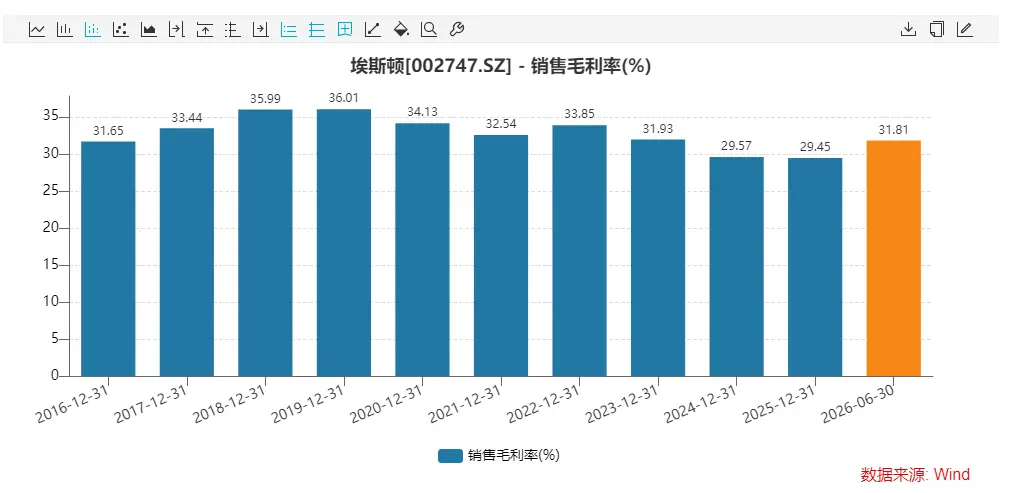
Gross margin improved to 31.81 per cent, up 4.17 percentage points, helped by a richer product mix, a shift toward higher-end customers and supply chain cost work. That still sits well below the 36 per cent reached in 2019. Domestic revenue fell 8.82 per cent to RMB 1.641 billion as the company deliberately cut low-margin business and divested a controlling subsidiary. Overseas revenue reached RMB 936 million, up 25.06 per cent, partly offsetting the decline, and the Hong Kong listing completed in the first half is funding further expansion in Europe, the Americas and Southeast Asia.
Operating cash flow turned positive at RMB 44.53 million from an outflow of RMB 119 million a year earlier. The H-share raise cut the debt ratio from 78.5 to 68.2 per cent.
Two indicators point the other way. Receivables reached RMB 2.201 billion, still climbing and now 21 per cent of total assets. Contract liabilities, a forward demand signal, fell 31.74 per cent from the year-end level to RMB 400 million. The company has positioned after-sales service as its second growth curve, but has not yet disclosed that revenue separately, which makes it an expectation rather than a number.
A ninefold premium for a loss-making affiliate
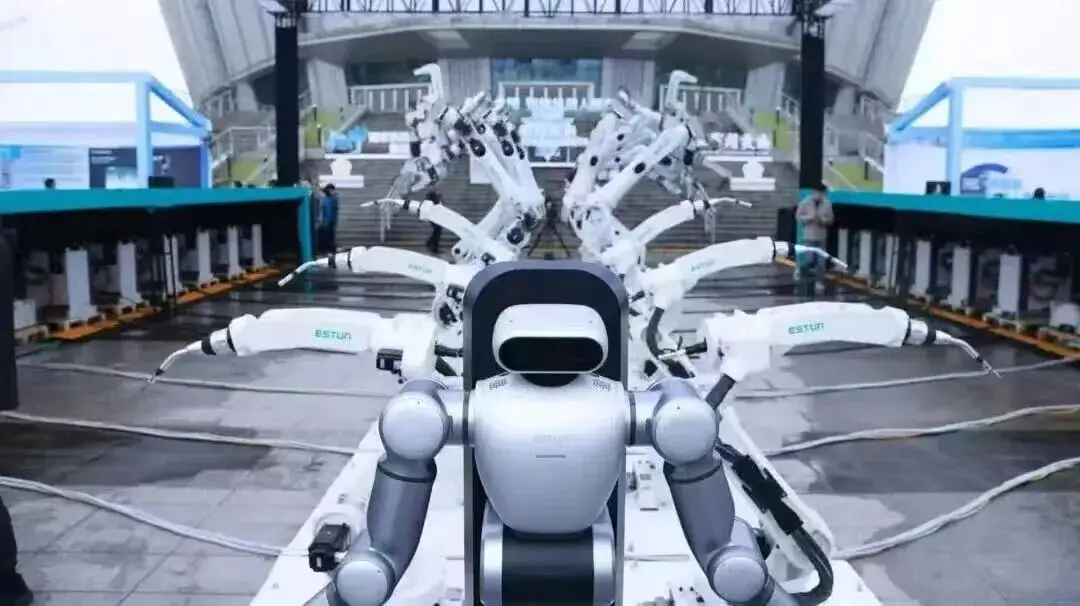
Between 2016 and 2025 Estun’s revenue grew from RMB 678 million to RMB 4.888 billion, and acquisitions were the engine. The company bought Trio, Cloos and M.A.i., adding machine vision, system integration, high-end welding robot technology and embodied intelligence, assembling a global product matrix quickly.
Acquisitions cut both ways. Goodwill on the books at the half-year was RMB 975 million, close to 30 per cent of net assets attributable to shareholders, most of it from Germany’s Cloos. Cloos generated RMB 543 million of revenue in the half and a net loss of RMB 15.27 million.
Estun has already been through one goodwill blow-up. In 2024 it wrote down RMB 345 million across four subsidiaries whose results fell short of expectations, and the year closed with a loss above RMB 800 million and a 700.14 per cent decline in net profit.
Cloos was bought from the controlling shareholder. In 2020 Estun paid RMB 409 million to Peerless for 51 per cent of Dingpai Electromechanical, a special purpose vehicle holding the German stake. The pattern of a controlling shareholder incubating an asset before injecting it into the listed company recurs. In September 2026 Estun paid RMB 487 million for further equity in Estun Kuzhuo, taking indirect ownership to 100 per cent. One counterparty was Peerless, holder of 39.07 per cent of the target, making the deal a related-party transaction.
Estun Kuzhuo was set up in July 2022 by Wu Kan with RMB 10,000 of registered capital. Wu Kan is the son of Estun’s controller Wu Bo. Four months later Wu Kan transferred the whole stake to Peerless, and Estun has since injected capital repeatedly. The valuation uplift on this transaction was 901.20 per cent. The target loses money: RMB 36.1 million in 2024, RMB 53 million in 2025 and RMB 12.66 million in the first four months of 2026.
Performance commitments were attached. Revenue must reach RMB 70 million for May to December 2026, then RMB 120 million, RMB 180 million and RMB 250 million, for a cumulative RMB 620 million. Non-recurring profit in the collaborative robot segment must reach RMB 5 million, RMB 15 million, RMB 20 million and RMB 26 million, for a cumulative RMB 66 million.
If those commitments are missed, the combination of a high premium, a related-party structure and a loss-making target puts goodwill impairment back over the income statement. Estun holds the shipment crown. The market is still waiting for an income statement that matches the label.
Editor’s note: This is an adapted translation of the original OFweek report. It has been trimmed and restructured for readability for an international business audience. The full original (in Chinese) is at https://robot.ofweek.com/2026-10/ART-8321202-12003-30709149.html.