Trump, the Nation Builder: How an Accidental Architect Built the Nation of Engineers
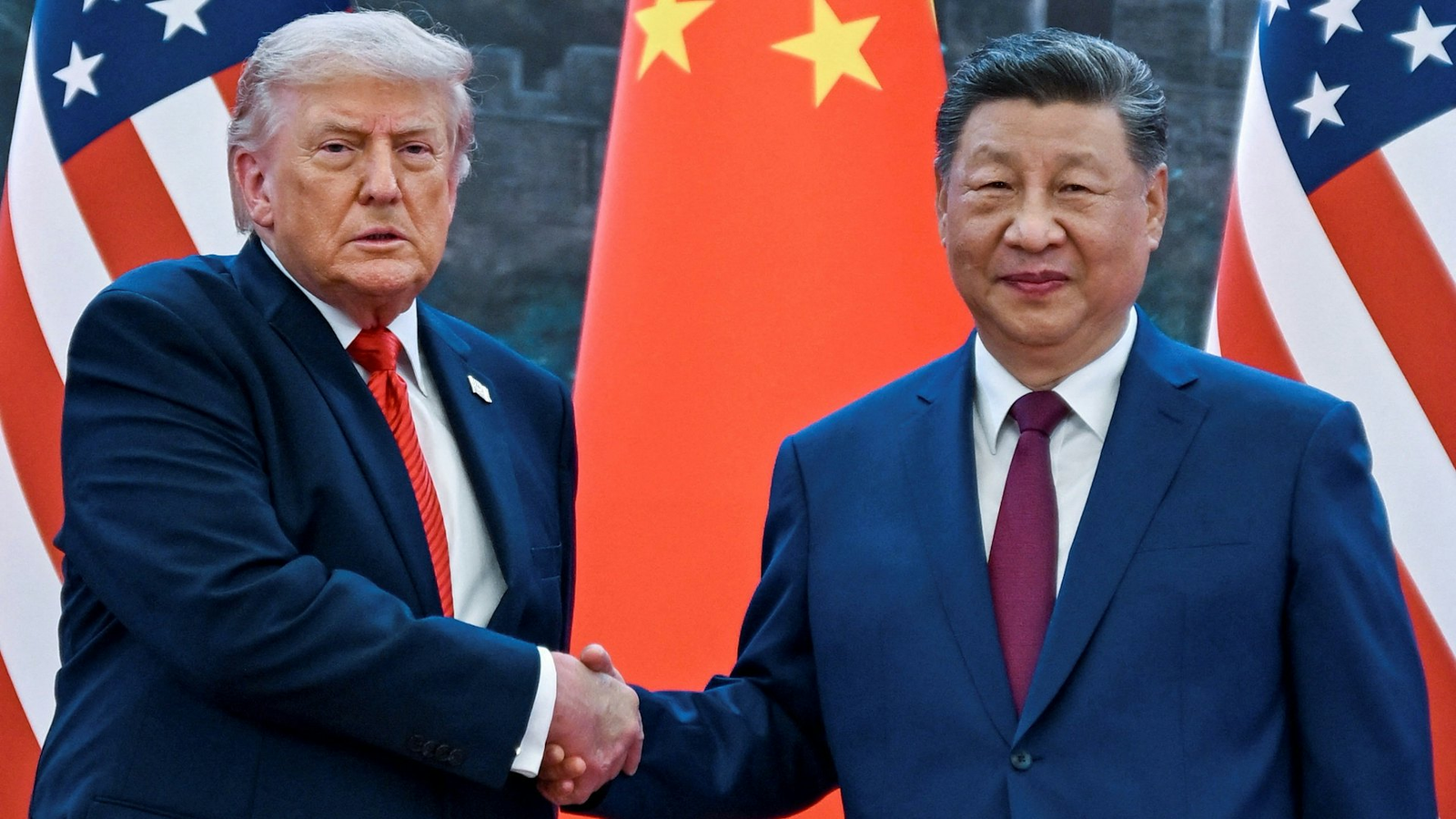
As Air Force One touches down in a self-assured Beijing this May 14th, 2026, a curious moniker echoes across the Chinese internet: Chuan Jianguo (川建国)—or “Trump, the Nation Builder”. It is a title born of exquisite geopolitical irony. To the Chinese public, the man arriving for this high-stakes summit is not merely the antagonist who disrupted their tech sector, but the accidental architect who forced its maturation. By weaponising supply chains and attempting to starve China of silicon, Mr Trump provided the existential “Sputnik moment” required to transform a country of app-builders and e-commerce moguls into a formidable nation of engineers. The summit in Beijing today is less a negotiation and more an inspection of the industrial fortress that American sanctions inadvertently helped to complete.
The shift is fundamental. A decade ago, China’s technological prowess was largely extractive—leveraging a massive population to scale up delivery platforms and social media algorithms. Today, the focus has pivoted to deep tech. Driven by the threat of decoupling, Beijing has executed a strategic turn toward engineering and manufacturing autonomy that is now bearing fruit across six critical sectors.
The Battery-Powered Titan
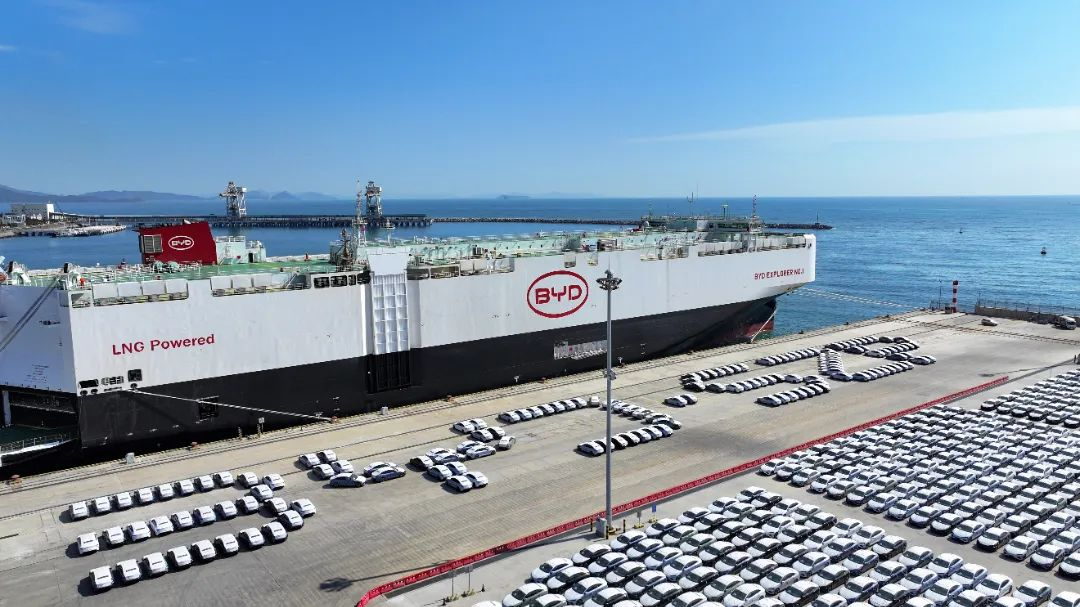
In 2017, Chinese electric vehicles (EVs) were often derided as “compliance cars”—flimsy boxes built to harvest government subsidies. Today, the laggard has become the frontier. China has successfully vertically integrated the entire green-energy stack. Firms like BYD and CATL do not just lead in sales; they dictate the global rhythm of battery chemistry and cost structures. With annual production exceeding 10m units, China’s EV sector has moved from a protected experiment to a global disruptor, forcing European and American legacy carmakers to scramble for defensive tariffs that look increasingly like palliative care.
Intelligence on a Budget
Perhaps the most significant blow to the “small yards and high fences” strategy has occurred in artificial intelligence. When the US restricted high-end chips, the consensus was that Chinese Large Language Models (LLMs) would wither. Instead, they adapted. The emergence of models like DeepSeek-R1 represents a tactical masterstroke: achieving reasoning capabilities that rival the best of Silicon Valley, but at a fraction of the computational cost. By prioritising algorithmic efficiency over raw brute-force hardware, Chinese labs have bypassed the silicon blockade, proving that in the race for AI supremacy, clever coding can often trump restricted GPUs.
The Iron Workforce
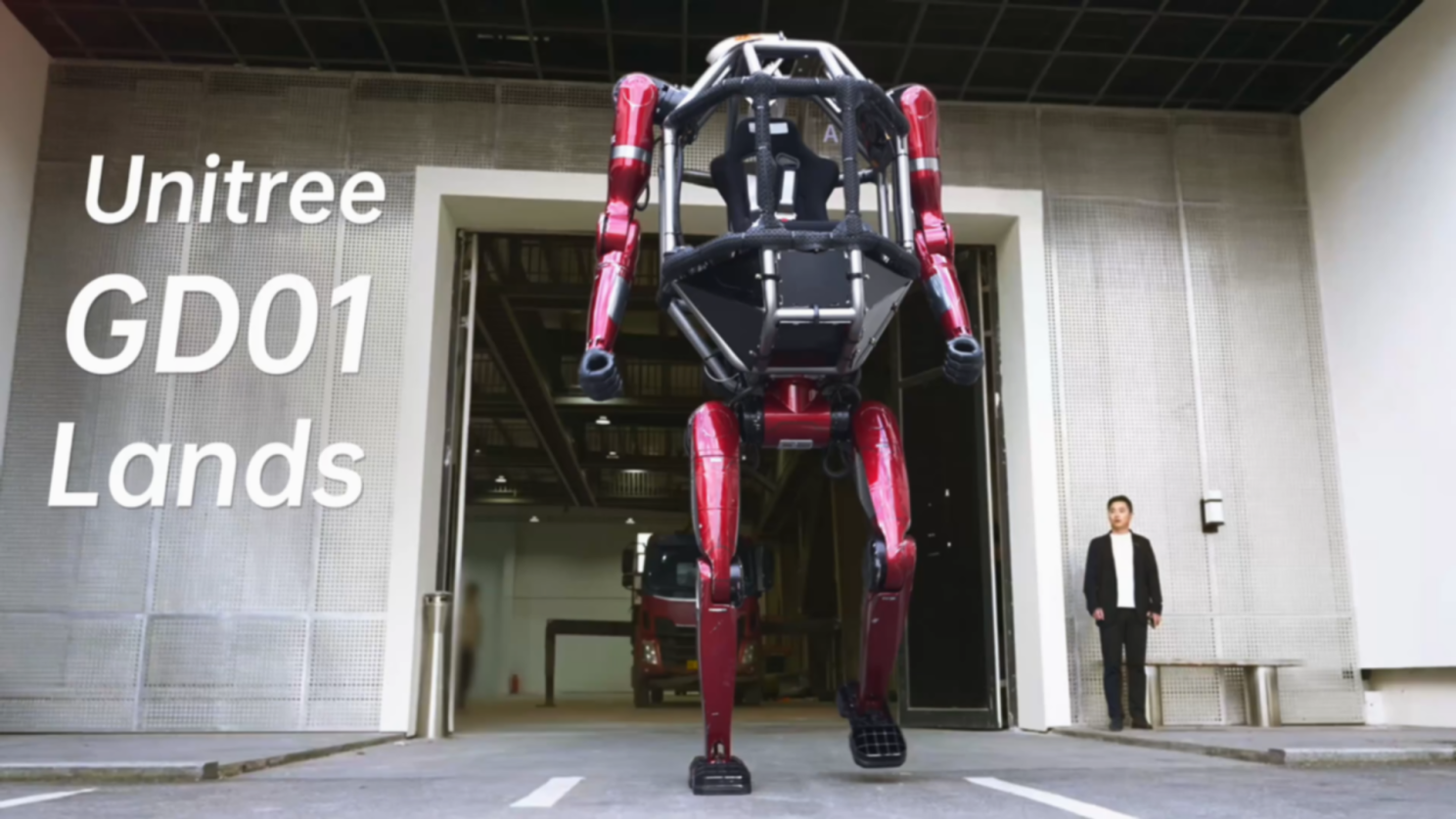
In the realm of robotics, China has transitioned from the world’s factory floor to the world’s laboratory. Having installed more industrial robots than the rest of the world combined, Beijing is now aggressive in its pursuit of the “humanoid moment”. By leveraging its peerless hardware supply chain, China is rapidly modularising robotic joints, sensors, and actuators. This industrial density has allowed Chinese firms to iterate on humanoid forms at a speed and cost that threaten to commoditise embodied AI before Western competitors can even exit the prototype stage.
Sub-cloud Commerce
While Western regulators remain mired in the bureaucratic thicket of urban air mobility, China has simply taken flight. What Beijing calls the “low-altitude economy” is no longer a futuristic trope but a state-sanctioned commercial pillar. Shenzhen and Shanghai now host the world’s first scaled operations of eVTOL (electric vertical take-off and landing) aircraft. Having issued the world’s first commercial operating licences for pilotless passenger drones, China is betting that the next great logistics revolution will happen 300 metres above the pavement.
Silicon Sovereignty
In the semiconductor theatre, the American strategy has been a success only in the most narrow sense: China remains behind in sub-3nm lithography. Yet, this focus on the tip of the spear ignored the rest of the shaft. China has quietly cornered the market on mature nodes—the chips that actually run the world’s cars, washing machines, and industrial robots. By achieving high levels of domestic substitution, the “Red Supply Chain” has become insulated from external shocks. Meanwhile, experimental forays into 2D semiconductors suggest that Beijing is looking for leapfrog technologies to render current American advantages obsolete.
The Artificial Sun and the Moon
Finally, the transition from theory to engineering in frontier science is accelerating. China’s “Artificial Sun” (the EAST device) has maintained steady-state operation at 100m degrees Celsius for over 1,000 seconds—a record that puts limitless fusion energy within the realm of engineering, rather than just science fiction. Coupled with the success of Chang’e 6 in retrieving lunar far-side samples, China’s deep-space programmes signal a nation that is no longer content to copy the blueprints of the 20th century, but is intent on drafting those of the 21st.
The Great Decoupling Paradox
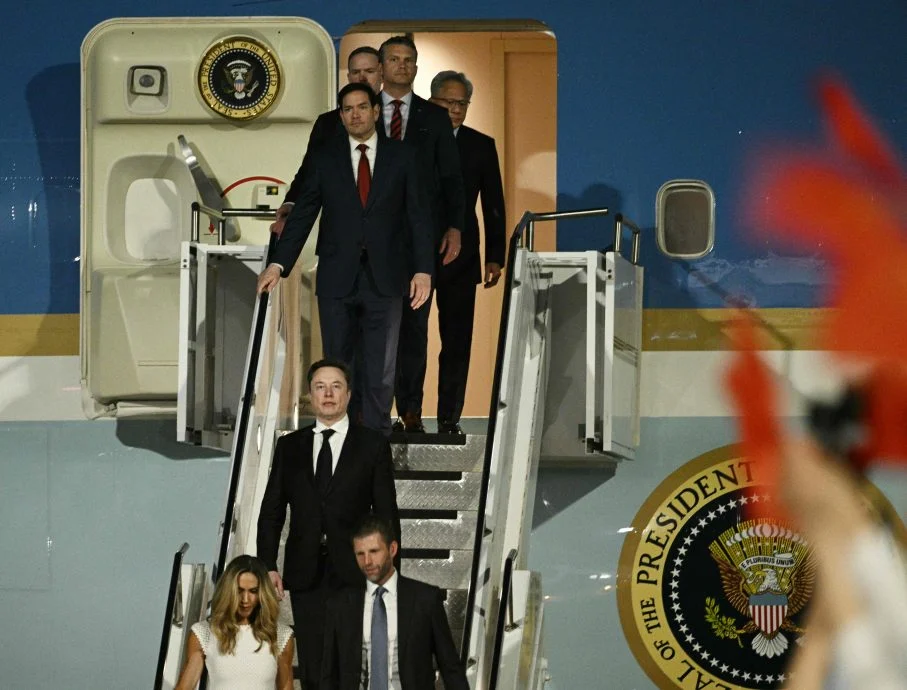
If China’s recent technological leaps appear invincible, one must ask: does “Trump the Nation Builder” still hold the ultimate trump cards? The answer, it seems, was written in the skies. The reported last-minute boarding of Air Force One in Alaska by Jensen Huang signals a pivotal moment in the geopolitical tech race. Huang, an indisputable seer who accurately predicted China’s aggressive AI expansion years ago, remains the fulcrum upon which the balance of power tips.
There is no denying that China’s AI cohort—scientists and engineers alike—has performed a Herculean task. Despite stringent US export controls on high-end GPUs, Chinese firms have successfully birthed frontier Large Language Models (LLMs) and sophisticated video-generation AI. They have proven that brute-force innovation can, to some extent, bypass hardware bottlenecks.
However, Jensen Huang’s vision extends far beyond current-generation chatbots. The Electric Vehicle (EV) is merely the “opening act” of a much larger AI and Robotics revolution on wheels. Moving from a standard EV to a “complete manifestation” (完全体) of a smart car is not a simple upgrade; it is a paradigm shift.
The Three-Computer Moat
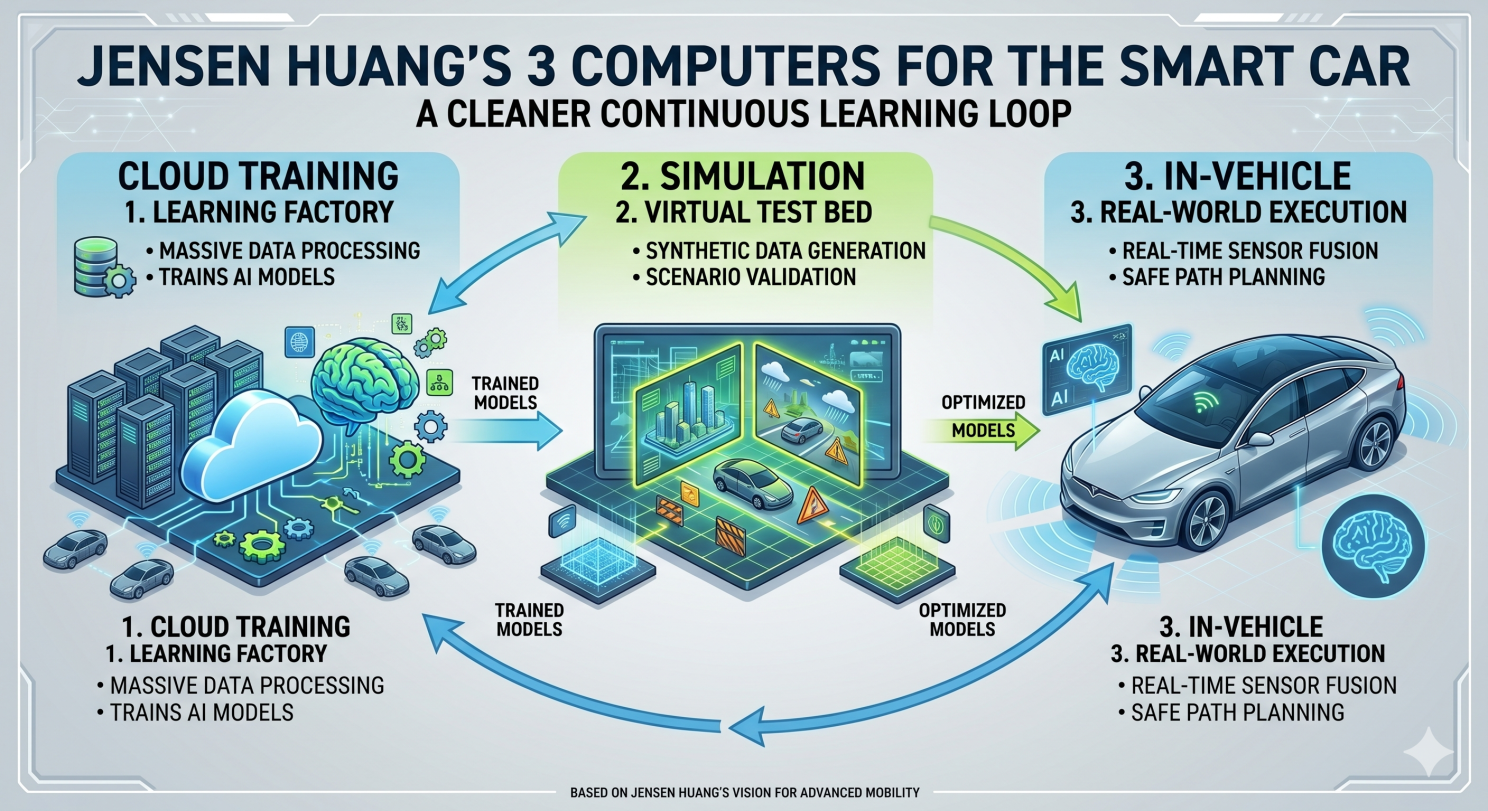
What is the missing link for Chinese manufacturers? Huang has frequently articulated that a true smart car relies on a closed-loop ecosystem of three computers—a domain where Nvidia remains decidedly far ahead:
The Training Computer (The AI Factory): Nvidia maintains an extreme lead in the massive data-centre infrastructure required to train neural networks.
The Simulation Computer (The Omniverse): This is the secret weapon. While many automakers are “simulation-poor,” Nvidia provides the only high-fidelity digital twin environment to test AI in virtual worlds.
The In-Car Computer (The Brain): Although Chinese domestic chips are catching up in raw processing power, they still struggle to match Nvidia’s cloud-to-car software unity.
The Musk Factor: A High-Stakes G2 Signal
Guess who else was spotted on board Air Force One? President Trump is holding another formidable “Trump card”: Elon Musk. As a singular figure who has concurrently shaped the EV industries of both nations—pioneering the American transition while his Giga Shanghai acted as the “catfish” that electrified the Chinese supply chain—Musk represents the ultimate bridge and threat.
His industrial footprint spans five of the six sectors Beijing now dominates: Tesla’s battery vertical and custom FSD silicon rival China’s energy and semiconductor gains; xAI and SpaceX challenge the frontiers of intelligence and space; and the Optimus humanoid project serves as the premier Western heavyweight in the global robotics race.
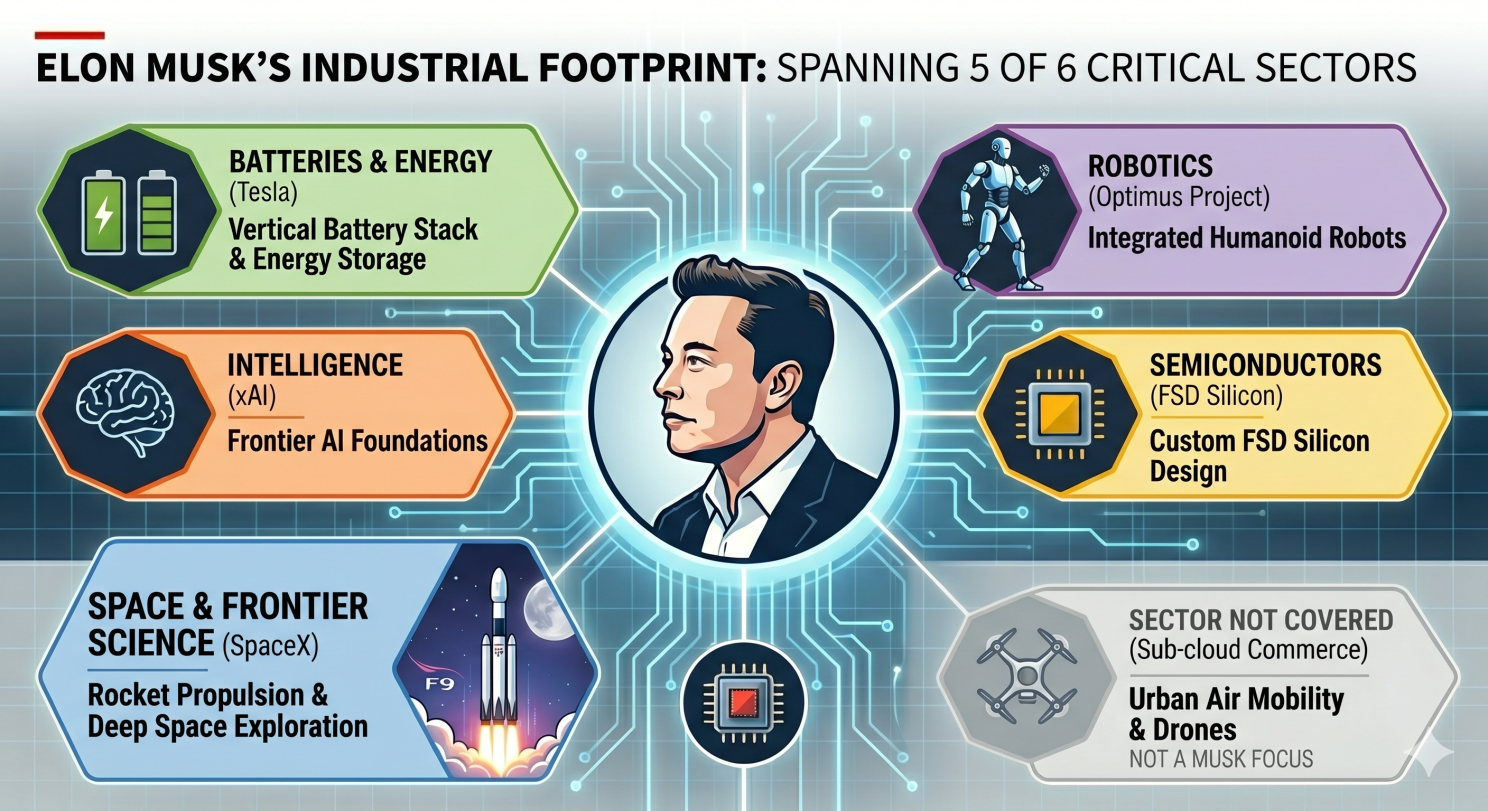
The presence of both Huang and Musk on the same presidential flight sends a crystal-clear signal to President Xi. A collaboration between the architect of the world’s AI infrastructure and the pioneer of scaled autonomous robotics could birth a “complete smart car” that leapfrogs China’s currently unstoppable EV momentum.
This alliance suggests two possible futures: either a unified American front that secures absolute tech hegemony, or a framework where the G2 could finally work together. In this latter vision, the two superpowers would move beyond “nation-building” in isolation, instead leveraging their respective tech strengths to build a better, more automated world.
The Catch-Up Game
Are China’s OEMs aware of this triple-threat requirement? The awareness is uneven. While many excel at battery density and cabin aesthetics, mastering the holy trinity of Training, Simulation, and On-board Inference remains a steep mountain to climb. As the AI revolution accelerates, the Chinese car industry finds itself in a familiar position: sprinting to catch up in a race where the finish line is constantly being moved by the men who are now, quite literally, flying together.
The Bottom Line
The 2026 Summit marks a moment of clarity. The “market-for-technology” era is dead, replaced by a sovereignty-through-scarcity model. By weaponising the global supply chain, the US provided China with the one thing a command economy often lacks: a non-negotiable deadline. China now possesses a unique quartet of advantages: the world’s largest industrial capacity, a complete internal supply chain, a massive domestic testing ground, and a surplus of disciplined engineering talent. For Mr Trump, the “Art of the Deal” in 2026 will require a sobering admission: the blockade did not break the Great Wall; it simply finished it.