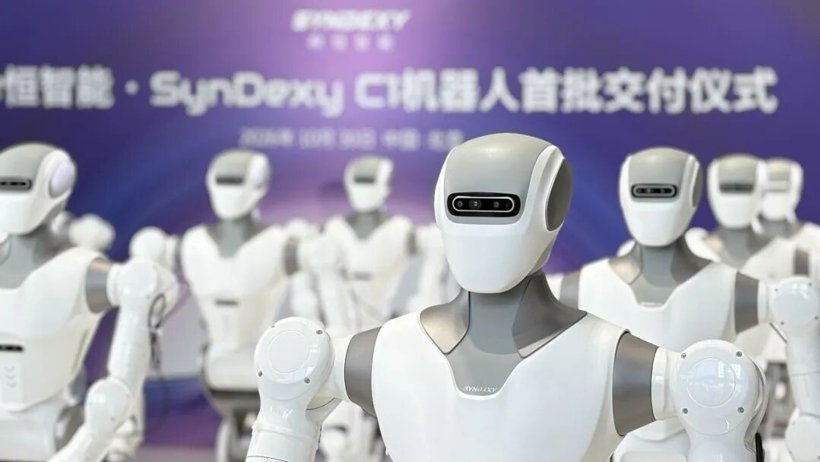
On 30 October, SynDexy said it had completed the first small-batch delivery of its C1, a dual-arm wheeled humanoid built for dexterous manipulation. The machines are destined for precision assembly work at consumer electronics and electronic component factories.
That is the hardest first customer in the industry. Assembly tolerances for flexible flat cables and connector insertion leave no room for a hand that hesitates, and unlike a warehouse or a showroom, a factory line exposes the failure on the first shift.
What is in the machine
The core claim is visuo-tactile fusion. C1 carries a self-developed tactile-visual sensor with micron-scale spatial resolution. On top of that it runs SynDexy M1, which the company describes as the first model to fuse vision, touch and force into a single manipulation stack.
Physically, the robot has 22 degrees of freedom across the body and claims one-millisecond real-time motion control. The company says key-task success rates exceeded 98 per cent in testing before delivery.
The tasks it can do are specific rather than theatrical: flexible flat cable assembly and cable insertion, both of which demand force feedback as much as position accuracy. A vision-only policy can see where a connector is. It cannot feel when it has seated.
The calendar is the real story
Development started in April 2026. A first-generation prototype was complete in July. Small-batch delivery came in October. Six months, three milestones.
That tempo describes the sector better than any benchmark score. Chinese embodied companies are no longer competing on which architecture is most complete on paper. They are competing on who can get a machine into a real production cell first, because the data and the reference customer both only exist after that happens.
SynDexy was founded in 2025 and is led by Fang Bin, a professor at Beijing University of Posts and Telecommunications. Its stated approach is to take requirements from the line and put them back into the line, with product definition and technical development both judged against production-floor metrics rather than laboratory ones.
The caveat that should travel with the headline
Small batch is not mass production. Stability and cost control for the C1 still depend on later orders and much longer running time on real lines, and the company says as much itself.
A 98 per cent success rate measured in testing is also not the same as 98 per cent measured across a three-shift week with tooling wear, operator changeover and material variation. The industry has learned this lesson repeatedly: the demonstration is the easy part, and the yield curve over months is where humanoid businesses are actually decided.
Still, the direction is unambiguous. The constraint on humanoid deployment in 2026 has moved. It is no longer whether a hand can do the task. It is whether anyone will let that hand near a shipment.
Editor’s note: This is an adapted translation of the original Gasgoo report. It has been trimmed and restructured for readability for an international business audience. The full original (in Chinese) is at https://www.gasgoo.com/apps/e060bad9eca91db7f01403fc7120041f/robot/news/70476373-1/.