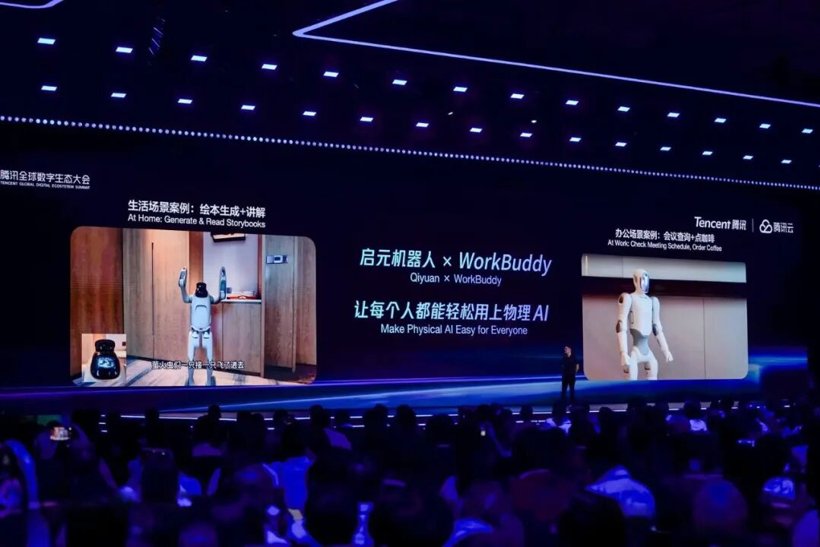
At the 2026 Tencent Global Digital Ecosystem Summit, Qiyuan Robotics chief executive Tian Hua said the company’s consumer robots had been connected to Tencent WorkBuddy, alongside a strategic cooperation agreement to build a cloud-edge-device consumer robot line.
The chain is straightforward to describe. A user speaks an instruction. WorkBuddy parses the intent and breaks it into steps. The robot executes those steps using its own perception and motion capability. What used to be a single command becomes a task with a plan behind it.
The number that matters is 100,000
WorkBuddy carries more than 100,000 Skills. Connecting Qiyuan to that library extends those skills into robot application development, and the consequence is that a user can compose a robot behaviour in natural language instead of writing code.
That is the part with strategic weight. Consumer robotics has been stuck for a decade on a simple problem: the hardware ships with whatever behaviours the manufacturer imagined, and nothing else ever arrives. A robot that can be extended by its owner is a different product category from a robot that cannot.
The first integrations are already live across Qiyuan’s Q1 and T1 machines: Tencent Meeting, WeRead, QQ Music and picture-book generation. In an office a robot can check a meeting schedule or place a coffee order. At home it can play music or narrate a story. Tian demonstrated the last one: WorkBuddy generates the story, the illustrations and the robot’s movements, and the machine performs it for a child.
Five thousand units and a factory
Qiyuan is the consumer embodied brand under Shangwei New Materials. The Q1 launched in December 2025. The transformable T1 followed in July 2026. The company has built two internal platforms, PrimeHub for skills development and PrimeFlow for appearance customisation, and says it has completed first mass production with its 5,000th personal robot off the line.
Tian frames the problem as three walls: building the body at volume, building the intelligence, and building the application ecosystem. His answer is to let all three evolve together rather than in sequence, which is why the Tencent deal is about skills rather than silicon.
Why the ecosystem route is the Chinese route
American and Japanese consumer robot programmes have generally tried to win on the body: better actuators, quieter joints, more graceful motion. That is an engineering contest, and it is expensive.
China’s advantage is not a better actuator. It is WeChat, Alipay, Meituan and a hundred other services that already sit inside every phone, plus an enormous population of developers willing to build small things for small money.
Wiring a robot into that stack converts a hardware launch into a platform launch. It also moves the competitive question from can this machine walk, to how many things can it do by next quarter.
What is still unanswered
Ecosystem capability does not solve willingness to pay, and it does not solve retention. A personal robot that can play music and read stories competes with a RMB 300 smart speaker, not with another robot, and the thing that would justify the price is physical work in the home that almost no machine can do reliably yet.
Qiyuan’s own framing concedes this. The integration makes the robot more useful. Whether it makes the robot worth buying is a question the market answers in living rooms, not at a developer conference.
Editor’s note: This is an adapted translation of the original Gasgoo report. It has been trimmed and restructured for readability for an international business audience. The full original (in Chinese) is at https://www.gasgoo.com/apps/e060bad9eca91db7f01403fc7120041f/robot/news/70476374-1/.