Thailand plans to raise the excise tax on imported battery electric vehicles from the current 10 per cent to 35 per cent, part of an effort to build a domestic vehicle manufacturing base as Chinese-built models flood in.
Industry minister Varawut Silpa-archa said the cabinet approved the battery electric vehicle tax package on 3 November, with the new rate taking effect on 1 January.
Speaking after the cabinet meeting, Varawut said the government prioritises supply chains and investors that have spent decades helping develop Thailand’s automotive industry and supporting its economy, naming Japanese companies in particular.
Excise department director-general Pornchai Thiraveja said the adjustment is intended to attract local investment in vehicle manufacturing and to push Thailand towards becoming a regional electric vehicle production centre.
The import gap behind the decision
Thailand is the third-largest automotive market in Southeast Asia after Malaysia and Indonesia. Electric vehicle penetration has risen steadily, led by Chinese brands, while higher fuel prices have accelerated the shift away from combustion cars.
Federation of Thai Industries data shows passenger electric vehicle sales of 161,532 units between January and September, 31 per cent of total vehicle sales. Domestic electric vehicle production in the same period was 70,472 units, which indicates the scale of the import gap.
The government’s stated rationale is that large volumes of imported electric vehicles do not help build a local supply chain or create jobs.
The existing structure left battery electric vehicles outside the bands applied to other powertrains. Locally assembled hybrid vehicles are taxed at 6 to 15 per cent, and combustion vehicles at 25 to 35 per cent. Japanese carmakers, which mostly build hybrids and combustion models locally, have argued that the current treatment is unfair and erodes the competitiveness of locally produced vehicles.
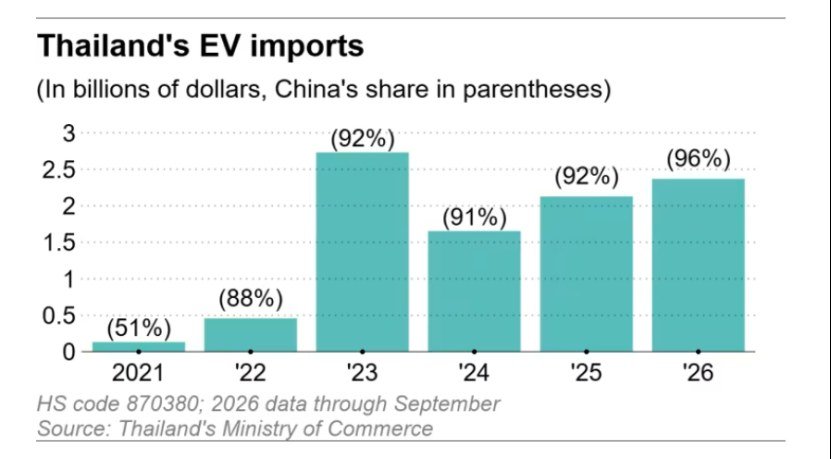
Thai commerce ministry figures put electric vehicle import value at about USD 2.36 billion in the first nine months of 2026, of which 96 per cent came from China.
BYD, Great Wall Motor and several other Chinese manufacturers have invested in Thai assembly, and the new rate is calibrated to protect that investment while raising the cost of simply shipping cars in.
Kasikorn Research Center analyst Rujipan Assarat cautioned that with the Thai economy weak, even after the new tax, consumer demand may not be strong enough to lift production. She said a subdued economic outlook and soft demand make it difficult for vehicle output to rise quickly.
The parallel with Europe is direct. Tariffs are being used to convert an import market into a production market, and the test of whether it works is not the tax rate but whether anyone builds the second plant.
Editor’s note: This is an adapted translation of the original Gasgoo report. It has been trimmed and restructured for readability for an international business audience. The full original (in Chinese) is at https://auto.gasgoo.com/news/202611/4I70476861C501.shtml.