Wanyuan Technology received a CSRC filing notice on 30 October to issue up to 12.6886 million shares on the Hong Kong Stock Exchange main board. If it lists, it will be the first pool cleaning robot company to reach a public market.
Pool robots get treated as a vacuum cleaner thrown into water. The engineering is not the same. GPS does not penetrate water, current and refraction confuse the sensors, and the unit has to survive IP68 sealing while keeping a lithium pack cool underwater.
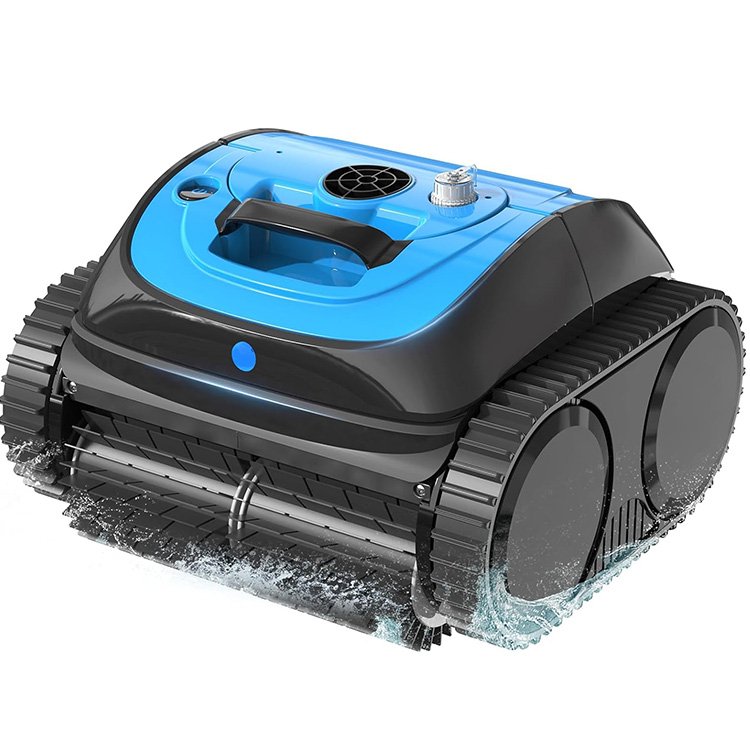
The global market has been led by Israel’s Maytronics and Spain’s Fluidra, mostly with corded machines. Cable snagging has been the category’s chronic complaint for two decades.
From contract manufacturer to own brand
Wanyuan was founded in 2005 by Fu Guilan, who started the business at 50, and her son Yu Qian. On 2024 shipments and gross merchandise value it ranks third globally and first in China, with about 9.2 per cent of the world market. In cordless pool robots it holds 19.7 per cent, the largest share anywhere. Products sell in more than 60 countries.
The first breakthrough came in 2009 with a light cleaner for above-ground pools, a third of the weight and less than half the price of existing units, which took the company to break-even. In 2017 it shipped the industry’s first cordless lithium-powered pool robot. In 2019 it added automatic return-to-dock charging, a capability few companies hold. In 2023 it moved into AI, and its flagship WYBOT S3 now carries underwater acoustic positioning, underwater AI vision, 3D modelling, autonomous navigation and automatic debris recovery.
The company holds more than 160 registered patents, 27 of them invention patents, and carries EU CE and North American ETL certification. Cordless products generate 97.5 per cent of revenue.
The numbers behind the filing
Revenue rose from RMB 378 million in 2023 to RMB 812 million in 2025, a compound rate of 46.6 per cent. Gross margin climbed from 57.5 per cent to 62.9 per cent.
Net margin went the other way. It sat above 30 per cent during the earlier A-share filing period, fell to 16.1 per cent in 2023 and to 12.4 per cent in 2025.
The cause is the shift to own brands. WYBOT and Winny Pool Cleaner now sell direct to consumers overseas through Amazon and its own storefronts. Own-brand revenue grew from 67.1 per cent of the total to 83.5 per cent, with ODM down to 15.6 per cent. Own-brand gross margin is 65.2 per cent and accessories reach 75.1 per cent.
Brand building is a front-loaded expense. Sales and marketing spending reached RMB 303 million in 2025, more than three times the RMB 97 million of 2023, with two consecutive years of growth above 70 per cent, well ahead of revenue. Advertising, after-sales claims and overseas staffing absorbed most of the gain from higher gross margin.
Research intensity moved the other way. R and D as a share of revenue fell from 5.1 per cent in 2023 to 3.7 per cent in 2025.
Seasonality compounds the problem. Sales concentrate in the northern hemisphere summer. Inventory rose from RMB 120 million to RMB 282 million and turnover days stretched from 248 to 293.
Cordless conversion is past its steepest point
Cordless penetration rose from 6.6 per cent in 2020 to 51.5 per cent in 2025, overtaking corded units for the first time, and is forecast to reach 71 per cent by 2030. The steepest part of that replacement curve is behind the category. Growth from here depends on new pool installations and replacement demand abroad.
Governance and overseas exposure
The company is family controlled. Fu Guilan and Yu Qian hold 71.58 per cent of voting rights through layered holding vehicles, while outside institutions hold a dispersed minority.
Two pre-listing dividends have drawn attention. The company paid RMB 85 million before its 2021 A-share attempt and another RMB 62 million before the Hong Kong filing, equal to about half of adjusted net profit that year, most of it to the controlling family. Proceeds from the Hong Kong offer include working capital.
Revenue is 93.1 per cent overseas, with North America and Europe together at 85.1 per cent. Tariff policy in those markets is a direct threat to margin and price competitiveness. A US Section 337 investigation has been terminated, but patent litigation remains open in California and France.
Editor’s note: This is an adapted translation of the original OFweek report. It has been trimmed and restructured for readability for an international business audience. The full original (in Chinese) is at https://robot.ofweek.com/2026-11/ART-8321202-12003-30710051.html.