Three announcements in seven days, from three different companies, all pointed the same way. The fight in physical AI has moved off model intelligence and onto the infrastructure that lets a machine learn, simulate and then act.
Seven days, three moves
On 21 October at GTC Berlin, Nvidia expanded its Isaac open robotics platform with a humanoid reference platform, new datasets, a runtime and an updated robot learning framework. On 27 October, Google DeepMind published Genie 4, a world model with more realistic interactive simulation and native audio generation, where a user can change a scene in real time with natural language. Around the same period, Intel and SAP demonstrated a proof of concept that turns business tasks in a warehouse management system into robot actions, then feeds execution status back into the enterprise system.
Each came from a different layer, a world model, a development platform and an industrial deployment, yet all three addressed the same gap. Generative AI has been trained on text, images and video. A robot needs to know where a cup is, what shape it has, how it will move and what happens when a gripper closes on it.
What a world model is actually for
Genie 4 builds explorable environments from text rather than generating a fixed video clip. Ask for rain instead of sun, a new camera angle, or an extra object, and the simulation keeps running while applying the change. Google is also pairing Gemini’s reasoning with Genie’s simulation. In one demonstration, Gemini 4 Argon decomposed a chess task into steps and fed them as live instructions to Genie 4, which simulated Apptronik’s Apollo humanoid carrying them out.
That matters more for training than for gaming. A vision-language-action model can already watch a camera feed and obey an instruction, and it does reasonably well on familiar tasks. Fragile objects are where it fails, because contact, force, collision and object motion have to be predicted rather than classified. A world model can rehearse an action before it is taken, then hand the result back for correction.
Nvidia is rebuilding CUDA for robots
Isaac is being assembled as a full pipeline rather than a toolkit. The data layer includes Human 1M, a dataset of human activity with synchronised three-view video and 3D hand tracking, plus a SimReady library of more than 2,000 simulation-ready assets. Training runs through Isaac Lab 3.0, an open-source agent-capable framework using multi-GPU workflows and the Newton and PhysX physics engines. Deployment runs through Isaac OS, an open runtime built on Holoscan that binds AI, sensors, control systems and robot hardware with deterministic real-time performance. Jetson Thor provides local inference and control, and Halos addresses safety during deployment.
The strategic reading is hard to miss. Nvidia does not want to be a chip supplier to robot makers. It wants the position CUDA gave it in AI compute, which means owning the tools developers use to generate data, train models, run simulation and then deploy. Once enough robot companies build on that stack, the value sits in the ecosystem rather than in any single product.
Intel’s bet is the boring one
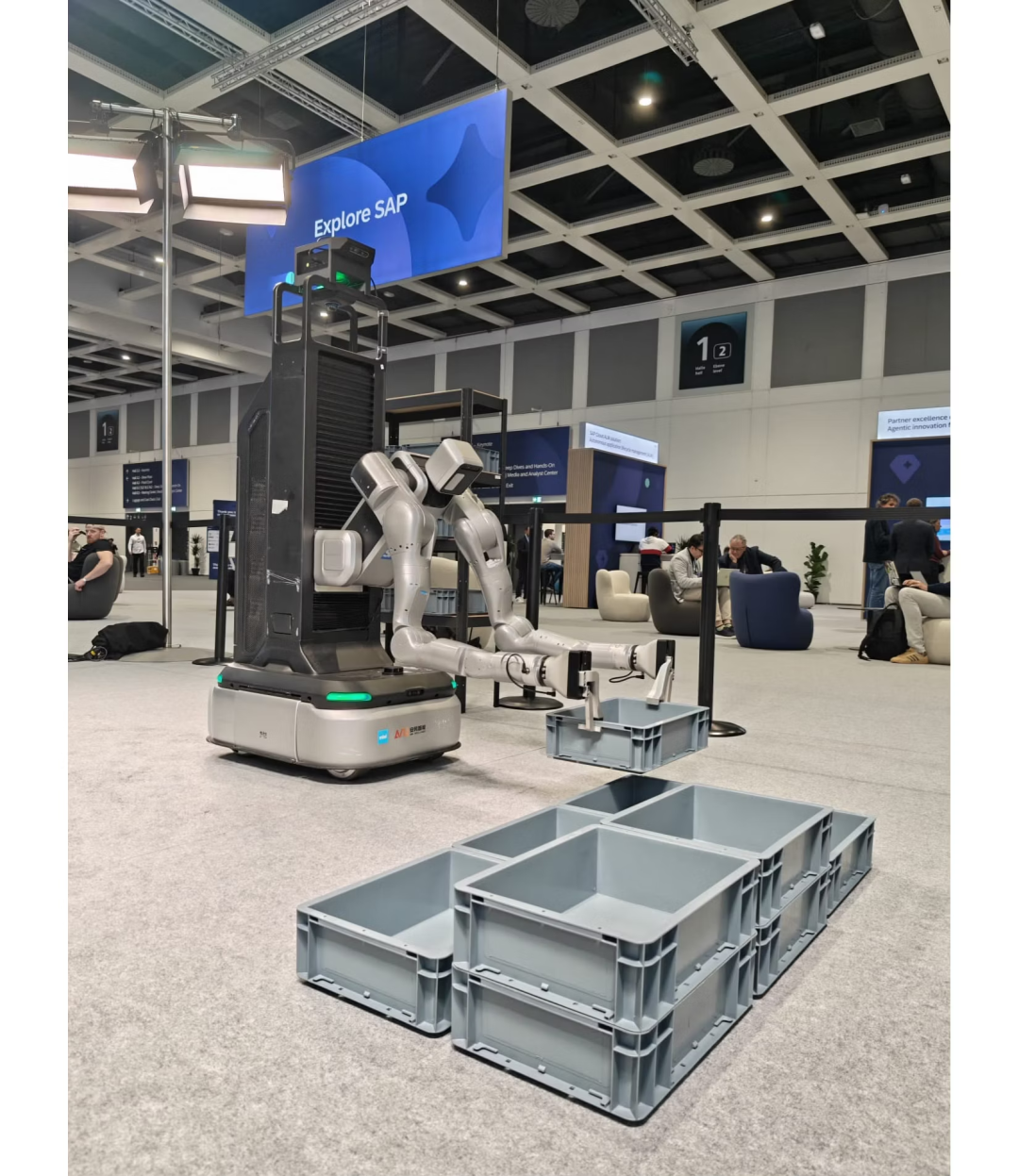
The Intel and SAP demonstration is the least glamorous and possibly the most commercially important. SAP’s Extended Warehouse Management system issues the task, Intel’s edge hardware and software dispatch it to autonomous robots, and the robots return status and completion back to the enterprise system. The result is a closed loop between the business workflow and the physical execution.
The distinction from ordinary warehouse automation is the context. SAP is not sending a move command. It is supplying the business rules and the workflow behind the task, and receiving outcomes back. Intel’s contribution includes heterogeneous computing across CPU, GPU and NPU for local perception, reasoning, navigation and control, plus OpenVINO Physical AI, Physical AI Studio and a Robotics AI Suite intended to reduce integration work.
That last part is the actual bottleneck. The model is rarely the reason a robot does not reach a factory floor. Integration is. Whoever lowers the cost of connecting a robot to an existing enterprise system sets the pace of deployment, and that work looks much more like enterprise software than like a research breakthrough.
Editor’s note: This is an adapted translation of the original OFweek report. It has been trimmed and restructured for readability for an international business audience. The full original (in Chinese) is at https://robot.ofweek.com/2026-11/ART-8321205-8420-30710693.html.