Sorting and warehousing in China are more than 80 per cent automated. Loading a truck is under 20 per cent. That gap, known in the industry as the last twenty metres, is where a new round of robot money is going.
A small round with an unusual structure
Anhui Qingtian Intelligent closed a Pre-A round in the tens of millions of yuan on 6 November. The lead investor was an unnamed domestic industrial group. Hefei’s municipal government investment fund, already a shareholder, put in more; the Huoqiu industry fund followed, and a specialist equipment manufacturing firm joined as a strategic supplier. The structure is not a financial cheque. It is strategic investment plus shared deployment sites.
The prize is a job nobody wants. Inside a truck trailer the temperature reaches 60 degrees Celsius in summer and minus 18 on the cold-chain side. Cartons are stacked from the floor to the roof with a gap wide enough for one person to squeeze through sideways. Most dockworkers are over forty, and the going rate is about RMB 10 per tonne lifted, turned and stacked.
The Americans solved unloading first
Boston Dynamics released Stretch Gen 2 on 3 November with a peak unloading rate of 1,000 boxes per hour. DHL signed a memorandum for more than 1,000 units in May 2025, and Hyundai Motor Group has disclosed that Stretch has unloaded over 20 million boxes cumulatively.
Unloading takes boxes off a stack that someone else built. Loading is the reverse: a robot has to build a stack from nothing inside an empty trailer, keep the centre of gravity between the axles, interlock the layers and stop the last row from pressing against the door. A single truck often serves several stores and warehouses, so loading order is unloading order. Get one layer wrong and half the truck is rebuilt downstream.
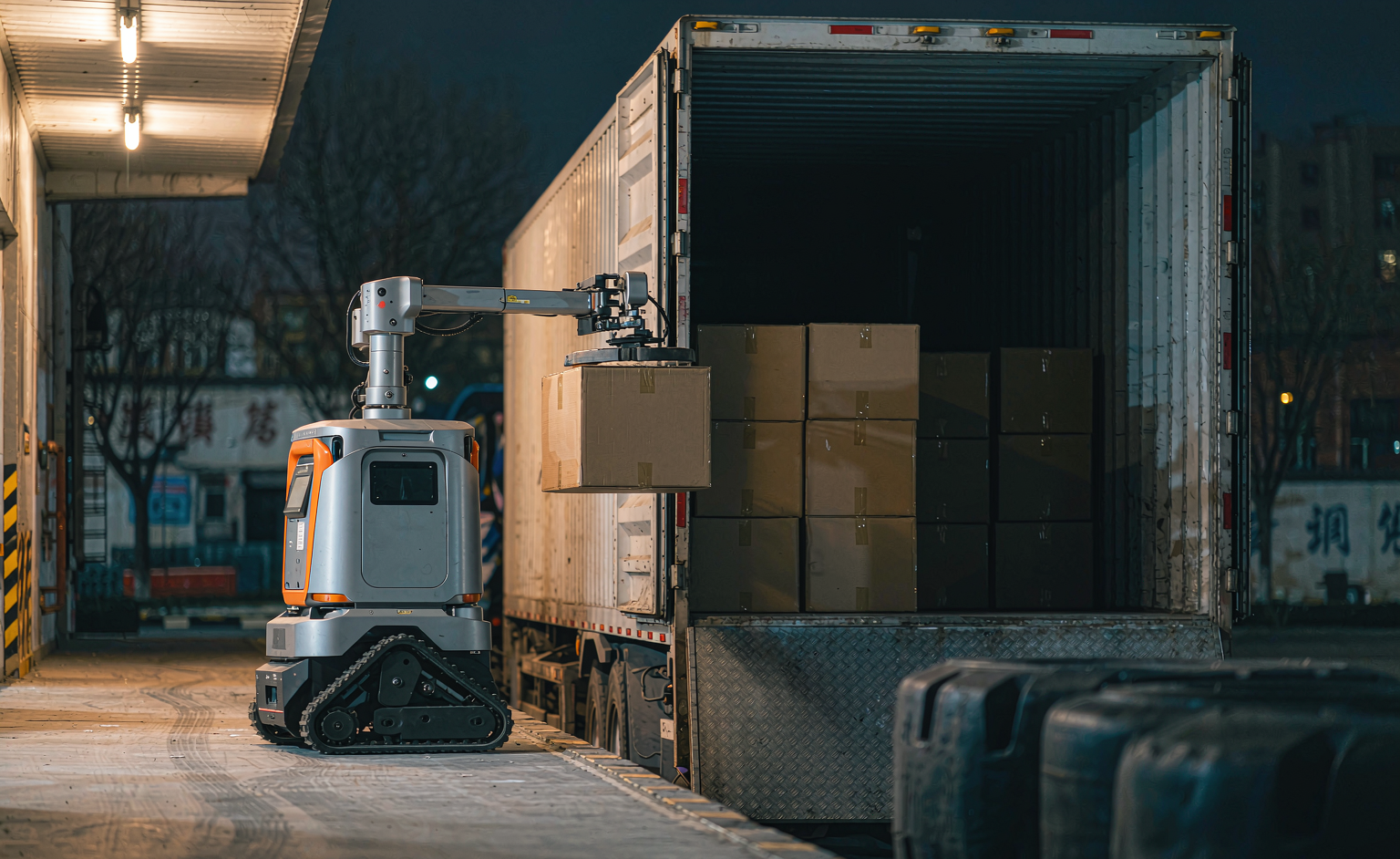
Qingtian’s T2 handles those constraints in software. Hefei’s industry and information technology bureau lists 900 boxes per hour and a positioning accuracy within plus or minus one millimetre, and gave the machine a provincial first-of-its-kind designation in 2025 at the level of internationally advanced.
The hard part is rhythm. A loading cycle takes about 60 seconds, and that budget covers observation, planning and end-effector correction. If the truck parks crooked, the robot has to stop, look, recompute the angle and reach in again. A person does this by feel. The machine has to reconstruct the feel.
Dexterity, founded in the United States in 2017, has raised about USD 300 million and counts FedEx and UPS as customers, with truck loading as its main scenario. Truck loading is being attacked everywhere. Chinese suppliers are simply getting engineered products out first, and the reason is less clever algorithms than less forgiving trailers.
A thousand box types is an entry fee, not a moat
Qingtian discloses more than 1,000 box types and over 1,000 truck-load records, which fundraising documents describe as a data moat. It is closer to an entry ticket. Loading data is highly industry-specific. Tobacco cartons are rigid cuboids, dairy cases deform, sugar bags slip. Change industry and the box, stack pattern, trailer and acceptance standard all reset.
What transfers is the abstraction, the ability to separate how a stack stands from what the box looks like. The acceptance bar is stricter than any benchmark: a customer is not buying 99 per cent success, but 100 per cent. One jammed carton stops the line and blocks the yard, and the loss dwarfs the RMB 10 per tonne saved.
The buyers have changed
The size of the cheque matters less than who signed it. Chinese embodied AI raised RMB 93.5 billion across 322 deals in the first half of 2026. In this corner of it, the money now comes from cargo owners and capacity owners. Sinotrans has the cargo, Manbang has the trucks, Wuliangye is a shipper in its own right. All three have invested in rival loading-robot maker Senade across three rounds in March, June and September.
Their logic is not valuation. It is yard congestion, cargo damage and the impossibility of hiring. Zhongli, a materials handling maker, published a full robot range on 29 June and put loading into its four core scenarios.
The demographic arithmetic is the real order book. China had about 11.5 million people working in loading and unloading in 2025 and is forecast to have 8.2 million by 2030, a loss of 3.3 million in five years, with more than 70 per cent of the current workforce already over forty. That gap cannot be filled by recruiting. It can only be filled by equipment.
Editor’s note: This is an adapted translation of the original OFweek report. It has been trimmed and restructured for readability for an international business audience. The full original (in Chinese) is at https://robot.ofweek.com/2026-11/ART-8321202-8420-30710599.html.