Chinese maths just grew up
The five-syllable head start behind China.s maths oversupply
Chinese are better at maths. In a very childish way.
Not genes. Language. The advantage is installed in childhood, by the mother tongue itself, long before the first maths lesson.
Seven sevens are forty-nine. In Mandarin, that takes five syllables, and it rhymes. 七七四十九. In English it takes eight syllables, and it limps. This is not a cherry-picked example. It is the single longest chant in the English multiplication table. A Chinese six-year-old flattens it before breakfast.
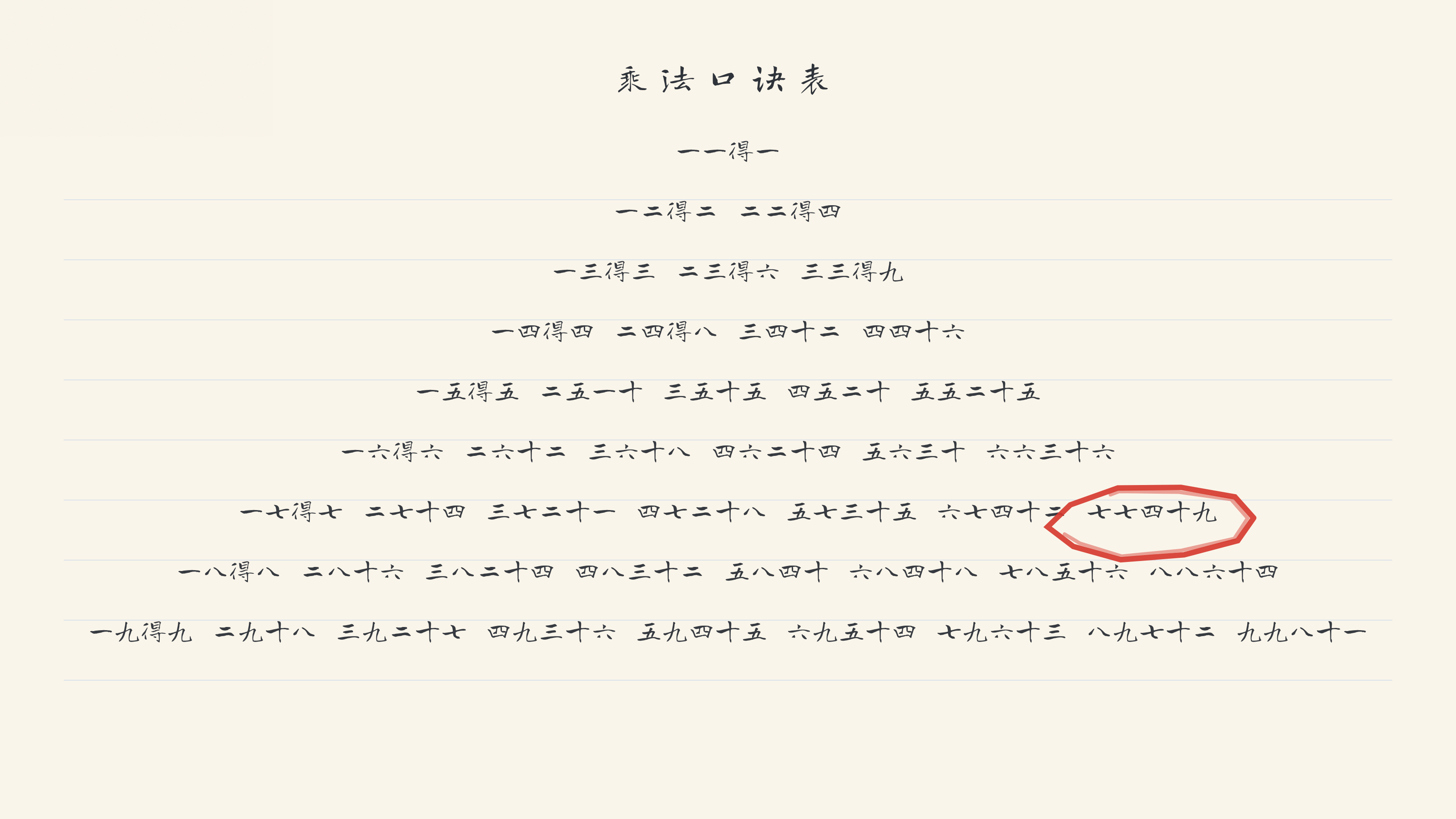
The head start is real. It is measurable. It is five syllables long. And this week, in Philadelphia, it collected two Fields Medals.
The head start is phonetic
Ask an English-speaking child what “eleven” means, and the honest answer is nothing. It is a fossil word, from an old Germanic phrase meaning one left after ten. The teens run backwards: sixteen says six first, then ten. At twenty the order flips back, and children routinely write 61 for sixteen. A Chinese child says 十一: ten-one, and place value arrives before anyone teaches it. The same transparent logic runs from ten-one to nine-ten-nine, without a single exception to memorise. The full Chinese table holds forty-five facts. Every one of them chants in five syllables or fewer, and every one of them rhymes.
The measurement exists. In the 1990s, Kevin Miller’s team compared four- and five-year-olds in Illinois and Beijing. Up to twelve, they found no difference. Beyond twelve, the Chinese children pulled roughly a year ahead, and they never handed the lead back. Robert Siegler’s team then gave kindergartners a task neither group had practised: placing numbers on an empty line. The Chinese five-year-olds performed like American children one to two years deeper into schooling.
Working memory gets the same discount. The brain’s phonological loop holds about two seconds of sound. Mandarin number words are so short that more of them fit inside it. In digit span tests, Mandarin speakers routinely hold nine or ten numbers where English speakers manage seven. Studies have repeated that result for forty years.
If you doubt that a language can tax arithmetic, ask a French child. Ninety-nine in French is quatre-vingt-dix-neuf: four twenties, a ten and a nine. You must compute the number before you can pronounce it, and the tax arrives early. Eight times nine lands a French pupil at soixante-douze, sixty-twelve. Psychologists compared French-speaking Belgian children, who say regular septante, with French children stuck with soixante-dix. The Belgians made far fewer errors. Same language, same schools, different number words. Canadian researchers have recorded third-graders transcribing 78 as 6018, writing soixante-dix-huit exactly as it sounds.
Be precise about the claim. The advantage is specific, not pervasive. Language buys counting, place value, working memory and early arithmetic. It says nothing about higher mathematics.
It is firmware. Nothing more.
For a century, maths was the wrong major
So where did the firmware go, for a hundred years? Nowhere glamorous.
The prodigies were always there. Any veteran maths teacher in China knows the type. The fourteen-year-old who finished calculus alone in the back row. The question was what he could rationally become.
For two decades of the property boom, the answer was brutal. China’s highest gaokao scorers queued for civil engineering and architecture at Tsinghua and Tongji, because concrete paid. The next tier chose computer science, closer to mathematics in syllabus, closer still to money in intent. Even the mathematics and physics doctorates drifted sideways, into quantitative trading. Overqualification was the edge. Pure research was what you did when the better options were closed. The poor and brilliant made a quieter calculation. A tuition-free place at a normal university. Then a guaranteed post teaching maths at a county middle school, an iron rice bowl earned at the blackboard.
Even emigration saved no one. Zhang Yitang graduated from Peking University in 1982 and took a doctorate at Purdue. His adviser would not write him a recommendation letter, and academia closed its doors. A friend gave him a job at a Subway in Kentucky. He kept the books there for seven years, and for a while he slept in his car. In 2013 he published the first finite bound on prime gaps. He was fifty-eight. The Fields Medal has an age limit of forty.
It was a semiconductor fab retooled to make toasters.
The waste was never of talent. The talent was measured, sorted and certified every June by the most competitive examination on earth. What was missing was an industry willing to pay for it.
The starting line existed for a century. The track did not.
AI repriced the head start
Then the track arrived, and it was paved with arithmetic.
A large language model is not magic, but arithmetic. Linear algebra, multivariate calculus and basic probability, executed at planetary scale. Terence Tao has called the mathematics of modern AI surprisingly mundane. Mundane is exactly what China’s examination machine mass-produces. The national postgraduate exam alone certifies thirty thousand elite maths scorers a year. Hundreds of thousands more wait in reserve. At NeurIPS last year, 51 per cent of leading authors began their careers in China. None of this work rewards the romantic lone genius. It rewards ten thousand disciplined minds holding matrices in their heads.
Quantitative trading absorbed a sliver of this talent for two decades, but a quant fund is a zero-sum boutique. A few hundred elite minds in a handful of towers in Shanghai and Hangzhou, extracting money from one another. Artificial intelligence is not a boutique. Open weights turn every company on earth into a deployment site. Physical AI turns every factory floor and family home into another. The reservoir is finally draining at industrial scale.
The career arithmetic inverted with it. AI labs now pay starting salaries around ten times the national graduate average. When Washington restricted the silicon, algorithmic efficiency became a survival metric. DeepSeek produced a frontier model on 1 per cent of the compute budget of its Western rivals. The firmware finally had a killer app.
Now consider the word the West used. Since the 1980s, Western lecturers have filed Chinese students under a single label. Rote learners, silent in class, deadly in exams, somehow short on creativity. The education literature gave the puzzle a formal name. The paradox of the Chinese learner.
Here is the update. The West spent forty years calling it rote learning. Then it built a trillion-dollar industry out of rote learning. Gradient descent is repetition until convergence. A large language model is a machine drilled on the same corpus until its answers stop changing. The insult turned out to be the job description.
Fairness requires one addition. The same charge came from inside the house. Yau Shing-Tung is China’s greatest living mathematician. He has warned for years that his country trains students to solve problems, not to pose them.
That charge needed an answer.
The proof arrives on Thursday
The proof arrived on Thursday, in Philadelphia. At the opening of the International Congress of Mathematicians, four Fields Medals were awarded. John Pardon received one. Jacob Tsimerman received another. The remaining two went to graduates of the same undergraduate classroom. The School of Mathematical Sciences at Peking University, class of 2007.
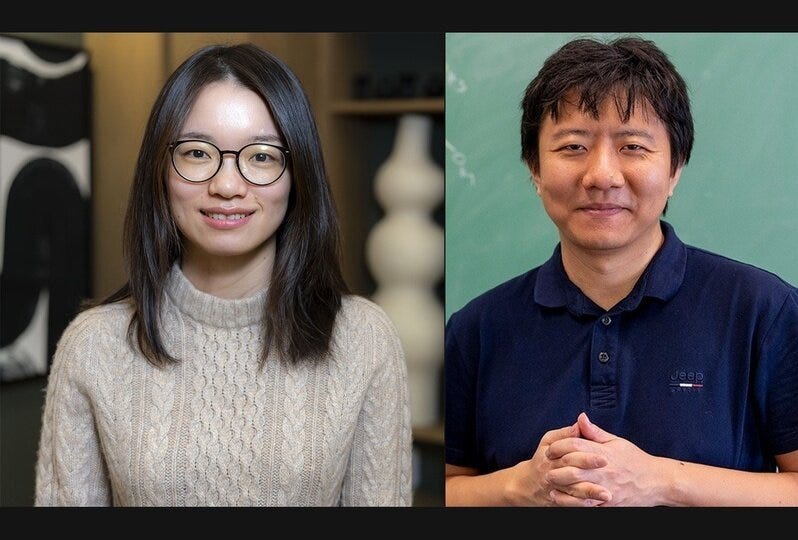
Wang Hong was born in 1991 in Guangxi and entered Peking University at sixteen. Now at the Courant Institute at NYU, she resolved the three-dimensional Kakeya conjecture alongside Joshua Zahl. The problem had stood for more than a century. She is the third woman ever to receive the medal.
Deng Yu was born in 1989 in Shenzhen and arrived with an Olympiad gold medal already in hand. Now at the University of Chicago, he resolved the special case of Hilbert’s sixth problem. His co-authors were Zaher Hani and Xiao Ma. Hilbert posed it 125 years ago.
Both were born in China’s deep south, Wang in Guangxi and Deng in Shenzhen. The Guangdong village that produced DeepSeek’s Liang Wenfeng lies a few hundred kilometres away. At the school’s graduation ceremony this June, the mathematician Tian Gang singled out both names to the newest graduates. He knew what was coming.
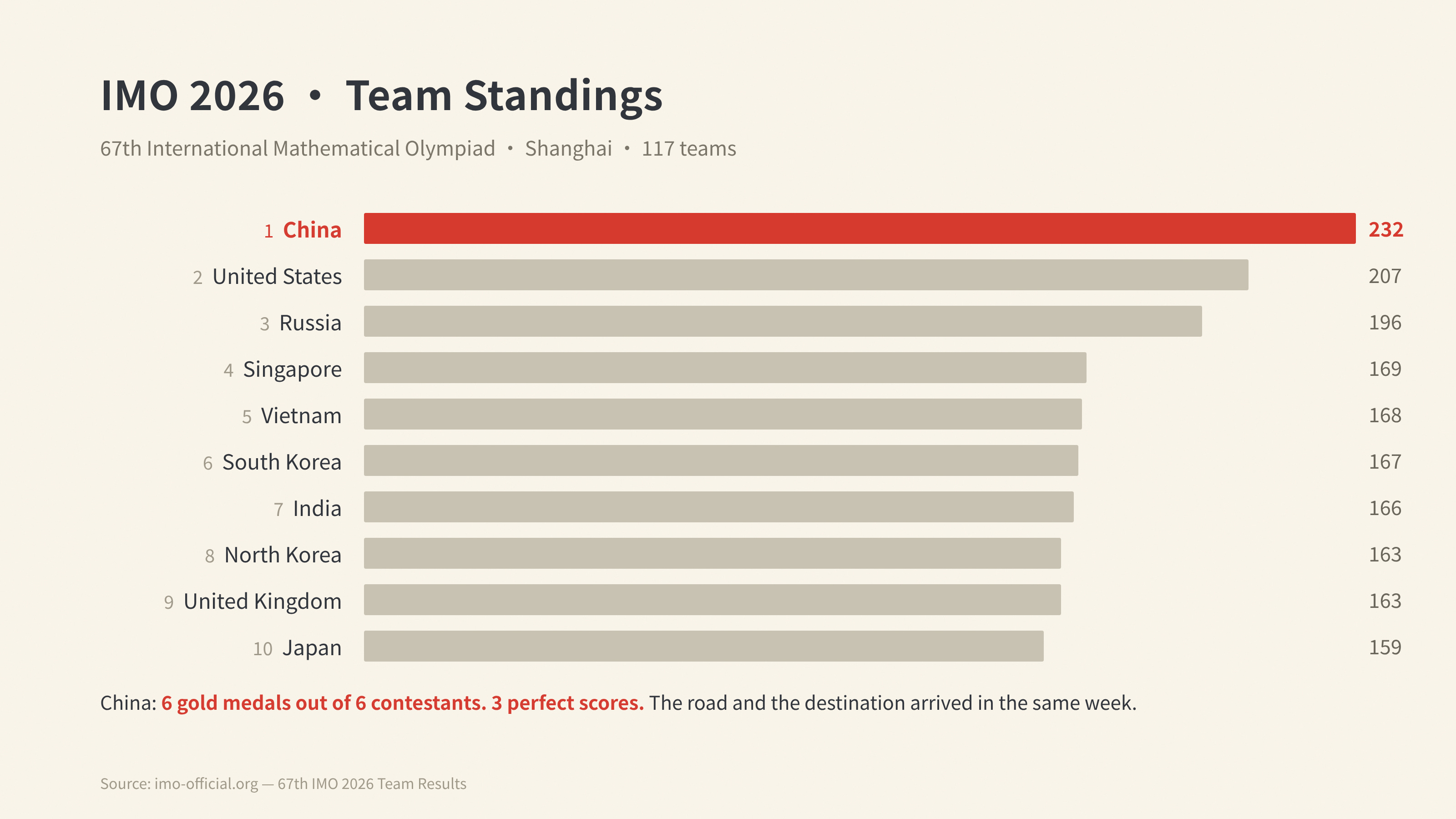
None of this came from nowhere. For most of a decade, China’s national team dominated the International Mathematical Olympiad. It won or shared five consecutive titles from 2019, then lost narrowly to the United States in 2024. The crown came back in 2025, with 231 points and six golds. All of it was the road here, and this week the road converged. On Monday, in Shanghai, the team defended its title on home soil. Six contestants, six gold medals, three of them perfect scores. On Thursday, in Philadelphia, two graduates of the same undergraduate classroom received Fields Medals. The road and the destination arrived in the same week.
Note what the proof consists of. Not exams, but open problems posed a century ago, resolved by people the framework said could only repeat old solutions. The paradox of the Chinese learner is closed. Professor Yau has his answer, from the same classroom, twice over.
Count the syllables. Five. They called it rote for forty years. Then the century’s most valuable industry turned out to run on exactly that. The head start was never a party trick. It was firmware, installed in childhood, waiting a century for the right application to run.
The West had the right word all along. It was childish. It grew up.
七七四十九。