China’s Bid to Flood the World with Cheap AI, Said Bloomberg. Half Right.
On Friday at 8:36am, Bloomberg published a sweeping story on China’s plan to flood the world with cheap AI. I am quoted in it, mapping DeepSeek’s investors to the layers of the industry.
Sixteen hours before that story ran, 29 countries signed the charter of the World AI Cooperation Organisation in Shanghai. Sixteen hours after it, Moonshot AI released a 2.8 trillion parameter model priced at five times the input cost of its predecessor.
One 24 hour window. Three events. Bloomberg got the flood right. This is the other half.
The front page was right. The adjective was wrong.
Give the cheap AI thesis its due first, because the evidence for it is genuinely strong. Chinese open source models have passed 30 percent of traffic on the aggregation platform OpenRouter in some weeks this year, against less than 2 percent in 2024. San Francisco startups report cutting their inference bills to a tenth of what they paid Anthropic. The economics of the flood are real and they are reshaping procurement departments from California to Copenhagen.
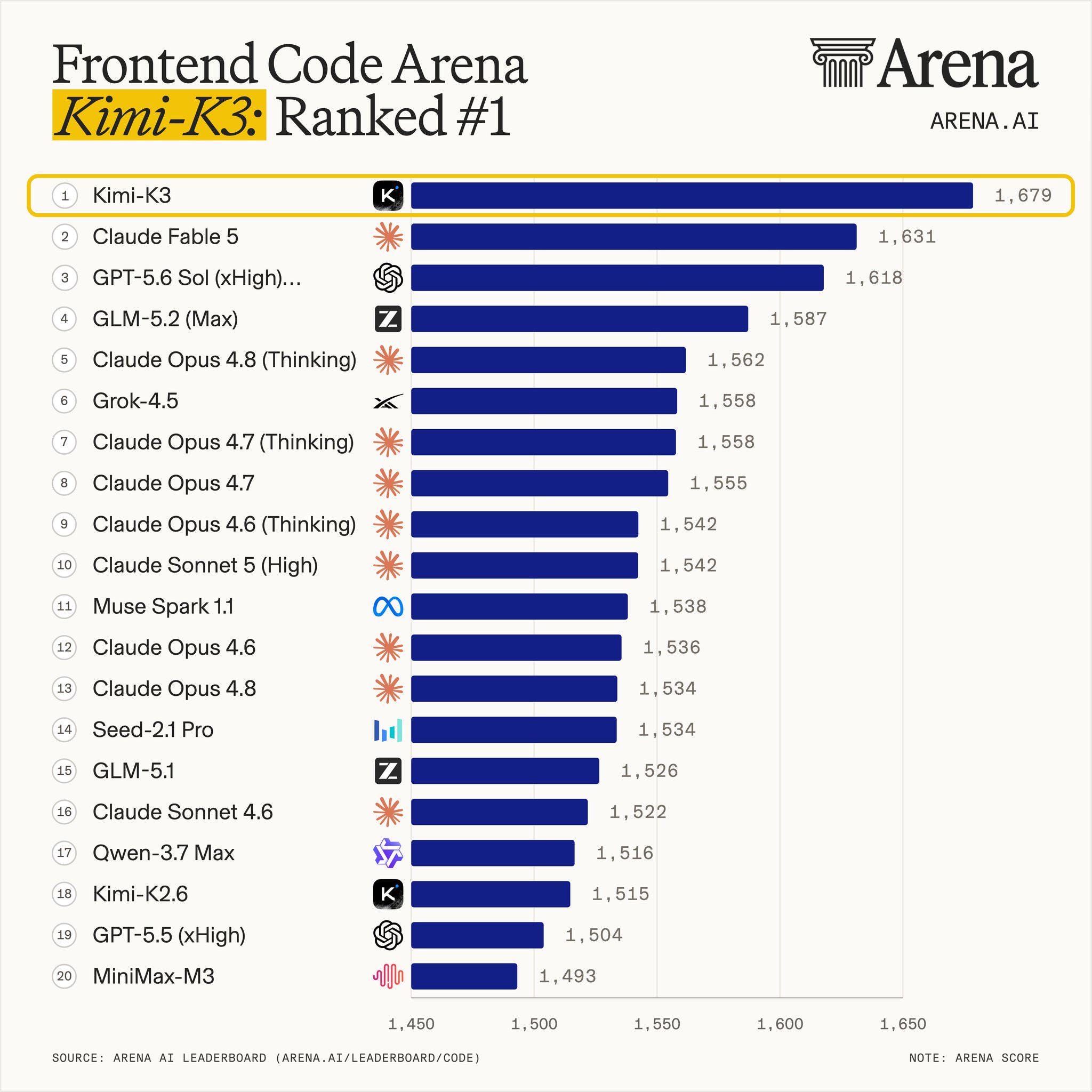
Then look at what arrived at midnight on Friday. Kimi K3 is the largest open weight model ever shipped. Two numbers matter more than the rest. On the Artificial Analysis Intelligence Index, K3 sits at 57.1, level with Claude Opus 4.8 and behind only the frontier’s two most expensive offerings. On the Frontend Code Arena it scored 1,679 points, first place, ahead of Anthropic’s Claude Fable 5. That is a 17 place jump from its own predecessor in a single generation, the fastest leap the leaderboard has recorded this year.
Now look at the price tag. K3 charges three dollars per million input tokens and fifteen per million output. That is Sonnet tier pricing, five times the input price of K2. Full open weights follow by July 27.
Read those two paragraphs together, because they invert the entire narrative. China’s new flagship is not dumping tokens on the developing world. It is charging developed market prices to raid the developed market, while giving the weights away so that every capability in the model becomes a permanent, unretractable artefact on the world’s hard drives. Cheap was never the strategy. Cheap is one front of a two front war.
Beijing did not assemble a funding round.
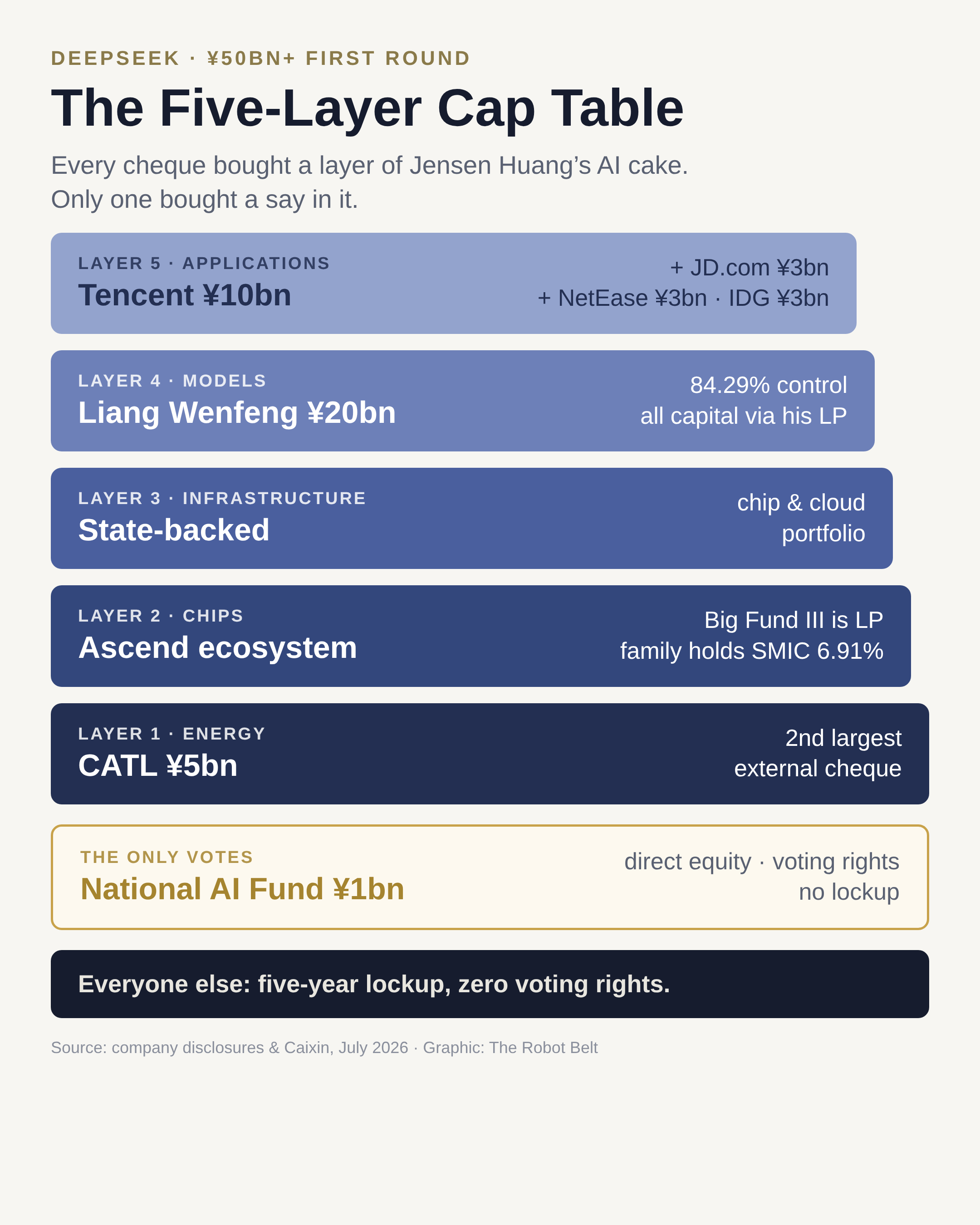
The Bloomberg story reported the shape of DeepSeek’s 7.4 billion dollar raise. Most investors, including Tencent and JD.com, entered through a limited partnership controlled entirely by founder Liang Wenfeng, accepting five year lockups and zero voting rights. One investor was spared those terms. The National AI Industry Investment Fund took direct equity, voting rights, and the freedom to sell at will.
What the story did not map is how deep this architecture goes. Caixin has since confirmed that CATL put in roughly five billion yuan, making the battery giant the second largest external investor after Tencent. The energy layer is not a metaphor. It is a line item on the cap table.
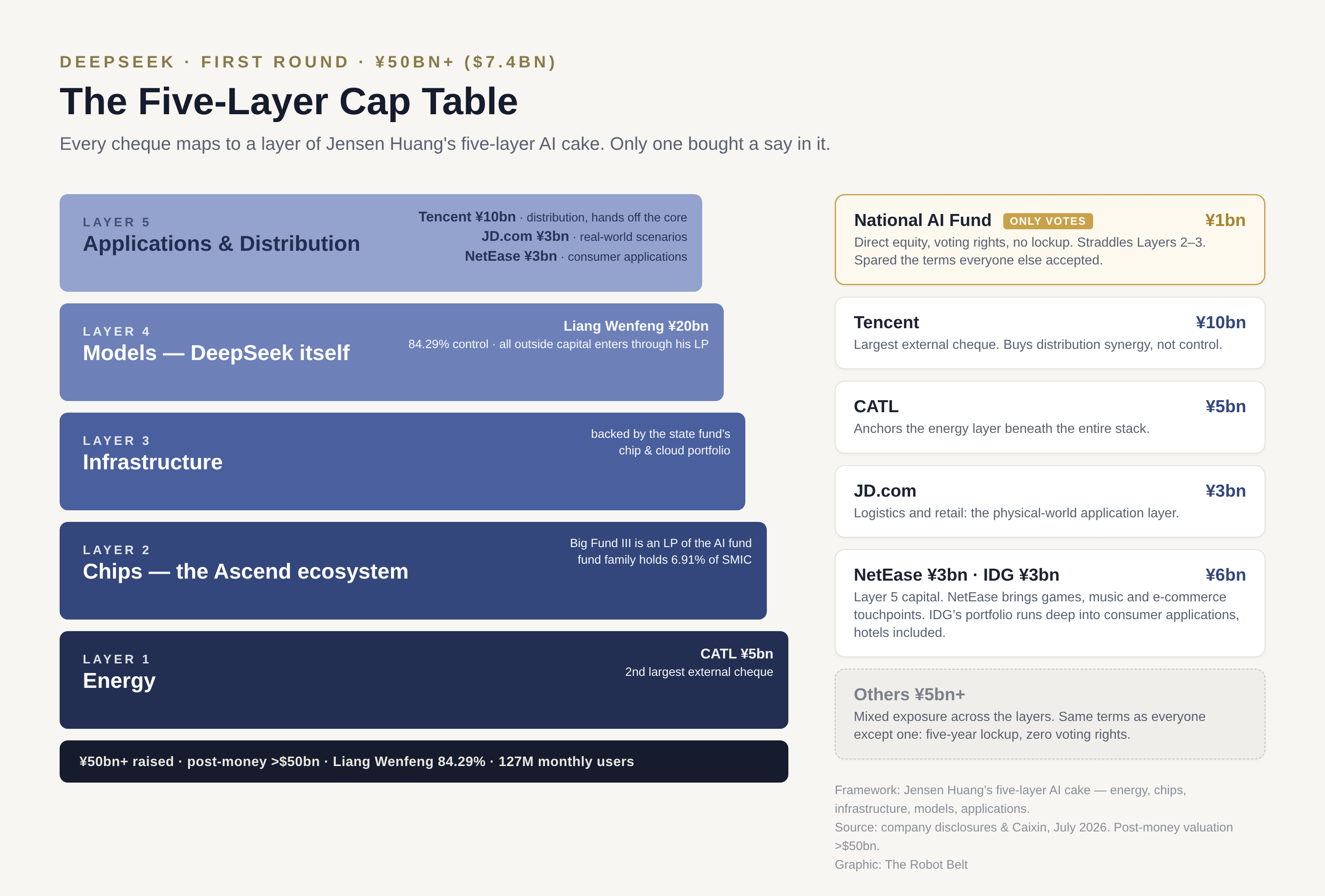
Follow the money upward and the structure gets more interesting. The state fund that took voting rights in DeepSeek counts Big Fund III, China’s national semiconductor fund, among its own backers. The same fund family holds 6.91 percent of SMIC, the foundry that manufactures Huawei’s Ascend chips, plus the memory makers, the equipment makers and the EDA vendor underneath them. Huawei itself needs no state equity at all. It is employee owned and already aligned with the national stack.
Beijing did not buy the chip layer. It built the share register of the entire chip layer, then parked DeepSeek on top of it.
The steel mill analogy fails.
Bloomberg’s framing leaned on a familiar comparison. Beijing once treated steel mills and shipyards as national assets to be nurtured, protected and eventually turned into exports, and now it treats frontier labs the same way. The comparison is instructive precisely where it breaks. China exported steel and cars because savage domestic competition produced surplus capacity that had to go somewhere. AI chips are the opposite situation. Ascend production lines cannot even satisfy domestic demand, and every alternative Chinese accelerator faces the same constraint.
So what left the port in Shanghai last week was not surplus product. It was the development kit itself: the weights, the training pipeline, the cooperation centres, the 5,000 engineers to be trained. You cannot dump what you cannot overproduce. You can only share what you deliberately choose to give away, and giving it away is the strategy.
What 29 signatures actually bought.
The week before the Bloomberg story, the World AI Cooperation Organisation came into being in Shanghai. Twenty nine founding members. Zero Western nations. Russia, Belarus, Cuba, Venezuela and Nicaragua sat next to Indonesia, Brazil, South Africa and Kenya, every government in that room signing with full knowledge of the sanction risk.
President Xi’s keynote told them what they had bought. Five thousand government funded training slots over five years. AI application cooperation centres spanning ASEAN, the Arab League, the African Union and Latin America. An AI weather warning system offered to 30 countries. He framed the whole package around open source and sharing, and the UN Secretary General attended the signing.
Strip the diplomatic language and the offer is one word. Sovereignty. The full stack, from chips to open weights to training, packaged so that a finance ministry in Jakarta or Nairobi can run national AI on its own servers, on its own soil, outside anyone’s kill switch. Washington can block a chip shipment. It cannot block a repository that has already been downloaded in forty capitals.
Here is the part that makes this bundle different from every previous technology transfer. Once the weights sit on your servers, no superpower holds a retraction mechanism. Not Washington. Not Beijing either. That is what free from intervention has to mean to be worth the paper, and it is why countries with everything to lose signed anyway.
The supply chain hiding inside the buyer list.
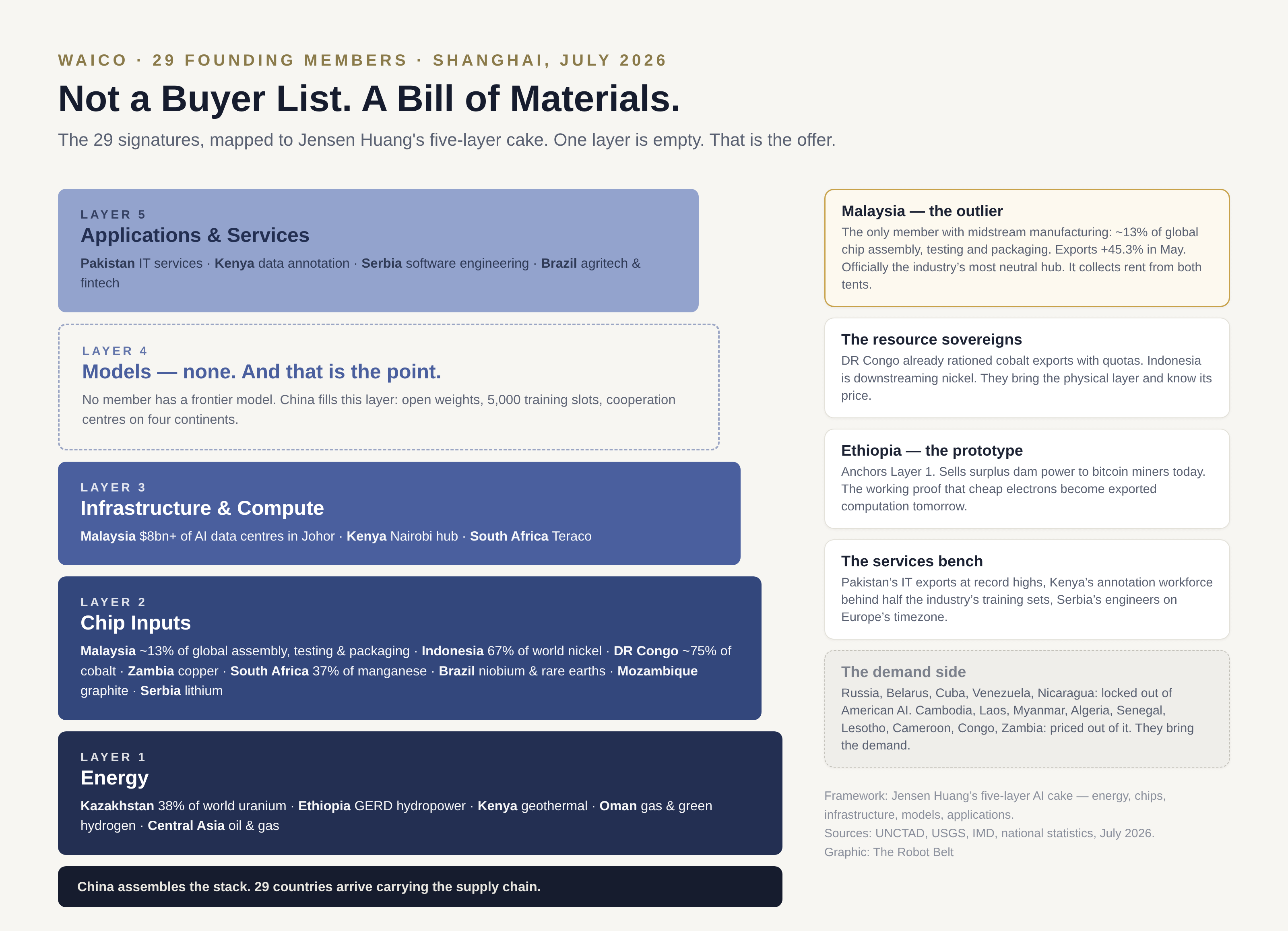
Look at the 29 signatures again and a second document appears. It is not a buyer list. It is a supply chain.
Malaysia is the only member with midstream manufacturing leverage. It runs roughly 13 percent of global chip assembly, testing and packaging, mostly from Penang, and its exports grew 45.3 percent year on year this May to a record trade surplus. Johor already hosts over eight billion dollars of AI data centre investment from Nvidia, Microsoft, ByteDance and Google, while Kuala Lumpur’s official strategy is to become the industry’s most neutral, non aligned hub. It intends to collect rent from both tents, and the open weight stack gives it the one thing it previously lacked: a frontier model it can host without asking anyone’s permission.
The rest of the list reads like the stack’s input layers. Indonesia produces two thirds of the world’s nickel. The Democratic Republic of Congo supplies three quarters of its cobalt and has already demonstrated resource sovereignty through export quotas. Kazakhstan mines 38 percent of its uranium, the fuel for any nuclear powered data centre future. Ethiopia sells surplus hydropower from its mega dam to bitcoin miners today, which makes it the working prototype of cheap electrons becoming exported computation tomorrow. Brazil holds the world’s dominant niobium supply and its largest rare earth reserves outside China. Pakistan and Kenya sell the services layer, the software talent and annotation workforce behind half the industry’s training sets.
Every layer of the stack has a member state attached. That is not a coalition. It is a bill of materials.
Europe is debating sovereignty. Caracas signed the charter.
The sharpest comment on my post this week came from a European communications strategist. While the EU debates what sovereignty means, she observed, even Venezuela, short of power and water a third of the time, signed an initiative that demonstrates it.
She is right, and the asymmetry is brutal. Sovereignty was never about uptime. Venezuela’s grid fails on its own terms. Europe’s AI would fail on someone else’s. Roughly two thirds of the EU’s cloud runs on American hyperscalers, which leaves Brussels with near perfect infrastructure and near zero control of the switch.
Ethiopia shows the alternative posture. In January 2024 it became the first country on earth to ban imports of combustion engine cars outright. No legacy fleet to protect, no lobby to appease. A blank sheet turned out to be the best thing a country could own. Now the same country has signed the WAICO charter, and this time the drawing arrives with chips, weights and training slots attached.
None of this cheque is reserved for China. The AI buildout across these markets is a power, grid and data centre buildout, and European capital, engineering and standards could all be in that room. Every lesson learned deploying AI where infrastructure is scarce travels home to Europe’s own sovereign stack. The seat at the table exists. Brussels is still scheduling the debate about whether to take it.
The adjective is up for grabs.
So the picture in full. Front one sells sovereignty to the South at a price no treasury can refuse, on hardware no sanction can recall. Front two bills the North at full price for parity it can no longer ignore. A single state assembled the capital stack, and 29 countries arrived carrying the supply chain.
Cheap is the anvil. Parity is the hammer. Caught between them is a subscription model that assumed it had both.
Bloomberg got the flood right. Half right. The adjective is up for grabs. So is the decade.