On the opening day of CeMAT Asia 2026 in Shanghai, ThunderSoft’s Xiaowu Intelligence and the Beijing Humanoid Robot Innovation Centre showed a full-stack industrial embodied platform. The design pairs one control brain with a heterogeneous fleet, and the target is the last hundred metres of factory logistics, from the storage block to the line-side rack.
Two systems, one loop
The platform is two systems working together. The Beijing centre’s general embodied platform, Huisi Kaiwu, supplies the foundation model, a cross-embodiment vision-language-action base model and whole-body motion control, and handles long-horizon task planning and spatial reasoning. Xiaowu’s industrial platform runs an industrial-grade real-time kernel and a business management layer that schedules mixed vehicle types and closes the single-machine control loop.
The result is a closed chain from intelligence layer to fleet scheduling.
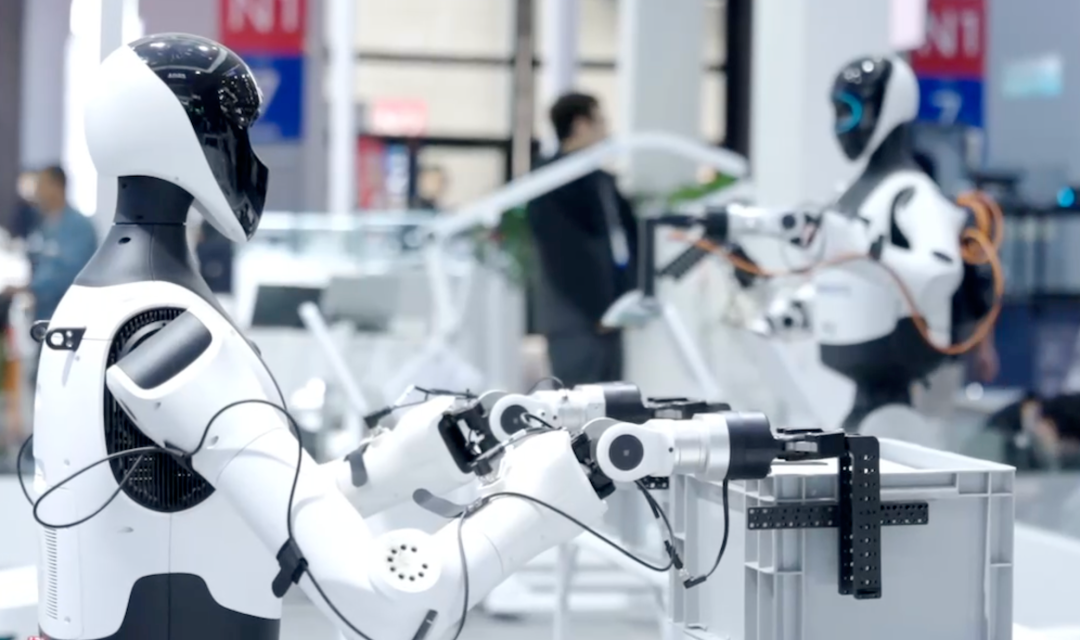
At the stand, three robots with different locomotion architectures worked under a single schedule. The Tianyi series from the Beijing centre handled valve-core precision assembly, screw picking and bin loading and unloading. A forklift FMR took pallet-level heavy loads and high-bay storage. A latent AGV moved between the storage area and workstations, fetching racks and carrying bins.
All of it was sequenced by the platform, which is the part that matters. Mobile transfer and manipulation have to interlock on timing, not just coexist in the same building.
The actual target
The platform is aimed at the repetitive, labour-heavy handoffs between a high-bay warehouse and the line-side buffer, and at the end-of-line material delivery that currently needs a person to walk it. Unstructured picking and automatic loading and unloading are the other two.
The named sectors are automotive, smart logistics, semiconductor manufacturing and consumer electronics. These are the environments where a mixed fleet makes commercial sense, because the vehicles already exist and the only new cost is orchestration.
Since the two sides signed a strategic cooperation agreement in January 2026, they have demonstrated heterogeneous fleet coordination at the World AI Conference, the World Humanoid Robot Games and the World Robot Conference. The next step is lighter, production-ready cluster products for automotive, high-end equipment and smart factories.
The interesting claim is not that a humanoid can assemble a valve core. It is that a factory can buy scheduling once and add robot types to it, rather than buying a robot and then discovering that each one needs its own traffic manager. Fleet software is where the margin sits, and it is also where the Chinese industrial stack is now competing.
Editor’s note: This is an adapted translation of the original Gasgoo report. It has been trimmed and restructured for readability for an international business audience. The full original (in Chinese) is at https://www.gasgoo.com/apps/e060bad9eca91db7f01403fc7120041f/robot/news/70477266/.