At the seventh World Media Summit forum on artificial intelligence and Chinese modernisation in Beijing on 5 November, Xinhua presented two bionic humanoid news anchors. They are called Xinyan and Xinyu. Both are one-to-one replicas of human proportions, and Zhang Yimou led the design of their appearance.
The hardware and the skin come from UBTech. The content engine is Xinhua’s own political news agent, built on a model the agency calls Xinhua Yudian. The two systems together let the units present on camera in a studio setting.
The market read it instantly
On 6 November the A-share humanoid robot index moved. Zhaofeng shares approached the 20 per cent daily limit, and suppliers across moulded plastics, structural parts and new materials followed.
What the market bought was not a robot. It was a template: national media plus a listed body maker, with the endorsement implied by the first word of that pairing.
Why an anchor is an easier commercial target than a factory worker
For two years the industry has pointed at physical labour, moving goods in warehouses and sorting parcels on lines. Those are structured or semi-structured environments, and they demand motion precision, force output and long-duration stability all at once. The technical bar is high and the commercial cycle is long.
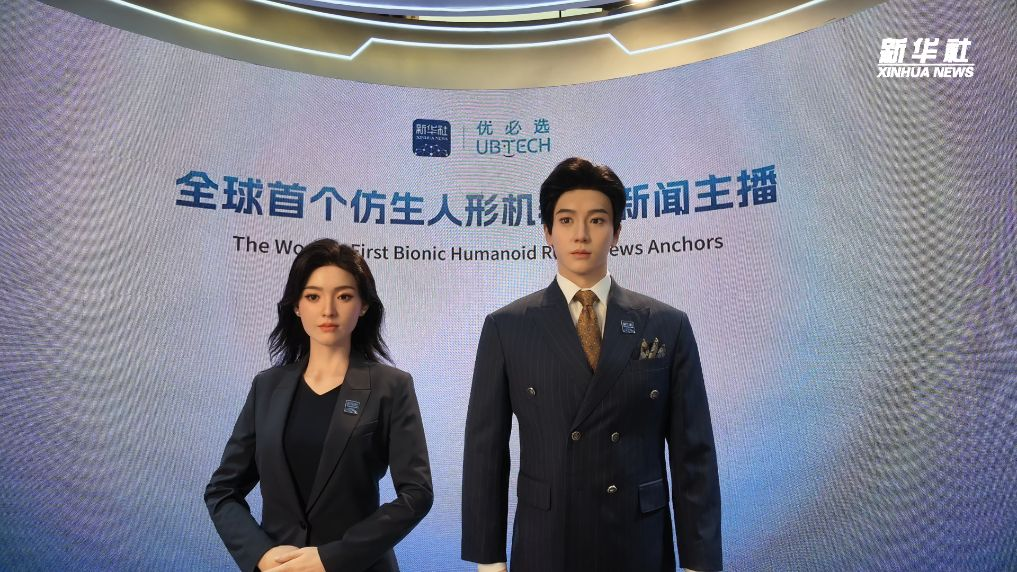
Studio presentation tests multimodal interaction instead. UBTech put the emphasis on skin texture and an emotional model, which sidesteps the maturity problem in complex physical manipulation and enters a task class with far higher tolerance for error and far higher emotional value per unit.
That is a genuine strategic choice, not a shortcut. Public service and commercial guidance are large addressable categories, and the failure modes are recoverable. A robot that reads a script imperfectly is a bad broadcast. A robot that drops a die-cast part on a press line is an insurance claim.
The boundary the client drew himself
The most useful sentence came from Qian Tong, director of Xinhua’s new media centre, who described a robot anchor as a new job category in the newsroom and not a new lead actor.
That is the client defining the ceiling of its own purchase. Embodied AI is being bought as an efficient auxiliary tool, not as a replacement, and the pricing will reflect that framing for as long as it holds.
There is a second reading. A state news agency chose to make its first serious humanoid deployment a front-of-camera role where the technical requirement is interaction rather than manipulation. That is the same calculation a bank makes when it puts a robot in the lobby rather than the vault: the demo is credible, the risk is bounded, and the footage travels.
Editor’s note: This is an adapted translation of the original OFweek report. It has been trimmed and restructured for readability for an international business audience. The full original (in Chinese) is at https://robot.ofweek.com/2026-11/ART-898890-8110-30710808.html.