Capital in China’s embodied intelligence sector is rotating away from humanoid robot bodies and toward the upstream components that make them work. One Shenzhen end-effector maker has reached the door of the public markets with a revenue base built on factory floors rather than on demonstrations.
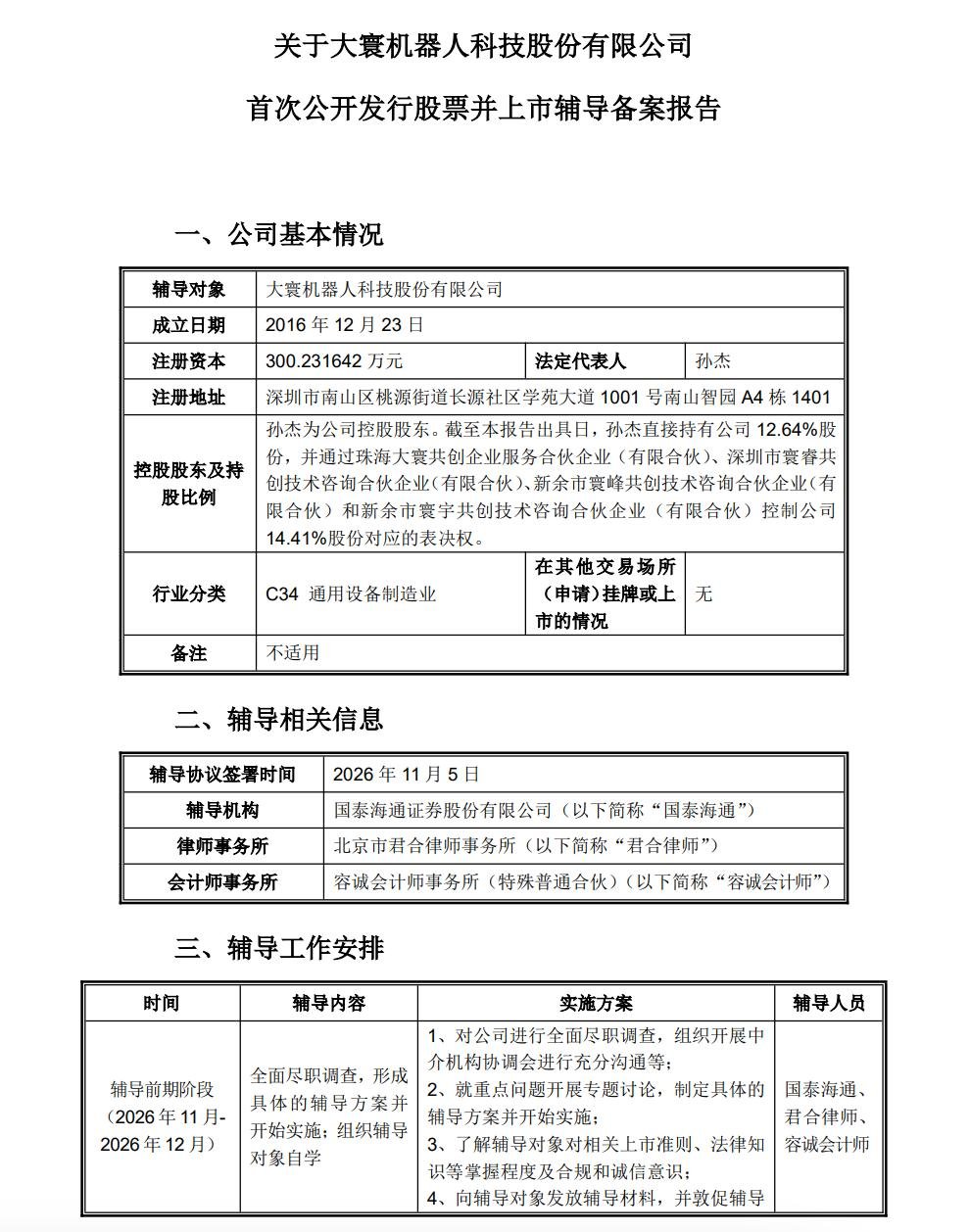
According to a 14 November disclosure from the Shenzhen branch of the securities regulator, DH Robotics Technology filed for IPO counselling on 13 November 2026, with Guotai Haitong Securities as sponsor.
A decade of grippers, not a demo
Founded in 2016, DH Robotics was started by Sun Jie, who studied mechanical automation at Tsinghua University and took a doctorate at King’s College London focused on dexterous hands and artificial intelligence. The team draws on the reconfigurable mechanism and compliant grasping research of Academician Dai Jiansheng.
Its catalogue covers electric grippers, dexterous hands, voice coil actuators, servo electric cylinders, the iFM intelligent compliant motion system and servo drives, serving industrial smart manufacturing and embodied intelligence. In 2024 it became the first electric end-effector company to receive the national Little Giant designation for specialised, high-technology suppliers.
Unlike startups selling an embodied intelligence story while relying on continuous funding, DH Robotics earns from conventional industry. Its electric grippers and precision motion systems have entered the supply chains of BMW’s Leipzig plant, BYD and CATL. Its products have also reached higher-end embodied intelligence customers including Huawei and AgiBot.
Eight rounds and a controlling founder
Corporate registry data shows eight completed funding rounds. Investors include ByteDance, which made a strategic investment through its Quantum Leap vehicle in 2022, along with IDG Capital, Qiming Venture Partners and Legend Capital.
Sun Jie holds 12.64 per cent of the shares directly and controls the voting rights attached to another 14.41 per cent through four employee and partner holding vehicles in Zhuhai, Shenzhen and Xinyu, giving him about 27.05 per cent of voting rights in total.
Timing the sector’s gear change
Through 2026, funding for embodied intelligence in China has stayed hot, with capital concentrated on humanoid body makers and pushing up valuations at the top of the market. The industry consensus is shifting, from form factor and walking demos toward real task capability, stability and cost control.
The filing lands at that inflection. A mature industrial automation business supplies steady orders, while humanoid commercialisation opens a second curve in which dexterous hands carry far higher value per unit.
The constraints are real. Humanoid robotics remains early in commercialisation, general-purpose deployment at scale is still some way off, and dexterous hand orders are mostly research and pilot projects rather than volume production. Overseas incumbents and new domestic entrants are both adding capacity to the end-effector segment, so holding a lead on cost and precision will take more than being first.
Editor’s note: This is an adapted translation of the original 36Kr report. It has been trimmed and restructured for readability for an international business audience. The full original (in Chinese) is at https://m.36kr.com/p/4073745359393923.