Two Chinese hyperscalers cut the price of agent work on the same day, and neither led with a public leaderboard. Alibaba and Tencent both argued their case with internal benchmarks built around ordinary office tasks.
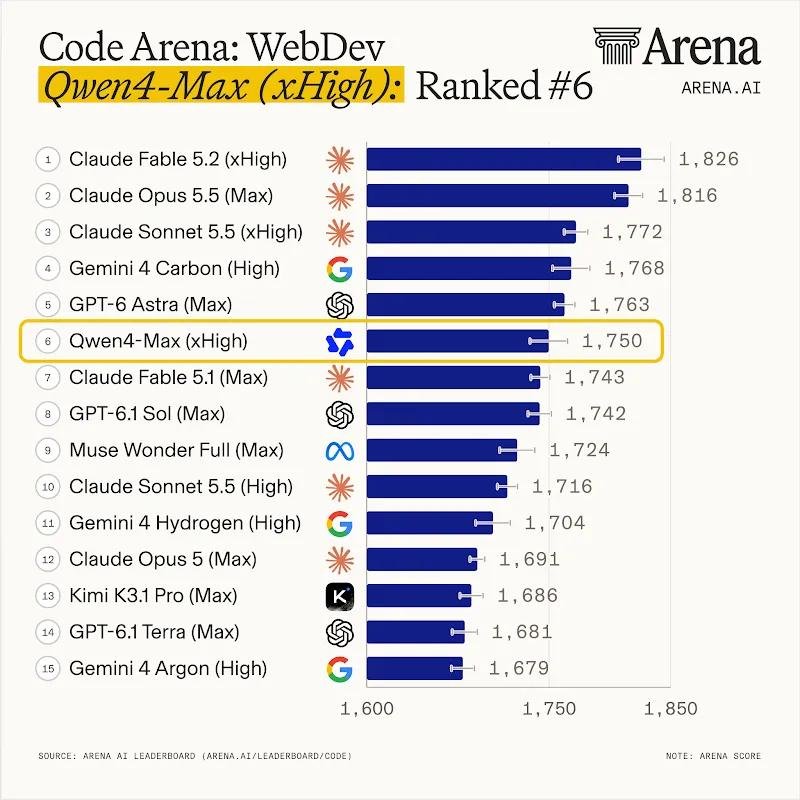
On 16 November, Alibaba released Qwen4-Max, the first flagship of the Qwen4 family, and Tencent Hunyuan released the lightweight Hy4 flash. On Alibaba’s Work360 evaluation, Qwen4-Max cut average cost per task from RMB 26.58 to RMB 11.16, a 58 per cent reduction, with cache-hit pricing as low as RMB 0.5 per million tokens. Tencent says Hy4 flash costs one twentieth as much per task as Hy4 and one eighth as much as DeepSeek-V4.1-Flash-1017 at its max-tier peak price, with cache hits at RMB 0.02. Both companies report third-quarter earnings on 18 and 19 November.
Qwen4-Max: 2.4 trillion parameters, half the task cost
Alibaba describes a new architecture with 2.4 trillion total parameters, 71 billion activated per token and a further 328 billion N-gram Embedding parameters, with native vision and a million-token context window.
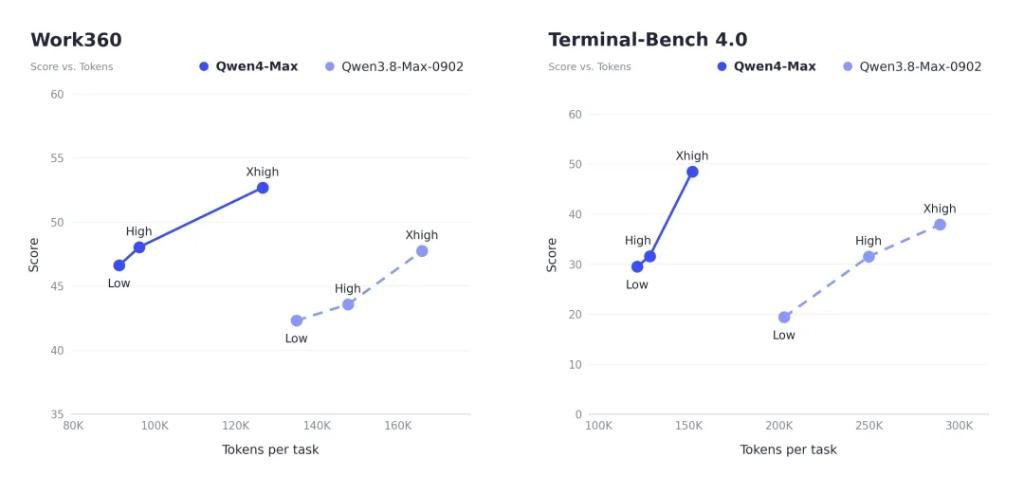
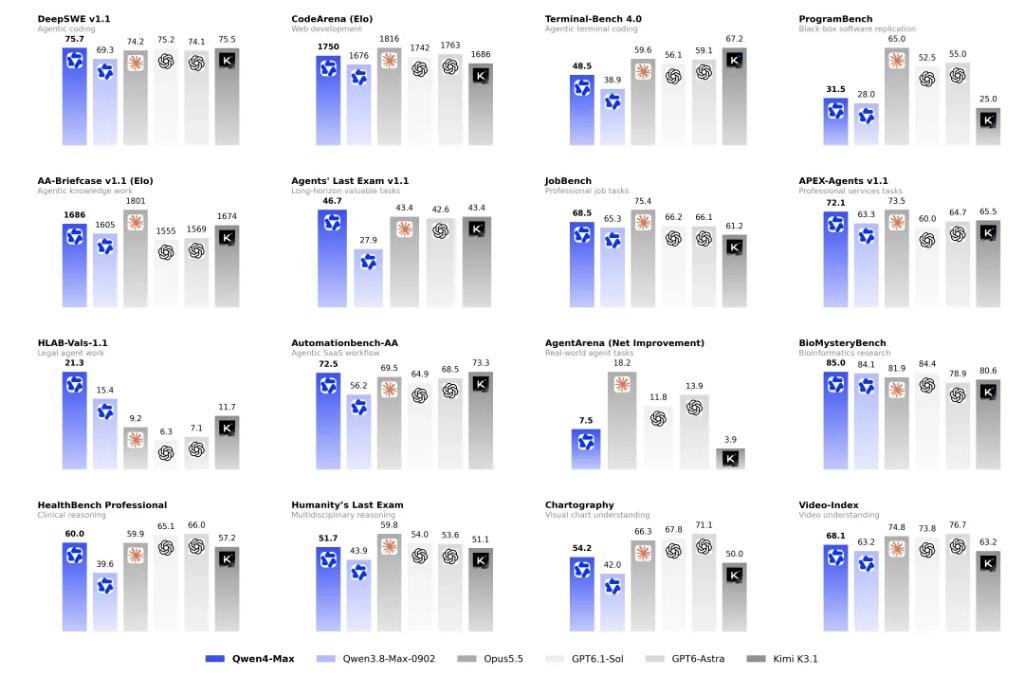
The cost fall comes from token efficiency. Against Qwen3.8-Max on Work360, Qwen4-Max used about 24 per cent and 35 per cent fewer tokens at Xhigh and High reasoning settings, and about 48 per cent and 49 per cent fewer on Terminal-Bench 4.0. API prices were cut across the board, most sharply for cache hits. On Work360 the composite score rose from 47.74 to 52.69, with gains on DeepSWE, AA-Briefcase and HLAB-Vals agent benchmarks.
Three architecture changes sit behind it: GDN plus Qwen Sparse Attention to cut long-sequence attention cost, Gated Residual to widen the residual stream into four parallel branches, and N-gram Embedding to expand capacity with little extra compute. On internal evaluations covering knowledge, code, question answering and STEM, Qwen4-Max-Base posted the lowest bits-per-byte of five models tested, 5 to 13 per cent below Qwen3.8-Max-Base across domains, while cutting activated parameters per token by about 25 per cent.
Hy4 flash: 12 billion active parameters
Tencent’s Hy4 flash has 224 billion total parameters, including 64 billion Engram parameters, but activates only 12 billion. It supports multimodal input and a 1M context. Tencent calls it the most cost-effective Hunyuan model to date. API pricing is RMB 0.5 per million input tokens and RMB 2 per million output tokens, falling to RMB 0.02 on a cache hit. On WorkIndex, cost per task is one thirteenth of Hy4 preview, one twentieth of Hy4 and one eighth of DeepSeek-V4.1-Flash-1017 at max-tier peak pricing.
Pretraining introduced hybrid attention, LatentMoE and Engram, bringing the KV cache to one twenty-fourth the size of Hy3 and one sixth that of Hy4. Post-training distilled Hy4 for general capability, then reinforcement learning cut end-to-end task output length by 50 per cent. Inference combines megakernels, 4-bit quantisation and DFly to push decoding past 150 tokens per second. The design is deliberate: activate very few parameters, then compress the number of tokens each task consumes.
Tencent ran a blind test with 85 internal WorkBuddy users across 259 everyday tasks in 27 categories. Hy4 flash scored close to Claude Haiku 5.5 on user satisfaction, came in below every tested model on cost per task and had the shortest task duration. Tencent says overall quality is slightly ahead of Hy4 preview.
Two different buyers
Qwen4-Max is pitched at complex enterprise work. Alibaba’s case studies include cutting human input for programming a single workpiece in car manufacturing from about 475 minutes to 24 minutes, a reduction near 95 per cent; processing 198 scattered source documents in an IPO legal due diligence exercise and delivering an 86-page report of more than 60,000 words; and calling 90 MCP tools to pull A-share, Hong Kong and US market data into a traceable investment research report.
Hy4 flash targets daily office work: deep search, document handling, slide generation, simple front-end display and computer use. Tencent recommends the higher-capability Hy4 for long-horizon software engineering. It is live on Tencent Cloud TokenHub, WorkBuddy, Yuanbao, WeCom, QQ, ima and Marvis, free on WorkBuddy until 30 November and half-price on TokenHub API for a limited period. Tencent says it plans to open source Hy4 flash and iterate quickly.
Both launches leaned on internal evaluation sets tied to real work rather than public rankings. Tencent’s WorkIndex is built from typical WorkBuddy tasks and focuses on artefact quality, single-turn output length and end-to-end time. Alibaba’s Work360 spans 26 top-level domains, 182 second-level and 721 third-level subdomains, an attempt to cover industrial and professional settings systematically.
Editor’s note: This is an adapted translation of the original 36Kr report. It has been trimmed and restructured for readability for an international business audience. The full original (in Chinese) is at https://m.36kr.com/p/4073192898794631.