One researcher, three and a half months, an empty code repository and under US$10 million of compute produced a frontier-class base model. Mirendil has now raised US$1.2 billion to industrialise that trick.
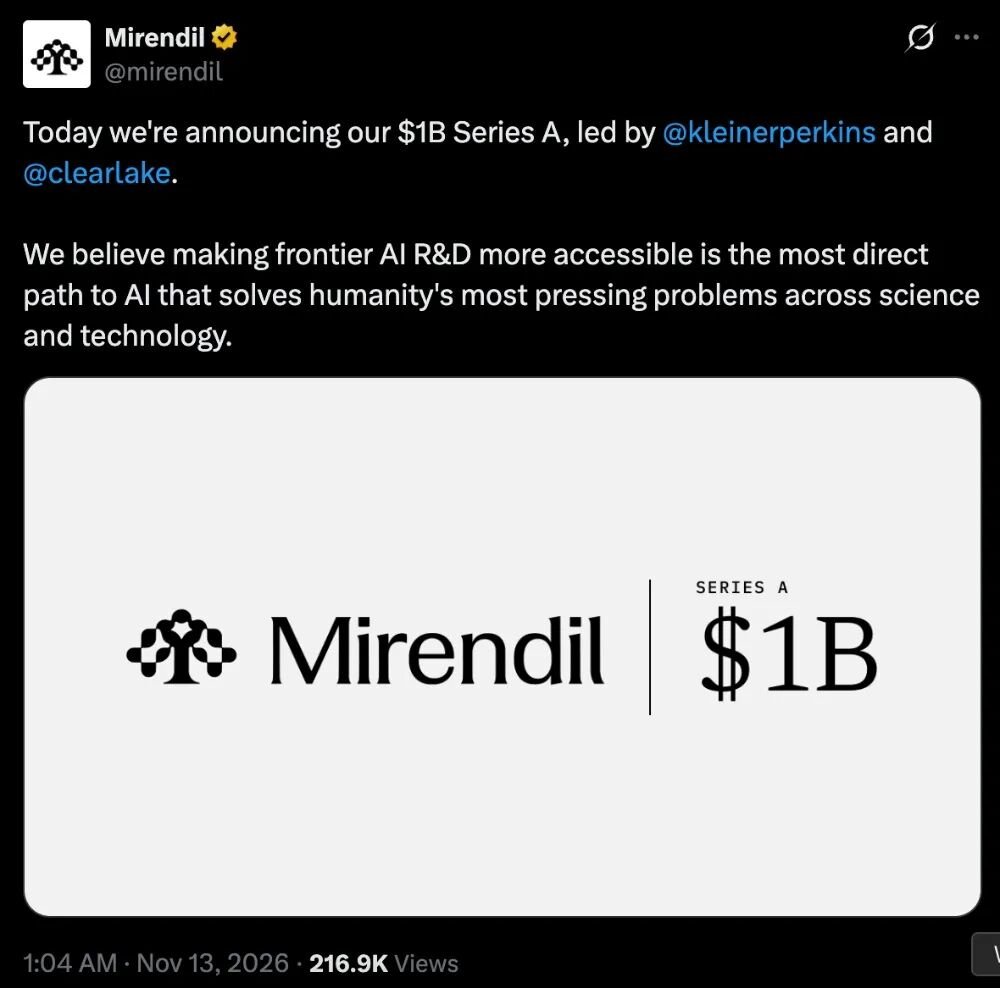
On 13 November, the San Francisco LLM unicorn Mirendil announced a US$1 billion Series A, about RMB 6.672 billion. No valuation was disclosed, though several outlets citing a16z internal information put it near US$5 billion. Kleiner Perkins and Clearlake Capital co-led the round, with Battery Ventures, Doerr Capital, Gil & Co, Google, M13, Pear VC and S32 participating. Together with a June round, Mirendil has raised US$1.2 billion, about RMB 8.006 billion.
Mirendil came out of stealth in June 2026, founded by former Anthropic researchers Behnam Neyshabur and Harsh Mehta, former xAI researcher Shayan Salehian and former OpenAI student researcher Tara Rezaei. In an earlier interview, Neyshabur described the product as a bit like AI for AI for science rather than AI for science: a tool that helps researchers build their own models.
The cost curve behind the claim
On 21 October 2026, Mirendil released its first foundation model, Mirendil-Base, with roughly 100 billion to 500 billion parameters. The company says one employee, working with agents, pretrained it from an empty repository in 3.5 months for less than US$10 million of total compute, a figure that includes experiments, agent token consumption and data processing. Agents wrote more than 99 per cent of the code, handling infrastructure, algorithm selection, data collection and iteration, while the human set direction and judged results.
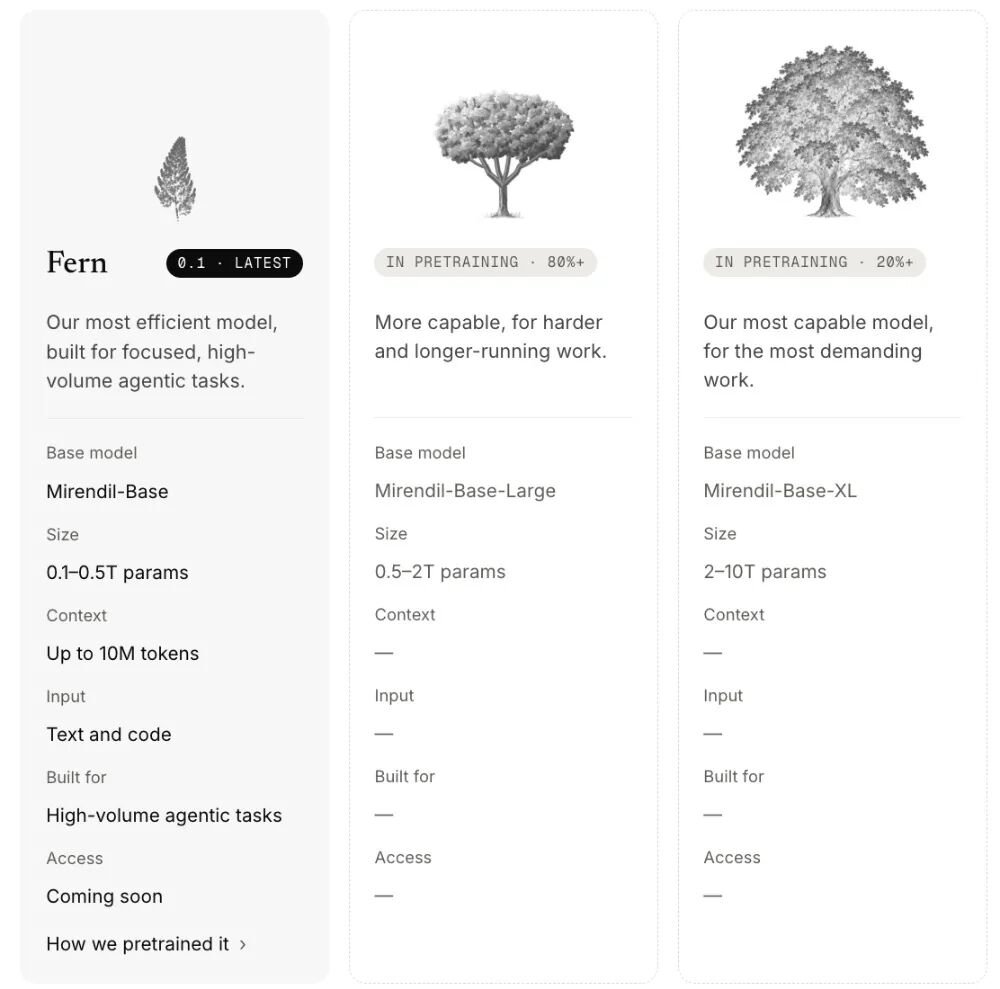
Fern 0.1 followed from post-training on Mirendil-Base, at roughly 0.1 trillion to 0.5 trillion parameters with a context window of up to about 10 million tokens. It is aimed at high-volume work such as debugging training logs, analysing complete agent trajectories and auditing pretraining data, and is in early access. Larger versions are in progress: Mirendil-Base-Large at 500 billion to 2 trillion parameters is about 80 per cent complete, and Mirendil-Base-XL at 2 trillion to 10 trillion parameters about 20 per cent.
Lor, the platform doing the work
Lor, a multi-agent R&D platform, entered private beta on 28 October 2026, and Mirendil says its own daily research now runs entirely on it. The platform dispatches hundreds of agents to write code and run experiments, automatically requesting and releasing compute, and can keep working for days or weeks.
One published run had 102 agents build an environment from 100 PyTorch pull requests, averaging eight minutes each. In an overnight run, agents found a security flaw in LiteLLM and fixed it before morning. Agents are separated from the machines they use: they decide what to run, Lor sends each command to a device the user selected, and a device can be removed at any time.
Lor supports macOS, Linux and the web, with Windows, iOS and Android planned. It works with open models including Kimi and DeepSeek, frontier closed models including Claude, GPT, Gemini and Grok, and Mirendil’s own models.
Compute, capital and the team
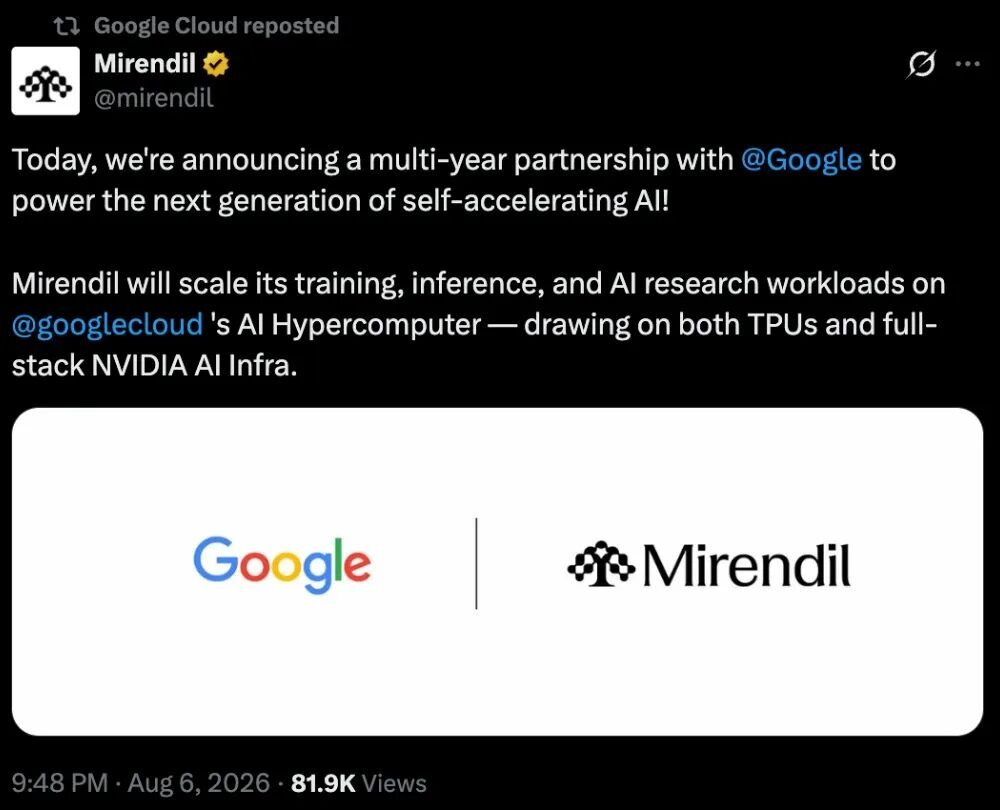
On 25 June 2026, Mirendil announced a US$200 million seed round led by a16z and Kleiner Perkins with NVIDIA among the followers, at a valuation the Wall Street Journal put at US$1 billion. In August it signed a multi-year strategic agreement with Google Cloud worth more than US$100 million, covering both Google TPU and NVIDIA GPU capacity to support large-scale pretraining and agent experiments.
Neyshabur studied at Sharif University of Technology, took a computer science doctorate at the Toyota Technological Institute at Chicago, and did postdoctoral work with Yann LeCun at New York University and the Institute for Advanced Study. From 2019 to 2024 he was a senior research scientist at Google DeepMind, co-leading the Blueshift team on foundation model reasoning that contributed to Minerva, early Gemini reasoning, Gemini 1.5 and Gemma 2. From late 2024 to December 2025 he co-led Anthropic’s Discovery team building AI scientists and engineers for long-horizon reasoning. He co-authored the ICLR 2021 Sharpness-Aware Minimization paper, and his work has more than 50,000 citations.
Harsh Mehta, chief technology officer, graduated from IIT Guwahati and spent close to a decade at Google Search and Google DeepMind on Gemini and on long-sequence modelling, state space models and learning rate schedules. At Anthropic from 2024 to December 2025 he led the first version of the internal autoresearch platform, the direct precursor to Mirendil’s approach. Shayan Salehian studied at Sharif and the University of California, Riverside, worked on timeline ranking and model serving at Twitter and X from 2018 to 2024, and joined xAI in October 2024 to work on Grok post-training, inference, memory, coding infrastructure and agents. Tara Rezaei, the youngest founder, won silver for Iran at the 2021 International Olympiad on Astronomy and Astrophysics, studied electrical engineering and computer science at MIT, and was an OpenAI student researcher working on interpretability and program synthesis.
Who gets to train a model now
Frontier capability is concentrated in a handful of labs with huge compute budgets, scarce talent and a closed experiment loop. Mirendil is betting agents can compress work that took dozens of people and months or years into one person, a few months and compute in the tens of millions of dollars. Specialised labs in drug discovery, materials science and robotics could then iterate near-frontier models without assembling a full pretraining team, which may be what capital is underwriting with two bets in six months.
The caveat is that Mirendil’s most striking results are still internal experiments. External user experience and a durable technical moat while frontier models iterate quickly are questions the founding team still has to answer.
Editor’s note: This is an adapted translation of the original 36Kr report. It has been trimmed and restructured for readability for an international business audience. The full original (in Chinese) is at https://m.36kr.com/p/4072499374380166.