AMD completed its acquisition of World Labs on 13 November, disclosing the closing in an amended Form 8-K filing three days later. The consideration was 14.978 million newly issued AMD common shares, valuing the target at about USD 8.2 billion, or RMB 54.6 billion. It is AMD’s second-largest acquisition on record, behind the 2022 purchase of Xilinx.
The numbers that drew attention were not the price but the headcount. World Labs employs roughly 70 people, was founded in 2024 and has almost no revenue. That works out to about USD 117 million per person, or RMB 782 million.
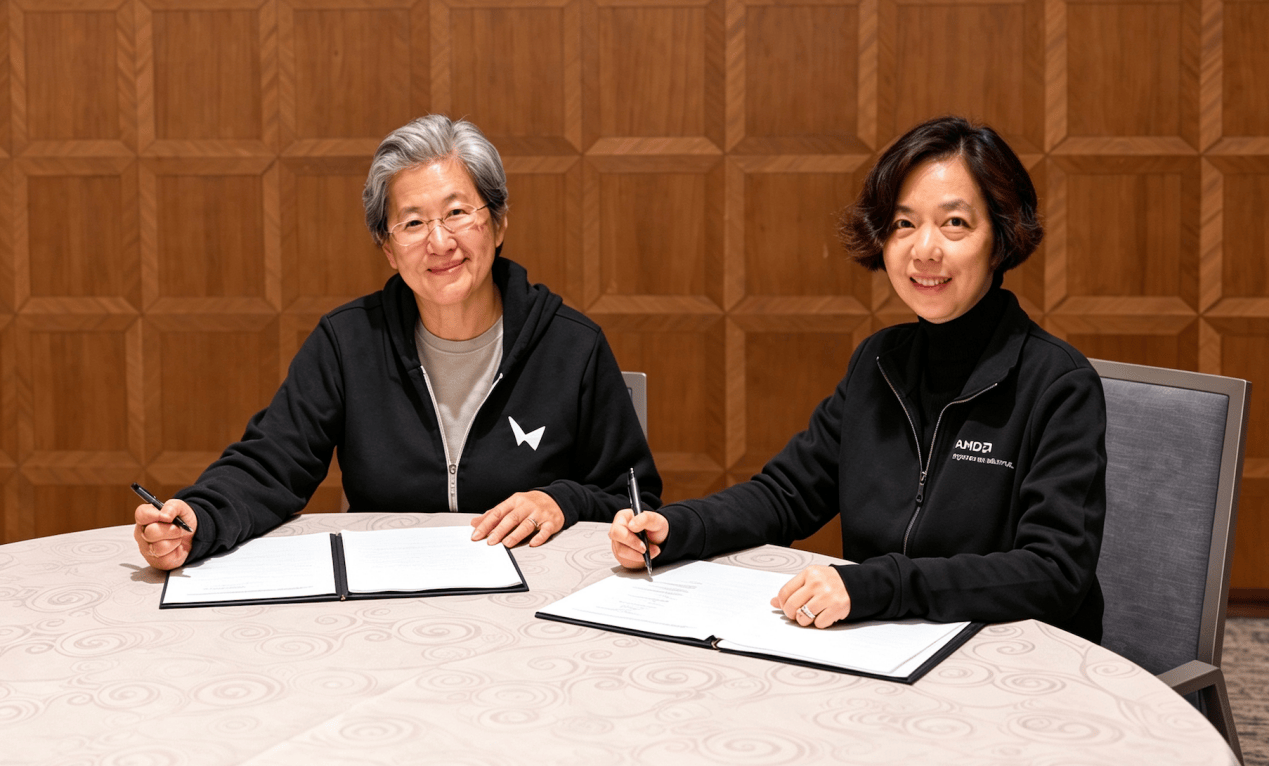
Fei-Fei Li becomes executive vice president and chief scientist of AMD, reporting directly to chief executive Lisa Su. Photographs released with the announcement showed Su visiting World Labs’ San Francisco headquarters, the two cutting a cake in front of staff.
What a nearly revenue-free lab is worth
World Labs was built around spatial intelligence rather than the crowded large-language-model field. Li argues that language alone cannot give AI a grounded understanding of the three-dimensional physical world, and that spatial intelligence is a prerequisite for reaching artificial general intelligence.
The company launched with USD 230 million at a USD 1 billion valuation. Its first product, Marble, generated explorable three-dimensional scenes from text and image inputs. In February 2026 it raised a further USD 1 billion, with AMD and Nvidia among the investors. In July it acquired robot-simulation company SceniX, closing the loop from real world to simulation and back.
Its September release, the Atlas world model, predicts new viewpoints from spatial context instead of the text context used in mainstream models. With a small number of reference images it can fill in space the camera never captured and turn a real scene into a simulation quickly.

The chip design argument
For Su, the acquisition buys a first-hand view of what next-generation AI workloads will demand from silicon. In the language-model era, chip designers could work from parameter counts and context lengths. Physical AI changes the requirements on memory, bandwidth and compute, and waiting for model companies to finish their algorithms before adapting chips leaves a chipmaker a step behind.
Former AMD executive and analyst Patrick Moorhead said the price was about people and their understanding of models rather than present earnings. He compared the deal with Nvidia’s recent USD 12.9 billion purchase of Hugging Face, which had annualised revenue of about USD 150 million.
The market reacted quietly. AMD closed at USD 504.28 on 16 November, down 5.58 per cent amid a wider semiconductor sell-off.
Four days before the closing, Su and Li appeared together at CoRL 2026. Su said physical AI, and robotics in particular, represents an opportunity measured in hundreds of billions of dollars over the coming years, and confirmed AMD already has a substantial internal robotics team, though its layout remains early.
Li drew a direct line between intelligence and compute. She also called the shortage of academic computing power a huge mistake, and said the industry’s biggest problem is a lack of patience. Neither is close to declaring AGI imminent.
Editor’s note: This is an adapted translation of the original Sohu Tech report. It has been trimmed and restructured for readability for an international business audience. The full original (in Chinese) is at https://www.sohu.com/a/1102777239_115565.