A professor complained about a paper he never wrote. The journal deleted it, then reposted the same text under a different author, and changed the author again two days later. Three names, one article, and the article was never the point.
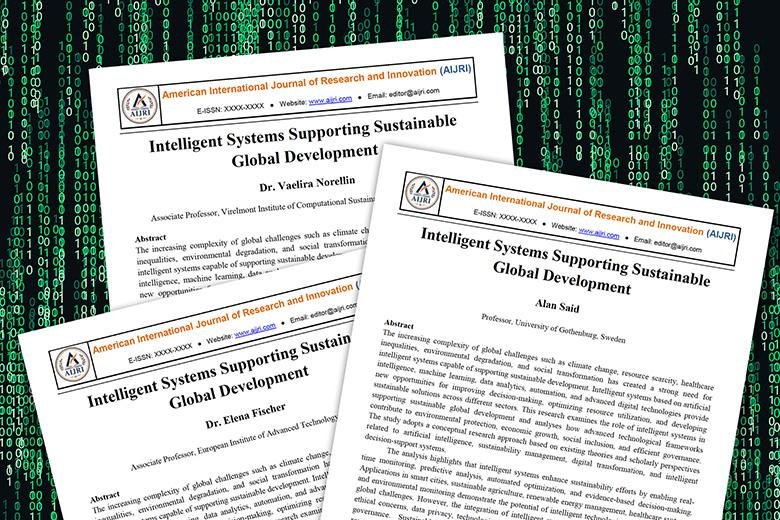
Alan Said, professor of computer science at the University of Gothenburg, received a Google Scholar alert that a new paper of his had appeared. Intelligence Systems Supporting Sustainable Global Development was published in the American International Journal of Research and Innovation, or AIJRI. The topic was close enough to his work on AI and sustainability, and the byline carried his name. He had not written it.
He told Times Higher Education that writing a paper in that area would not be surprising, but one look at the paper and its references made it obvious the text was AI-generated. There was no content, just slop.
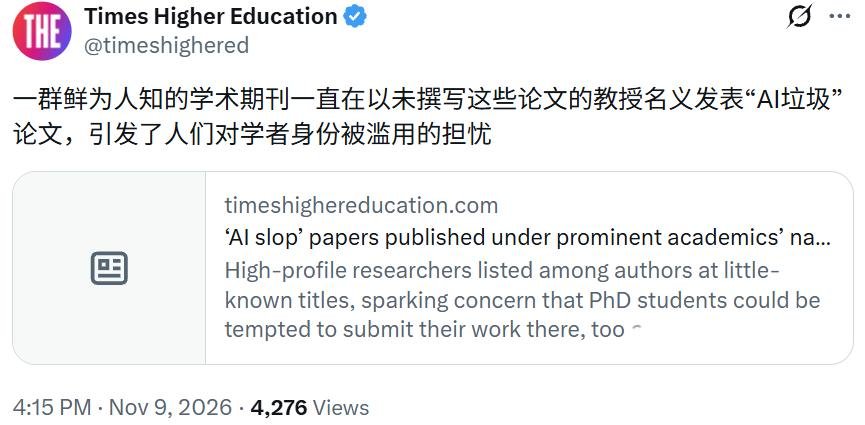
Following that paper, THE uncovered a wider operation: little-known journals publishing batches of AI-generated junk under the names of professors at Stanford, Berkeley and other top institutions. Among the borrowed names are Geoffrey Hinton, Yann LeCun, Yoshua Bengio, Fei-Fei Li, Christopher Manning, Michael I. Jordan, Andrew Ng and Stuart Russell. Some papers stack several of those names on a single title.
Delete the author, keep the paper
Said’s first move was to complain to the journal’s domain registrar, which replied that the article had been removed. It had not. The byline had simply been swapped to another person, and screenshots Said supplied to THE show it changing again two days later. The same text sat under three different names in sequence. For these journals the content is irrelevant and the name is the product, replaceable like a model photo on a shopping page.
Said then found two sister journals, the American Journal of Advanced Multidisciplinary Research and Innovation, or AJAMRI, and the American Journal For Multidisciplinary Research, or AJFMR. The three sites share a visual style, the same editor-in-chief and the same editorial board. AJAMRI alone had published dozens of papers attributed to well-known scholars, including Fei-Fei Li and Christopher Manning of Stanford and Michael I. Jordan and Stuart Russell of Berkeley.
Stanford computer science professor Jure Leskovec, also listed, told THE he could confirm that he did not write the paper, did not submit it, did not authorise use of his name and had not known the paper existed before the enquiry. He called it rather worrying.
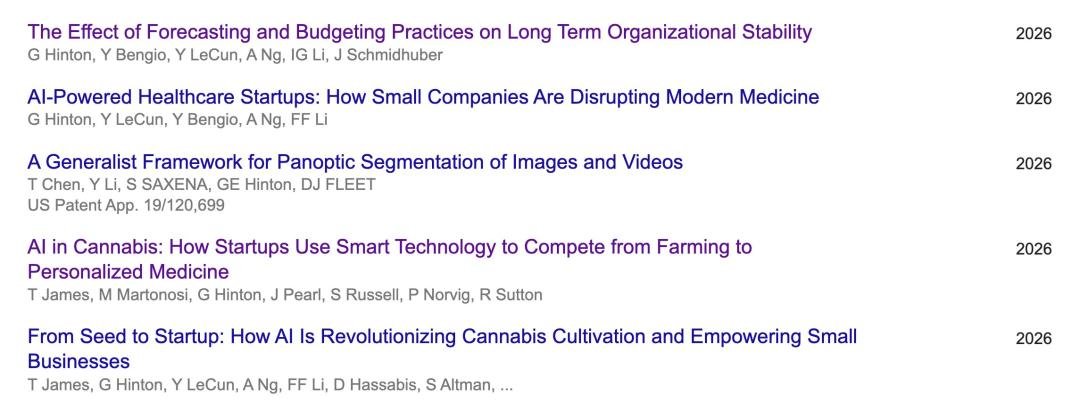
Domains registered in 2026 with back issues years old
All three domains were registered in 2026, yet the sites display archives of papers published years earlier. Each describes itself as peer-reviewed, open access and multidisciplinary, and each publishes a price list. AIJRI and AJAMRI charge US$200 for papers with five or more non-Indian authors. AJFMR charges US$80 for one to four authors and only US$10 for five or more.
All three name the same editor-in-chief, Denish Brown, with a US-number WhatsApp contact. The editorial board lists dozens of members, mostly from Indian universities. Kanakaraju Manupati, a postdoctoral researcher at Virginia Commonwealth University, told THE he did not know the journal existed, had no association with it and was surprised to find his name on the board. THE contacted all three journals and had no reply at the time of publication.
A worse scam than the old predatory journal
After the story ran, Christopher Manning responded on X. He had already seen two fake papers bearing his name, in the International Journal of Computer Vision and AI Applications, a title trading on the reputation of the long-established IJCV, and in the International Journal of Clinical and Medical Sciences, which would put an NLP researcher in a clinical medicine journal. Neither journal is among the three THE investigated, which suggests more than one group is doing this.
Manning wrote that predatory journals have always existed but this is a nastier scam, and that the crucial thing is to keep them out of indexes, appealing directly to Google Scholar. In the replies, one user complained that Google Scholar kept recommending obviously fake papers with lists of famous names attached and asked what the motive could be. Manning pointed to THE’s own account: listing famous scholars is meant to attract doctoral students to submit to these fee-charging journals. He added that it might actually work.
That is Said’s worry too. If a first-year doctoral student sees his name on that journal, the student may conclude it is a reasonable place to publish.
Traditional predatory journals sold fast publication and near-certain acceptance to authors under pressure to add lines to a CV. Their weakness was that they did not look like real journals. Generative AI closes that gap: formatted papers with complete citation lists and plausible argument can be produced in minutes, attached to top-tier names, and within weeks a dubious title can present a respectable back catalogue and an impressive author roster.
The precedent and the 2026 cluster
Diomidis Spinellis, professor of software engineering at the Athens University of Economics and Business, hit the same thing in December 2023. Global Business Strategies in the Digital Age appeared under his name and affiliation in the Global International Journal of Innovative Research, or GIJIR, complete with a valid DOI.
He did more than issue a denial. He crawled the whole GIJIR site, analysed it and published a case study in Research Integrity and Peer Review in 2025. Of the 53 least-cited articles, at least 48 looked AI-generated, with Turnitin assigning AI probabilities as high as 100 per cent on several. His conclusion was that such journals use borrowed-name AI papers to raise their standing and then attract authors who want to pad publication counts. A JMIR report this June described his three-way classification of GIJIR’s output: fake-authorship papers generated by the journal itself, purchased authorship papers paid for by authors, and a minority of genuine research.
Cases have clustered in 2026. In April, cardiologist Eric Topol found his name used by a digital health journal. In May, NBC News reported a network of fake journals that had published more than a hundred AI-generated papers, some also carrying the names of professors at leading universities.
Indexing is the real damage
If these papers sat on an unvisited website, the harm would be limited. Said found his only because Google Scholar indexed the paper onto his own profile and pushed an alert to him. Once an academic search engine indexes a paper, it appears on scholar profiles, in search results and eventually in other papers’ citations. Spinellis’s borrowed-name paper collected three citations within months.
For the AI industry there is a quieter risk. A large share of model training data is scraped academic literature. When AI-generated junk carrying real scholars’ names enters the indexes, it can flow back into the training corpus of the next generation of models, closing a loop in which AI generates, AI indexes and AI learns.
The problem is not technically unsolvable. Spinellis proposes stronger identity checks around DOI and ORCID, better AI-content detection and reform of research assessment that rewards publication counts. The JMIR report points to checklists such as Think.Check.Submit for verifying a journal’s ISSN, DOI and independent indexing before submission.
All of that runs into one asymmetry: generating a fake paper now costs almost nothing, while the entire cost of correcting one falls on the scholar whose name was taken. Said complained and the paper stayed up under a new author. Leskovec learned he had published a paper only when a journalist emailed. Manupati found himself on an editorial board he had never heard of.
If names like Fei-Fei Li and Christopher Manning can be borrowed at will, academic authorship has to be questioned as a credential in its own right. In an era when writing a paper is cheap, what academia needs to protect may no longer be only the truth of the content, but the truth of the name.
Editor’s note: This is an adapted translation of the original 36Kr report. It has been trimmed and restructured for readability for an international business audience. The full original (in Chinese) is at https://m.36kr.com/p/4071914037728135.