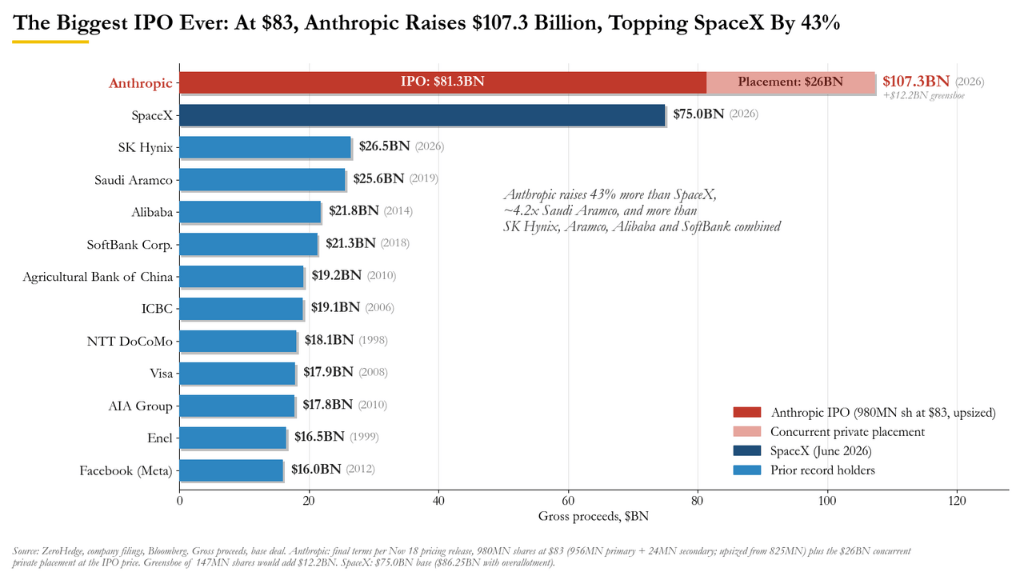
Anthropic has priced what is described as the largest initial public offering on record, setting its Class A shares at USD 83, about 6.4 per cent above the top of the announced range of USD 78. The company enlarged the deal from 825 million to 980 million shares, an increase of roughly 19 per cent. The stock is expected to start trading on Nasdaq on 19 November under the ticker ANT.
The headline numbers
The company and its founders together raised about USD 81.3 billion. Adding a USD 26 billion private placement from seven technology groups takes total proceeds beyond USD 107 billion, roughly 24 per cent above the SpaceX record set in June. Underwriters also hold a greenshoe option to buy up to a further 147 million shares within 30 days. If fully exercised, that adds around USD 12.2 billion and lifts the total to about USD 119.5 billion.
On a fully diluted basis the offering implies a valuation near USD 1.5 trillion. That figure counts 1.77 billion employee options at an average strike of USD 2.91, 1.07 billion unvested restricted stock units and 2.05 billion unissued shares. Based on priced float alone, ZeroHedge calculates a market capitalisation near USD 1.1 trillion, the number index providers will use. On the fully diluted measure, Anthropic would rank inside the top 15 listed companies globally, roughly level with Tesla and above Eli Lilly.
Demand and pricing
According to Bloomberg, order books at one point approached seven times the shares available, with institutional investors from Wall Street, London and Tokyo competing for allocation. Bankers told prospective buyers that existing shareholders would get priority, and some allocations came in below requests. Anthropic itself sold about 956 million shares while the seven co-founders sold roughly 23.65 million between them, about 3.38 million each. At USD 83 that is close to USD 280 million per founder and about USD 2 billion in total. Goldman Sachs and Morgan Stanley led the deal, with another 20 banks involved.
The pricing strategy was designed to let the shares rise the customary 20 per cent after listing and break through USD 100. If that does not happen, or the stock closes lower, investors should pay attention.
The circular money
The most striking structural feature is the source of the USD 26 billion placement. Seven companies bought the N-class stock: Google and NVIDIA at USD 10 billion each, joined by AMD, Broadcom, Micron, Microsoft and TSMC. Every one of them is also a chip or cloud supplier to Anthropic. That means much of the supposed investment can flow back as payment for computing bills. Because Google had already made a commitment, the genuinely new money may be closer to USD 16 billion, and after chip purchases could approach zero.
Nearly half of Anthropic’s revenue is sold through the cloud marketplaces of those same hyperscalers, which are also the main source of its receivables. Supplier, customer and shareholder overlap almost completely. That structure makes the headline fundraising number a poor proxy for actual outside confidence.
The financial reality
The revised prospectus shows third-quarter revenue up 47 per cent quarter on quarter to USD 16.96 billion, a sharp deceleration from 144 per cent growth in the second quarter. The company also posted an operating loss of USD 567 million, reversing its first-ever quarterly operating profit of USD 974 million, mainly because short-term compute procurement costs rose by about USD 5 billion. Pricing incentives and discounts cut roughly USD 600 million from revenue.
Operating leverage reversed within a single quarter. Total operating expenses climbed back to 103 per cent of revenue, and computing and infrastructure costs jumped from 48 to 58 per cent of revenue. Revenue generated per dollar of compute fell to USD 1.72 from a higher level in the prior quarter. The gap between the USD 1.1 trillion float valuation and the USD 1.5 trillion fully diluted figure matters more than the celebratory headlines suggest.
Editor’s note: This is an adapted translation of the original Sohu Tech report. It has been trimmed and restructured for readability for an international business audience. The full original (in Chinese) is at https://www.sohu.com/a/1103358878_130887.