Stephen Curry just pulled off the most strategically brilliant move of his career—and it didn’t happen on a basketball court.
On June 2, 2026, Curry announced a landmark 10-year partnership with Li-Ning, reportedly worth north of $400 million. But calling this a “shoe deal” misses the point entirely. This is an empire-building move that positions the Curry Brand to thrive long after the final buzzer of his NBA career.
Look closely at the architecture of this deal: Curry isn’t just thinking about retirement. He’s planning for reinvention.
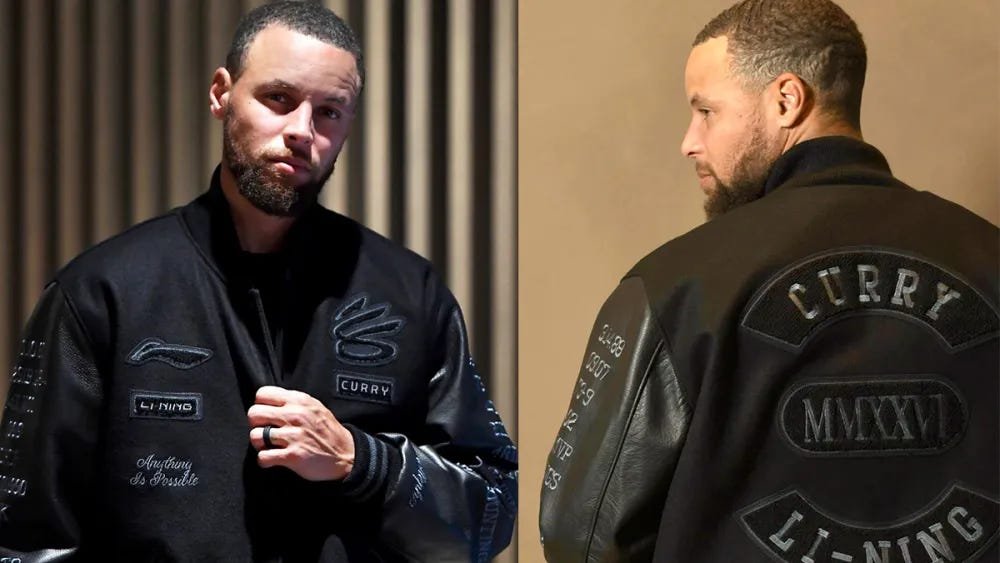
From Sneaker Free Agent to Global Brand Architect
Curry’s separation from Under Armour in November 2025 wasn’t just a business divorce—it was a liberation. Unlike most athletes who walk away from endorsement deals with nothing but cash, Curry walked away with something far more valuable: complete ownership of Curry Brand. That distinction changes everything.
Through his holding company Thirty Ink, Curry has quietly built a business portfolio that most athletes only dream of—Unanimous Media, Penny Jar Capital, Gentleman’s Cut bourbon, the Eat.Learn.Play. foundation, and the Underrated youth sports platform. In 2024 alone, Thirty Ink generated approximately $173.5 million in revenue with EBITDA nearing $144 million. This isn’t an athlete collecting checks. This is an entrepreneur building generational wealth.
The Li-Ning partnership gives Curry what he couldn’t build alone: global manufacturing infrastructure, access to 7,600+ retail points across Asia, and deep expertise in the world’s most complex e-commerce market. But here’s the critical part—Curry didn’t become Li-Ning’s employee. He chose a partner. He retains control. He can even sign other athletes under his own brand, something no other active NBA player except Michael Jordan has achieved.
The Golf Angle: Where This Gets Really Interesting
If you think this deal is about basketball shoes, look closer at the fine print. The partnership explicitly includes a full golf line—alongside basketball, athleisure, and lifestyle categories.
This isn’t a casual add-on. This is a strategic bet on Curry’s post-basketball identity.
Curry isn’t just a celebrity who plays golf on weekends. He’s a +0.1 to +2 handicap golfer who has competed in the Korn Ferry Tour (the PGA Tour’s developmental circuit), posted rounds of 71 and 74 against professionals, and won the 2023 American Century Championship with an eagle on the 18th hole. He has played rounds with Barack Obama and Bryson DeChambeau. Through his Underrated Golf initiative, he’s creating pathways for underrepresented young golfers—and earning recognition like the Charlie Sifford Award for advancing diversity in the sport.
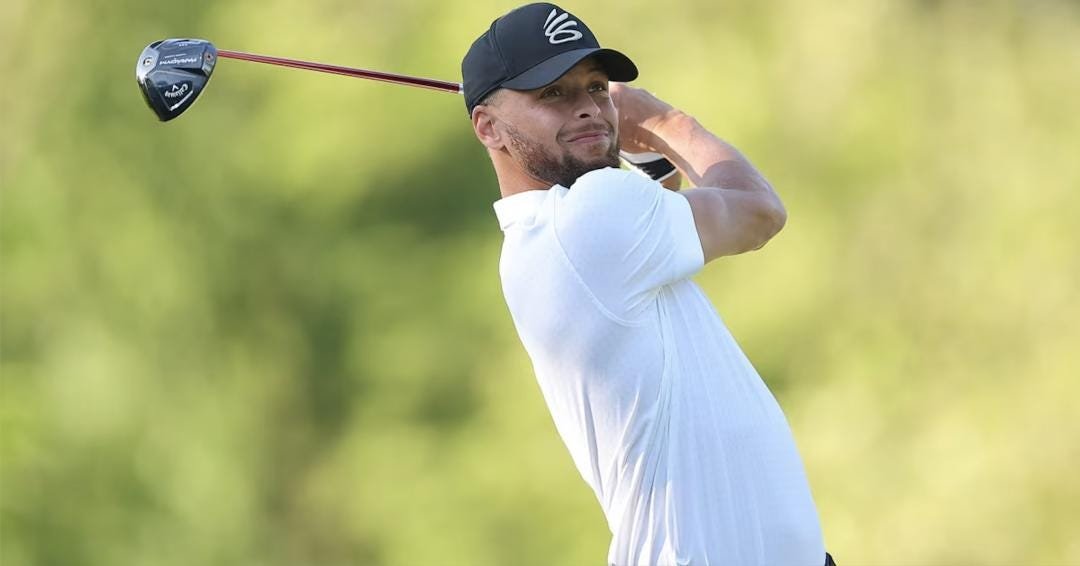
Is Stephen Curry going to join the PGA Tour? Probably not. But could he become the most visible golfer on the planet who happens to have once been a basketball player? Absolutely.
And here’s where the generational insight becomes powerful. The kids who grew up watching Curry drain threes in Oracle Arena? They’re in their early 30s now. They’re entering their peak earning years. And like millions of professionals across China and the world, their sporting interests are migrating from the hardwood to the fairway. Golf is the sport of career advancement, of business deals, of weekend discipline—and Curry is already there, waiting for them with a club in hand and a brand on his chest.
When Curry’s basketball career ends, his golf journey will just be hitting its stride. And the Curry Brand, powered by Li-Ning, will be right there with him—growing alongside his fans’ evolving passions rather than fighting to stay relevant.
The Mr. Li Ning Factor: Why This Partnership Is Different
Curry said something in his announcement letter that caught my attention. He described Li Ning’s founder as “an Olympic Gold medalist athlete, a forward-thinking businessman, and a visionary that I really respect and believe in.” He noted that it’s “amazing to see how he’s grown his namesake company as an athlete founder, knowing I have those same hopes and aspirations for Curry Brand.”
This athlete-to-athlete resonance isn’t marketing fluff. It’s the foundation of a genuine partnership.
Mr. Li Ning’s story is one that Curry clearly sees himself in. The “Prince of Gymnastics” won 14 world championships and 106 gold medals before a difficult 1988 Seoul Olympics marked his competitive farewell. After retirement, like so many elite athletes, he faced that terrifying void—loss of identity, uncertain direction, the painful transition from celebrated competitor to forgotten hero. At the Beijing airport returning from Seoul, he avoided the media and walked alone through a back corridor. The only person waiting for him with flowers was Li Jingwei.
Their bond ran deeper than business from the very start. In December 1988, at Li Ning’s official retirement ceremony, Li Jingwei offered Li Ning a role as Special Assistant to the General Manager at Jianlibao. But more importantly, he offered him a path to build something of his own. In 1990, with Jianlibao’s full backing, Li Ning founded a sportswear company—a wholly-owned subsidiary of Jianlibao, with the state-owned enterprise investing 16 million RMB, and the “Li-Ning” brand was born under Jianlibao’s wing.
Li Ning’s business instincts proved extraordinary. His first masterstroke—securing the 1990 Asian Games torch relay sponsorship—generated exposure to 250 million viewers and established the brand overnight. Sales grew 100% year over year. Jianlibao’s investment had paid off handsomely.
But by 1994, a mature Li Ning faced a dilemma that would define his legacy. He wanted to restructure the company into a modern shareholding enterprise and take it public.
And here is where the character of Li Jingwei reveals itself most clearly: he fully supported Li Ning’s independence. No obstruction. No bitterness. No exploitation of his position as the man who gave Li Ning his start. He let his “son” walk free.
The separation was clean and dignified. Li Ning paid back Jianlibao’s 16 million RMB investment in three cash installments. In September 1994, Li Ning Sports Industry Company was formally established as an independent entity. By 1996, headquarters moved to Beijing. The rest is history: a 2004 Hong Kong IPO, a market cap that would reach billions, and China’s homegrown answer to Nike and Adidas.
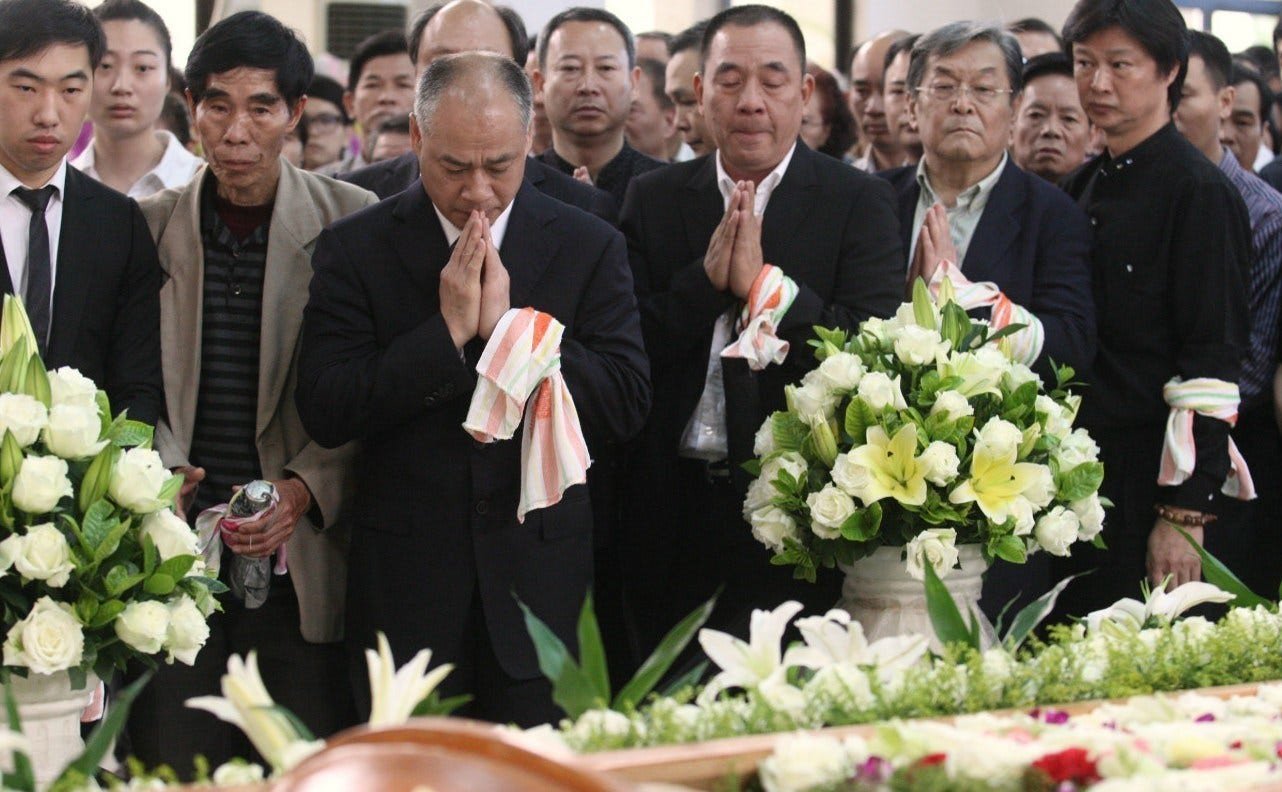
The depth of their bond transcended every commercial transaction. It is perhaps best captured in a single, profoundly moving detail: at Li Jingwei’s funeral, it was Li Ning who walked ahead of the coffin, holding the portrait of his mentor—a role reserved for the eldest son in Chinese burial traditions. That Li Ning stood in that place, fulfilling the filial duty of a firstborn son for the man who once believed in him when the world had moved on, tells you everything about what this relationship truly meant. It was never merely business. It was mentorship, gratitude, and family in the truest sense.
When Li Ning looks at Curry today, he doesn’t see a marketing asset to be exploited. He sees a younger version of himself: an athlete with decades of productive life ahead, determined to build something that outlasts his playing days. And he knows, better than anyone, what a difference it makes when someone with power chooses to see you not as a has-been, but as a founder-in-waiting.
Respect vs. Endorsement
That kind of respect, I would argue, is something Curry has never truly felt from other footwear brands.
Consider Nike’s catastrophic 2013 pitch to retain Curry: executives repeatedly called him “Stephon” instead of “Stephen,” a PowerPoint presentation mistakenly featured Kevin Durant’s name where Curry’s should have been, and the company offered roughly half of what Under Armour eventually paid. The message was unmistakable—we don’t see you as a priority.
Even Under Armour, for all their success together, ultimately couldn’t provide the structural partnership Curry needed to scale globally. And Anta, despite signing Curry’s teammate Klay Thompson to a lifetime deal, offers a traditional endorsement model—Thompson gets a signature line and product input, but not a platform to build his own brand empire.
The Li-Ning deal is categorically different. Curry isn’t a paid endorser. He’s a business partner with a decade-long commitment, shared global retail ambitions, and the freedom to define what Curry Brand becomes across basketball, golf, and lifestyle. The deal includes plans for dedicated Curry Brand stores in both China and the United States—physical evidence that this is about building something permanent, not just selling product.
The China Connection
None of this works without the China dimension—and Curry has spent years laying that foundation.
A 2022 study by Mailman ranked Curry the most popular NBA player on Weibo, China’s dominant social platform. His top two posts that season generated 248,000 engagements—exceeding the entire season-long engagement of the second-most popular player. During his 2024 China brand tour, fans lined up outside his hotel in massive crowds, chanting “MVP” and greeting him with elaborate drone shows recreating his signature “night night” celebration.
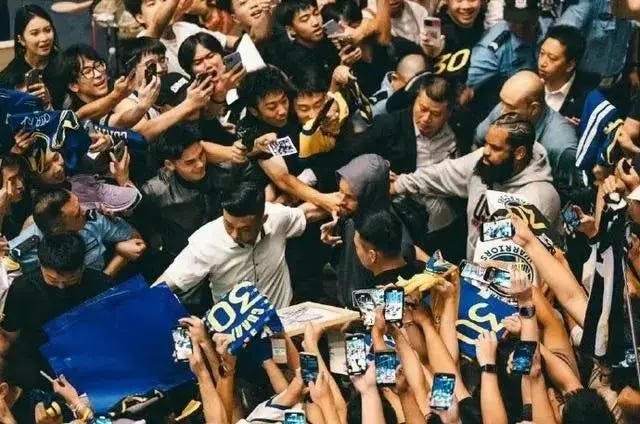
For Li-Ning, landing an active, generational American superstar represents a watershed moment in their decades-long global ambitions. For Curry, the partnership provides instant access to the world’s largest sportswear market through a brand that understands local culture, distribution, and digital commerce in ways Western companies struggle to replicate.
Livestream selling on Douyin and Taobao Live can move enormous footwear volumes in single sessions. Li-Ning is already fluent in this format. A globally recognized athlete fronting those streams is a conversion engine that Adidas and Nike are still scrambling to figure out.
The Long Game
When we evaluate this deal in five or ten years, I suspect we’ll see it as the moment Stephen Curry stopped being thought of as a basketball player who built a brand, and started being recognized as a brand architect who used to play basketball.
The $400 million headline is impressive. But the structure matters more than the number. Ownership. Control. A partner who sees him as a founder-in-training rather than a billboard. Explicit provisions for golf expansion as his competitive focus shifts. The right to sign the next generation of athletes under his own banner.
Most athletes see their commercial value peak during their playing careers and decline steadily after retirement. Curry is building the rare exception—a brand that will evolve with him, serving the same fans as they grow older, earn more, and trade their basketball jerseys for golf polos.
Mr. Li Ning understood this journey because he lived it. He knew the pain of walking away from the only world you’ve ever excelled in, the debt you owe the person who sees something in you when the rest of the world has stopped looking. He learned that the greatest gift one generation of athletes can give the next is not money, but belief.
That a man once held his mentor’s portrait as a son would—walking ahead of a coffin in the ancient role of the firstborn—that man now sees in Stephen Curry not an endorser to be managed, but a partner to be empowered.
And that’s why this is so much more than a shoe deal.
#CurryBrand #LiNing #SportsBusiness #AthleteFounder #Golf #BrandStrategy
Published simultaneously on The Robot Belt and Substack.