Part II of How Stellantis Rewrites the Transatlantic EV Playbook
In Part I, we mapped the Wuhan-Paris axis — a dual arbitrage allowing Stellantis to shore up its European defences using Chinese engineering. That was the dress rehearsal. The ultimate prize lies across the Atlantic, where Detroit continues to slumber inside its tariff-protected greenhouse.
Stellantis will not roll Wuhan-built Jeeps off a carrier in Toledo. That is not how the US trade regime works. It is airtight, and it has three locks.
The First Lock: The Tariff Wall
US Customs evaluates the geographic footprint of assembly lines, not corporate branding. Any vehicle stamped “Made by a Foreign Entity of Concern” (FEOC) faces exclusionary 100% tariffs and disqualification from the $7,500 IRA tax credit.
No exceptions. No workarounds.
The Second Lock: The National Security Wall
Proposed congressional frameworks and pending regulatory bans on Chinese software in connected vehicles signal a clear Washington consensus: a bipartisan intent to explicitly bar Chinese-developed smart cockpit software, Advanced Driver-Assistance Systems (ADAS) algorithms, and hardware tied to Chinese entities.
Not a single line of Chinese code can cross the Rio Grande.
The Third Lock: The Crimson Wall
The political toxicity of selling state-linked Chinese EV architecture in the American Midwest is not something tariffs can measure. It is measured in UAW boycotts and 30-state conservative media campaigns. Imagine a future Super Bowl ad: “Jeep. Born in the tech corridors of Wuhan.” The network airing it would face boycotts before the commercial even finished.
The Two-Step Laundry
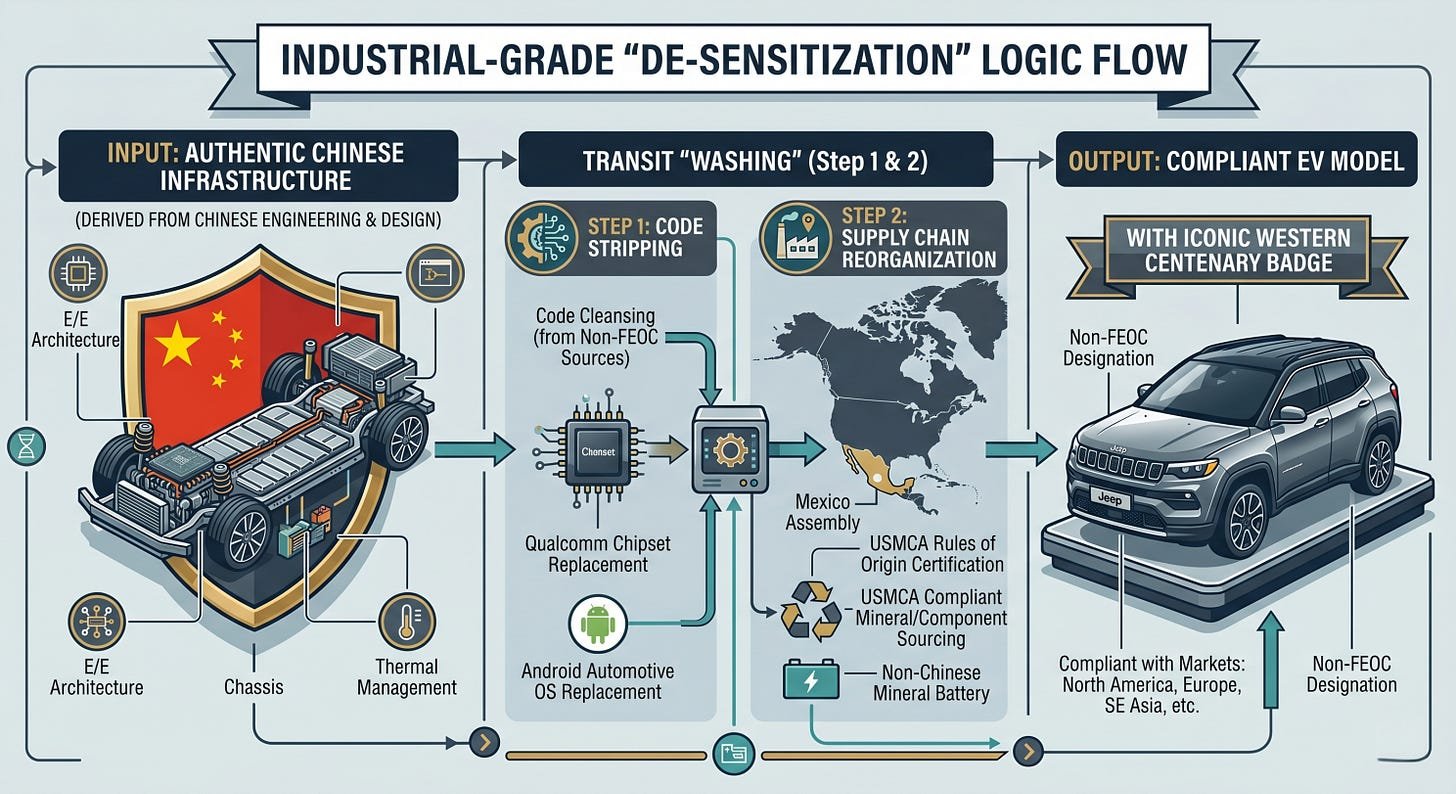
Consequently, to eventually leverage Chinese engineering efficiency within the North American trade zone, a manufacturer must perform an intricate industrial-level laundering rather than a corporate one. The process requires keeping the technology firmly anchored within China’s sovereign safety zone while preparing to move the physical vehicle architecture through Western manufacturing outposts like Mexico.
The hypothetical supply-chain surgery has two distinct, gruelling steps:
Step One: Scrubbing the Codebase
To satisfy pending national security mandates, a complete digital overhaul is required. Not a single line of Chinese smart cockpit or ADAS code can cross the Rio Grande. The entire digital brain must be expunged and replaced with a clean, Western-hosted codebase powered by Qualcomm chipsets and Android Automotive architectures — a software reconstruction requiring an estimated 18 to 24 months.
Step Two: Swapping the Supply Chain
The recipe is Chinese; the ingredients are strictly Western. While the physical chassis, cell-to-pack architecture, and thermal management designs remain intact, the actual components must comply with strict USMCA rules of origin. This means sourcing battery cells from South Korean or North American suppliers utilising entirely non-Chinese-mined lithium, cobalt, and nickel.
This is the geopolitical compliance premium. A global OEM must use Chinese industrial scale to keep its European operations alive, while its American business must appear more innocent than anyone else.
The Greenhouse Paradox
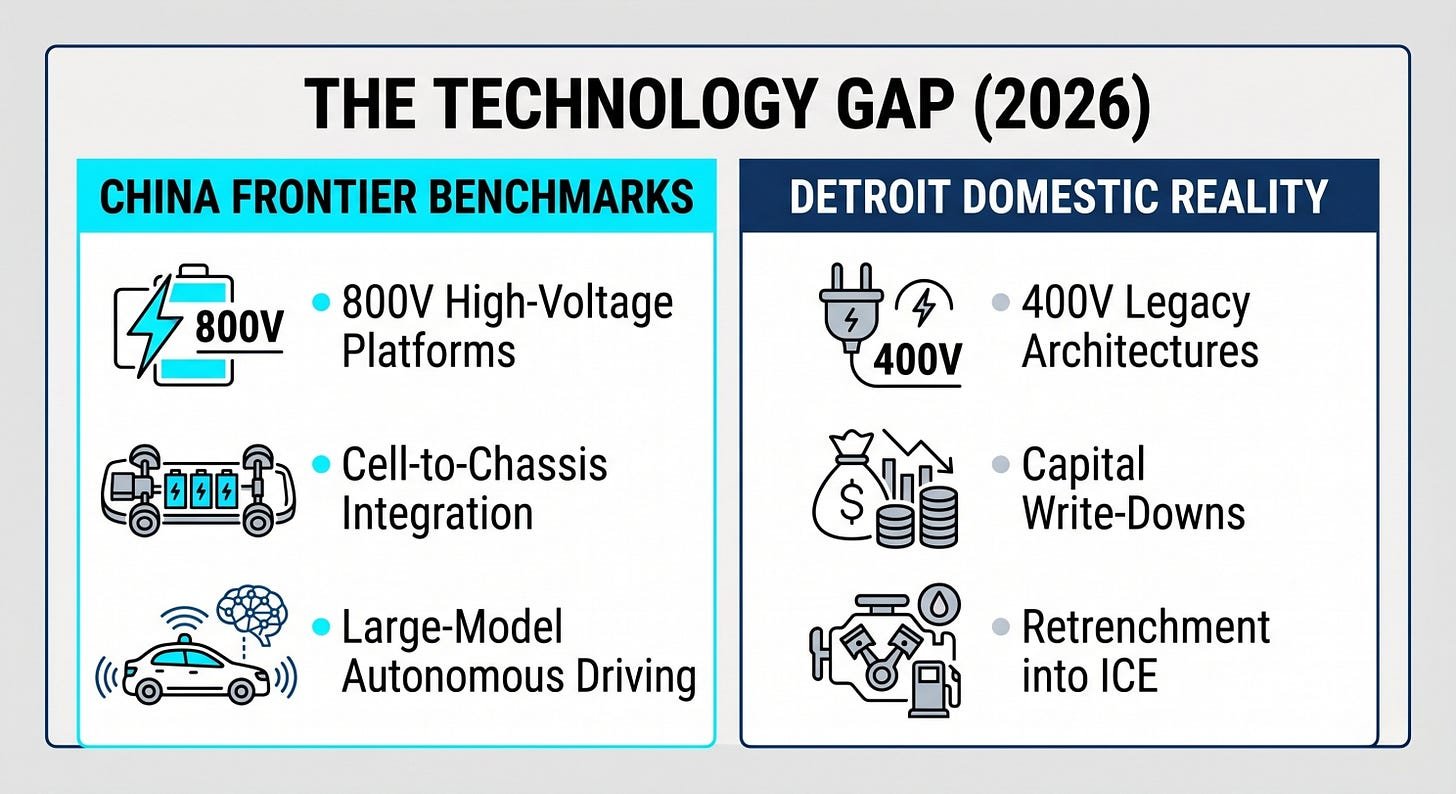
The strategic math behind this multi-year play relies on a cold industrial logic played at the absolute limits of regulatory boundaries and temporal generation gaps. Protectionism has backfired. By isolating the domestic market from direct exposure to China’s frontier innovations — such as 800V architectures, cell-to-chassis integration, and large-model autonomous driving — the US tariff wall is not actually protecting the Big Three; it’s anaesthetising them.
While Detroit’s legacy manufacturers scale back EV programmes and write down heavy electrification losses to retreat into profitable internal combustion trucks and traditional hybrids, their native architectures have stalled. Detroit Three production EVs still largely run on 400V platforms with energy density equivalent to China’s 2021–2022 level. They have effectively exited the self-driving arms race.
The technology gap in 2026 highlights this widening discrepancy. On one side stands China’s frontier benchmarks: 800V high-voltage platforms, cell-to-chassis integration, and large-model autonomous driving. On the other sits Detroit’s domestic reality: 400V legacy architectures, capital write-downs, and a protective retrenchment into traditional combustion engines.
The Arbitrage Math
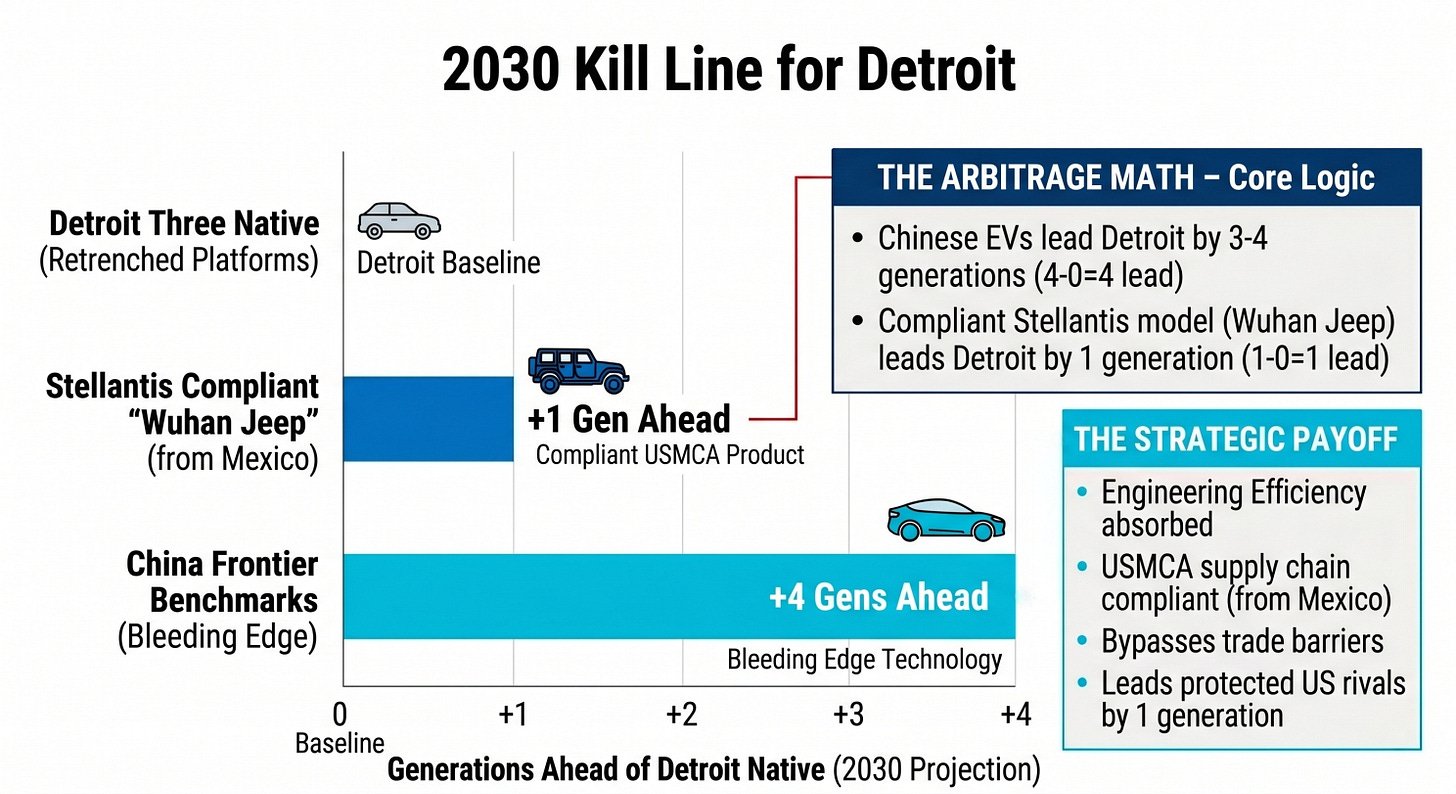
A global player utilising this arbitrage model doesn’t need to beat the absolute frontier of the Chinese domestic market. It only needs to ensure its immediate domestic rivals remain structurally obsolete. In a greenhouse, the plant that visited the jungle — even two seasons ago — still outgrows the plants that never left.
Moving the recipe away from the unencumbered supply chains of central China incurs a significant penalty. Wuhan’s 24-hour ecosystem allows for iterative manufacturing efficiencies that take three to five years to replicate in North America. By then, China will have iterated its technology another three generations. You can copy the blueprint; you cannot easily duplicate the kitchen.
But under a calculated industrial logic, being three generations behind the bleeding edge of Wuhan is entirely irrelevant, provided that the technology acquired keeps a legacy OEM exactly one generation ahead of Detroit. You only need a recipe that is one page newer than Ford’s.
The 2030 Kill Switch
This forward-looking timeline is driven by the cold arithmetic of time, tariffs, and technological absorption. While the current phase sees global players utilising Chinese platforms to anchor their defences in Europe, the years leading up to 2029 will be dedicated to stripping away geopolitical liabilities before they can cross the Rio Grande.
By 2030, when US EV demand experiences its projected second growth wave, Ford and GM may discover they have rested too long in the tariff-protected greenhouse. They will lack a competitive native EV architecture. Waiting for them will be a massive, union-friendly, and dealer-rich Western middle-class demographic — essentially a deep reservoir of “Anyone but Musk” buyers.
The strategist who waits will wrap this imported engineering in a Western corporate shell. These vehicles arrive seasoned across the hyper-competitive markets of the Global South. Once scrubbed clean of their sovereign vulnerabilities through localised North American assembly, they would capture that market by default.
A legislative fortress designed to achieve total technological insulation risks becoming the exact mechanism that guarantees domestic irrelevance. In the end, the new EV order in North America will be determined not by who built the best car, but by who managed the supply chain most quietly. When that engineering finally reaches the American heartland, it will be wearing an iconic Western badge, assembled in Mexico, and sold by a dealer the Midwest trusts.
The winners will be the best smugglers.
2030 is the kill line. Who pulls the trigger?
Published simultaneously on The Robot Belt and Substack.