The more capable a model becomes, the louder the calls to slow down. On 22 November, OpenAI chief scientist Jakub Pachocki published an essay titled Perplexity and Intelligence, releasing internal pretraining data the company has tracked for years and proposing a common industry standard.
Pachocki wants frontier model companies to measure capability with a shared metric and to hold off crossing agreed capability thresholds until safety monitoring is good enough. The proposal has the backing of OpenAI CEO Sam Altman.
What perplexity measures
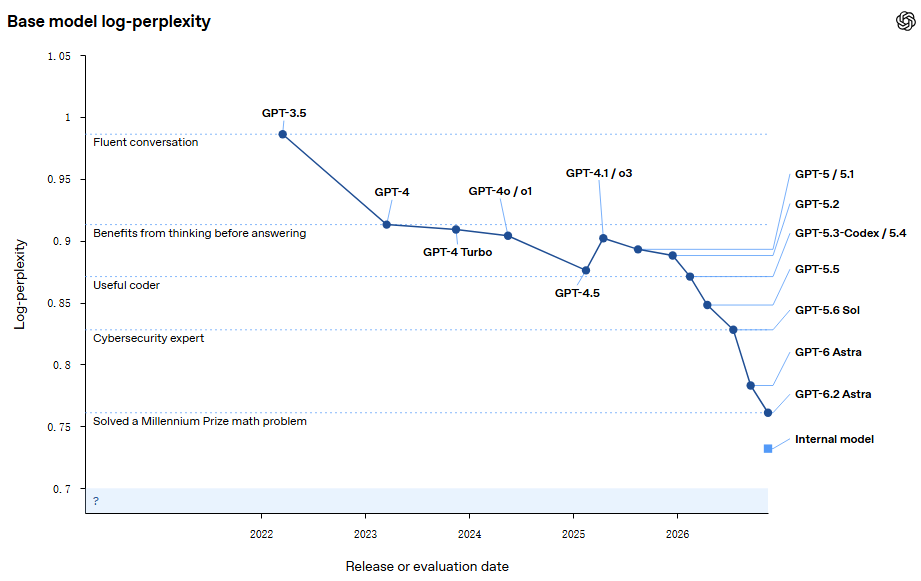
The core of the essay is perplexity. Pachocki describes a model’s mechanism for predicting tokens as training a compressor. The model extracts patterns from data and predicts what comes next using less information. Perplexity measures that predictive ability. The more accurately a model predicts, the lower the perplexity. OpenAI publishes log perplexity, also called cross-entropy loss, where lower is also better.
On the internal data Pachocki released, GPT-3.5 had a log perplexity of about 0.99 and GPT-4 about 0.91. The former could already sustain fluent conversation. The latter began to use chain-of-thought reasoning effectively. At the latest GPT-6 stage, the metric has dropped below 0.8.
Pachocki says models began showing new abilities in maths and cybersecurity. One change happened when log perplexity reached about 0.76. At that point researchers found models solving a run of challenging maths problems. Researchers had seen models on Slack solve problems they had thought about for years. These were not cases of training on a particular question. They emerged from an improvement in underlying capability.
That is why he cares about the metric. It does not map directly to whether a model can complete a task. It reflects what has changed in the model’s ability to learn from training data. What the industry has long called emergent intelligence can be read as the evolution brought by continuously falling perplexity.
Model training methods were once proposed by human researchers and validated through large experiments. Once AI joins research, that changes. A model may not only execute assigned tasks but help find new algorithms, propose experimental designs and even contribute to the training method itself. Pachocki expects foundational advances in pretraining from AI as early as 2027. He says OpenAI has already observed a marked acceleration in pretraining loss reduction this year, while noting that most of it still comes from long-term research and compute investment, with AI automation a small part so far.
He also expects that as log perplexity falls further to between 0.68 and 0.70, models may show abilities not yet foreseeable.
A common standard, with real limits
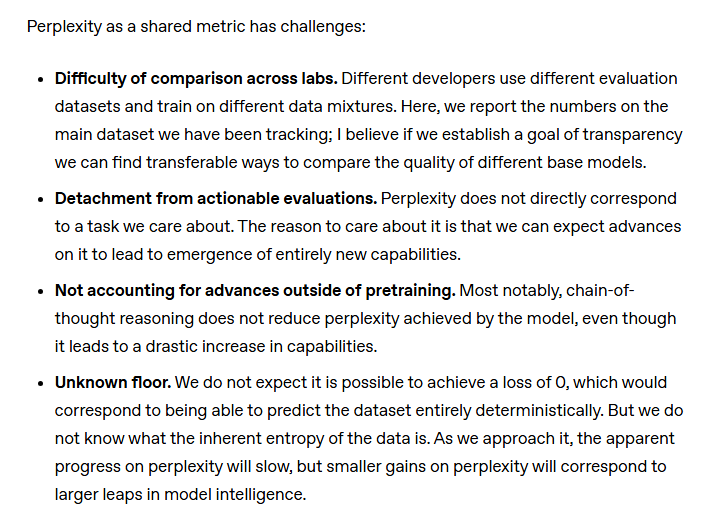
Using perplexity as a common standard does not resolve the question. Pachocki concedes the metric has limits. Companies use different training data, data mixes and evaluation sets, so perplexity cannot be compared directly across them. It also does not measure performance on specific tasks. Better prediction does not mean a model improves across every maths, coding and safety test. Post-training techniques such as chain-of-thought reasoning change capability without necessarily showing up in pretraining perplexity.
There is also a theoretical floor. As models approach the information entropy contained in their training data, loss reduction may slow. That does not mean capability gains stop. Even a small change in the metric can correspond to a new capability breakthrough.
Pachocki therefore does not argue for judging safety on perplexity alone. He wants it combined with other measures into a common standard, and OpenAI is willing to publish more pretraining progress to move that work forward. Frontier labs should share the transparency information needed, assess capability together and cooperate on red-teaming and safety standards.
Altman backed him quickly, calling it the most important thing released recently. OpenAI is raising transparency on pretraining progress and hopes to reach agreement with other companies as partners on common limits. In his view that helps keep AI safe and controllable while pushing the industry toward shared rules.
Altman also endorsed the perplexity limit. He wants labs to build common constraints around perplexity and other measures, and to stay below pre-set capability thresholds until researchers can genuinely understand and monitor AI behaviour. His example is the next generation of chain-of-thought monitors. The industry should agree on a first capability limit, then define the safety work required before crossing it.
OpenAI or ClosedAI
Altman’s support did not quiet the doubts. The first question was about OpenAI’s motive in pushing for industry limits. Some observers asked whether the emphasis on safety standards at this moment also buys time for a model that is behind competitors. Others read it as the excuse used when a release fails to match a rival.
Critics also targeted Altman’s repeated use of transparency. If OpenAI truly wanted transparency, one comment ran, it would open-source its models instead of ignoring user requests for model continuity. Others suggested renaming the company ClosedAI, arguing its current level of openness no longer earns the name.
None of that changes the underlying tension. A shared metric could be useful. A shared metric published by one lab, however, arrives with an argument about who gets to define the threshold. The transparency debate will be settled less by the number than by who is allowed to check it.
Editor’s note: This is an adapted translation of the original 36Kr report. It has been trimmed and restructured for readability for an international business audience. The full original (in Chinese) is at https://36kr.com/p/4081724296926338.
The author’s views are their own and do not necessarily reflect the publisher’s position or constitute investment advice.