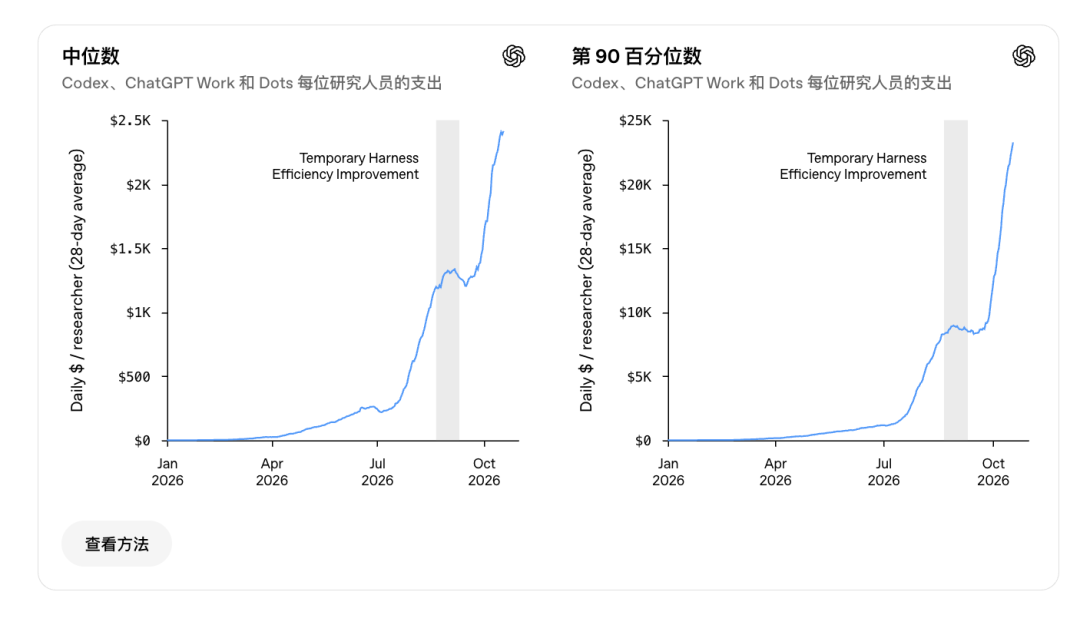
How deeply do OpenAI’s researchers use AI? The median researcher’s daily agent calls, converted at API list prices, come to USD 2,400. The heaviest 10 per cent reach USD 23,000 in a single day, about RMB 160,000. These researchers are not stingy with tokens.

OpenAI published its latest internal agent research report, Research Acceleration: The Jagged Frontier, laying out in detail how its own researchers use AI. The short version is this. Internal agents can now independently complete roughly 46 per cent of research tasks that used to take a human two to four hours. In March that figure was 23 per cent. In seven months it doubled. For work that used to take four to eight hours, autonomous completion rose from 13 per cent to 35 per cent.
The researchers themselves cannot do without it. OpenAI surveyed 101 researchers and asked what they would give up to keep access to frontier agents for the next three months. Respondents were generally willing to trade 40 per cent of their team’s headcount, or 30 per cent of computing resources.
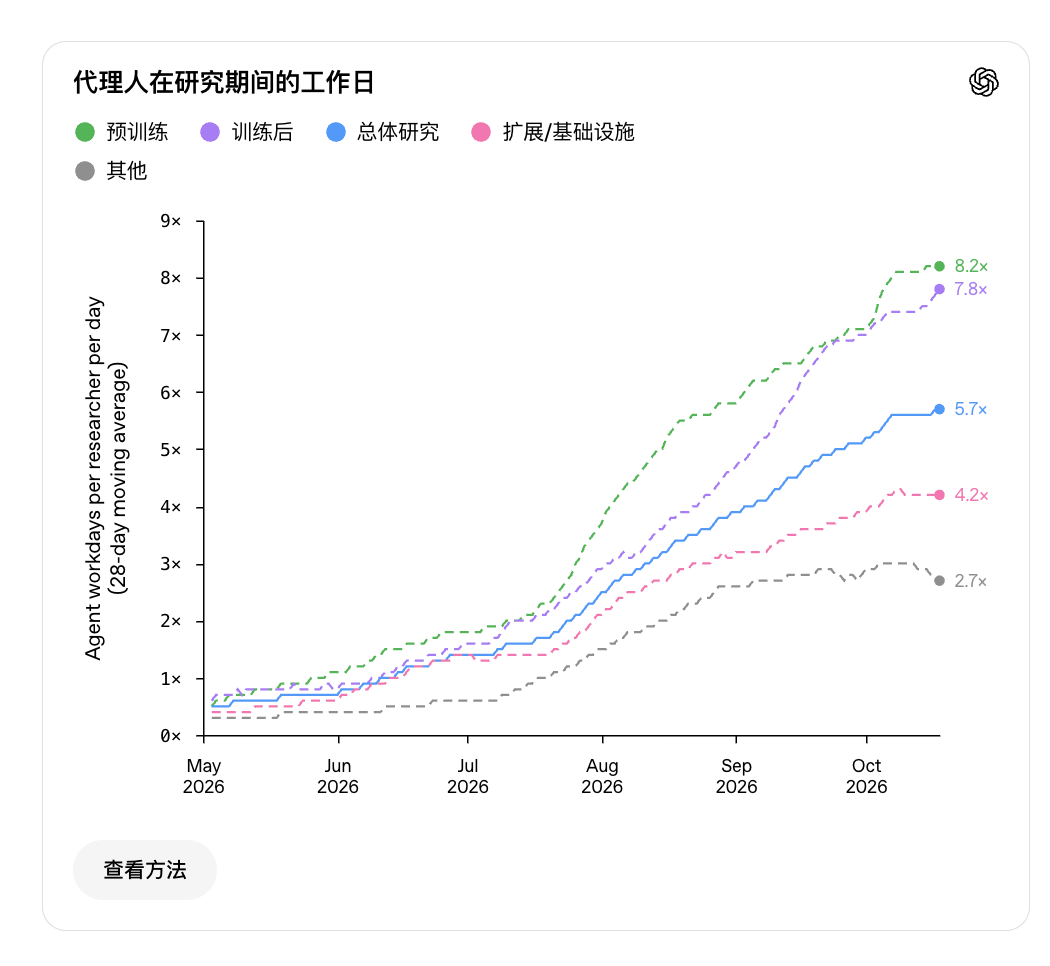
One AI day equals 5.7 human workdays
From September to October, the median researcher’s daily agent spend rose from USD 1,500 to USD 2,400. The top 10 per cent jumped from USD 11,000 to USD 23,000.
The report defines an agent workday. Eight cumulative hours of agent runtime count as one workday. In workload terms, each researcher now drives an average of 5.7 agent workdays a day. That is nearly six tireless AI assistants on permanent call behind every researcher. The figure is 11 times the previous baseline.
Researchers have also got used to working in packs. More than two thirds run at least four agents at once every day. Over 10 per cent run at least 16 simultaneously.
Then comes the comparison with real bite. The API-equivalent value of agent use has reached twice a researcher’s non-equity salary. That salary excludes the large equity component, but the point lands anyway. Inside OpenAI, the value of labour supplied by AI has passed the human line on the books.
The internal survey asked a pointed question. If you could not use the top coding agents for three months, what would you sacrifice? The answer was a 30 per cent cut in team compute, or giving up 40 per cent of your human colleagues. Faced with an agent that works around the clock and 40 per cent of the live team, the choice was not hard.
So what is all that money and compute actually doing? Can AI do research on its own? The core answer is the jagged frontier. Agents perform well on communication, 69 per cent, and analysis, 58 per cent, but fall behind on the most important category, building, at 43 per cent.
In plain terms, they are good at looking things up, running data, writing emails and monitoring experiments. Ask them to build a complex system from zero and they struggle. Monitoring a training task succeeds 79 per cent of the time. Writing inference and serving code succeeds only 25 per cent.
Researchers repeatedly raised one issue in interviews. AI agents lack research taste. A model usually cannot propose a well-defined problem it cannot itself solve. One researcher said asking an agent to do a task just like another one often goes wrong, and they end up fixing it themselves. An agent is an excellent tool for writing and debugging code, but it cannot pose good questions, tell good code from bad, or judge whether data is sound. You have to watch it like a foreman or it produces a pile of worthless AI slop.
An executive co-pilot, not a chief scientist
The current workflow splits the roles. Human researchers generate ideas, set direction, define problems, make key decisions and own final quality control. Agents act as a supercharged pair of hands and eyes, turning ideas into working code fast and running mass quantities of tedious tests and analysis.
One researcher said evaluating whether an open-source project was usable used to take one or two weeks. Now it takes a day, or a few at most, to get a result.
That is the role AI plays today. It is a top-tier executive co-pilot, not a chief scientist. The boundary is moving, though. The report notes that while building GPT-6.2 Astra, the pretraining team credited the generation of a key idea for the first time to a conversation with Codex. The idea was the researcher’s, but Codex proposed a change that made the whole scheme work.
Is AI accelerating the birth of AI? That is the question everyone cares about, the so-called recursive self-improvement. On the results, the answer is yes. In 2026, lines of code produced per active contributor kept climbing above 2025 levels. Experiments run per active experimenter reached 1.68 times the 2025 baseline. On OpenAI’s internal capability index, the frontier improved 16.4 points a year since August 2025, above the previous industry trend of 14 points a year.
The report stayed cautious. It stressed that AI-driven progress may not be linear, and warned of sudden, leapfrog breakthroughs like the ones recently seen in mathematics.
One final number is worth noting. Across all research directions, which area saw the largest increase in human effort? Not pretraining, not multimodal. It was safety and alignment, with the biggest workload growth of any area. New hires and internal transfers were flooding into safety projects.
AI is accelerating its own development on one side, while humans hurry to work out how to keep it safe and controllable on the other. The jagged frontier is not only about uneven technical capability. It may also be an honest portrait of an era pressing the accelerator and hunting for the brake at the same time.
The original report is available on OpenAI’s website.
Editor’s note: This is an adapted translation of the original 36Kr report. It has been trimmed and restructured for readability for an international business audience. The full original (in Chinese) is at https://36kr.com/p/4077710435324809.
The author’s views are their own and do not necessarily reflect the publisher’s position or constitute investment advice.