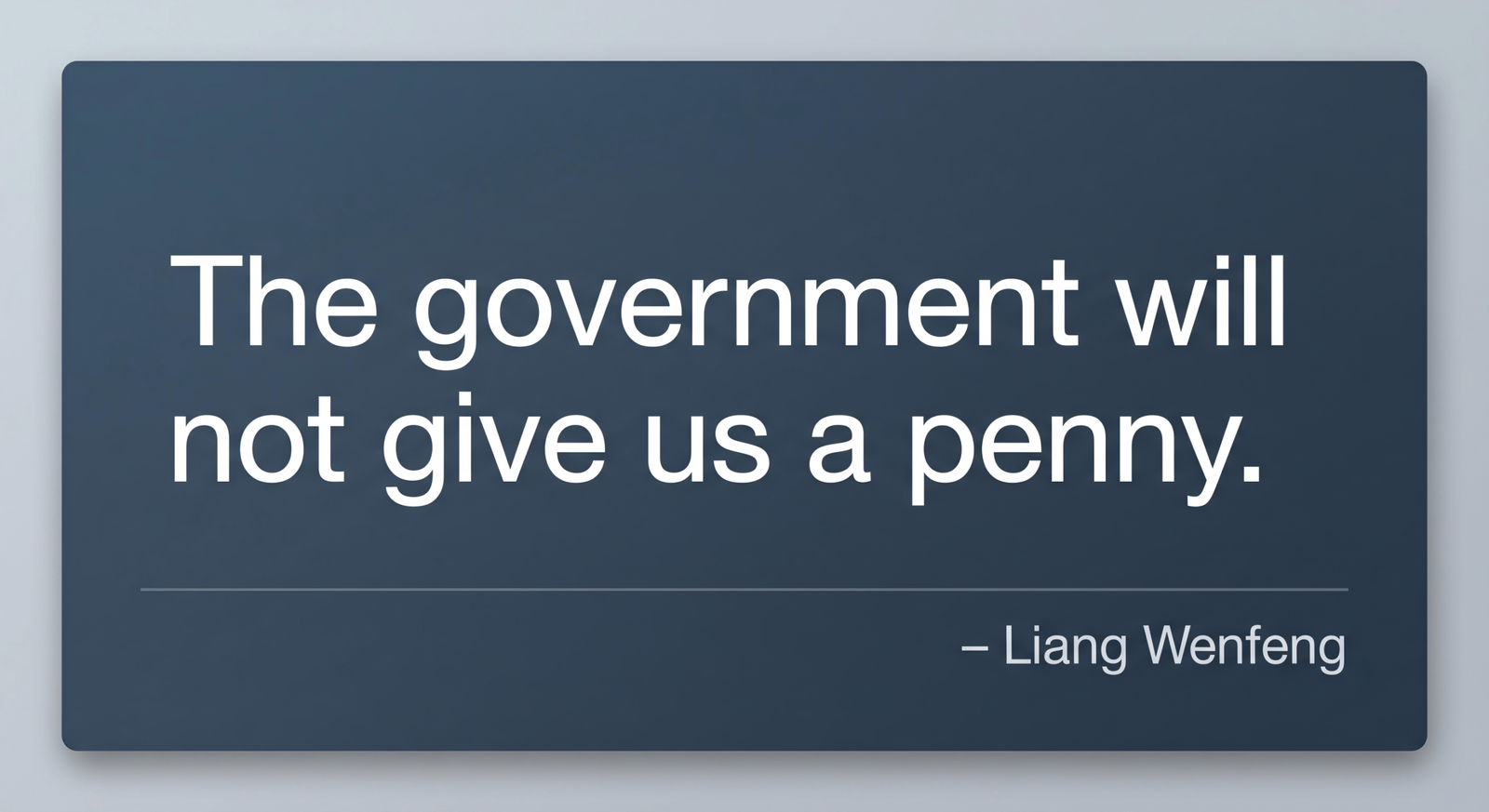
“The government will not give us a penny.” Liang Wenfeng just broke Washington’s favourite DeepSeek story.

For eighteen months, Washington has told one story about DeepSeek. The company is a state project. Its models are subsidised. Its cheap tokens are industrial policy dressed up as software.
Recently, a transcript began circulating in Chinese investor circles. It records Liang Wenfeng answering 118 questions from his investors. One answer kills the story.
“The government will not give us a penny.”
Both cannot be right.
The transcript is unverified, and I cannot confirm every word. But its internal consistency is striking, and the man speaking in it says things no propaganda office would write for him. I translated all 118 answers into a bilingual document, linked below. Here is what actually matters in them.
The accusers are specific
Start with what Washington actually said, because the accusations are precise.
In March 2025, OpenAI wrote to the White House calling DeepSeek “state-subsidized, state-controlled, and freely available.” In June, a State Department official told Reuters that DeepSeek “willingly provided” support to China’s military and intelligence operations. This March, the US-China Economic and Security Review Commission framed Chinese open models as tools that “reinforce China’s industrial dominance.”
Notice the verbs. Subsidised. Controlled. Provided. Each is a claim about where the money comes from and who gives the orders.

The denial sits in a strange place
Liang’s denial does not appear in a press release. It appears in an answer about why DeepSeek commercialises at all.
“We are clear that commercialization is a must,” he says. “In the end we have to survive. We are, after all, a company, and the government will not give us a penny.”
A subsidy claim is a claim about a cheque. Liang is describing a company with no cheque. He discusses the new funding round exactly twice in 118 answers. The first time, he says it removed his biggest risk, because the share options finally made his researchers’ wealth real. The second time, he says the investors were “carefully chosen” for aligned interests and the least hostility, inside a partnership structure that he controls.
Washington’s story requires a ward of the state. The transcript describes a founder who handpicks his own cap table.
One clarification matters, and I will make it precisely. The subsidy, where it exists, does not sit on DeepSeek’s books. It sits in the layers beneath it. Cheap Ascend silicon. Cheap western electricity. Liang never explains why those inputs are cheap. He simply builds on them. DeepSeek the company takes no subsidy. Whether the ground beneath it is subsidised is a separate question. That is a harder sentence to attack, and it happens to be true.
If the state does not pay, who does
The transcript answers with arithmetic.
DeepSeek prices its API at what Liang calls a reasonable profit, defined concretely: a batch of equipment pays for itself in ten months. He expects a few hundred million dollars of enterprise revenue this year. The company, he says, is not far from net profit, and may already be there. His worst case is that selling APIs alone could support a listed company.
Read that against the accuser. OpenAI has told investors not to expect positive cash flow before 2029. The company calling DeepSeek subsidised has raised more outside money than any startup in history.
The cost pattern is older but it anchors everything. V3’s final training run cost $5.576 million in H800 GPU hours, per DeepSeek’s own technical report. Critics rightly note this excludes prior research and hardware. The true figure is some multiple. Even at twenty times the sticker, it sits far below reported Western frontier runs. Today DeepSeek’s V4-Flash sells output tokens at $0.28 per million. OpenAI’s GPT-5.4 charges $15. That is a fifty-fold gap, and Liang says he runs it at a profit.

The doctrine of taking less
Here is what will outlast the news cycle. Liang has a theory of why he wins, and it is the exact opposite of the subsidy story.
“Those who take more will be beaten by those who take less. You do not even have to actually take more. If your vision is to take more, you will be beaten by someone whose vision is to take less.”
This is not modesty. It is doctrine. Low cost, he says, is first a result of model architecture and algorithm work, tied to the vision. Cost discipline is a capability American labs never built, because “they do not have to do it, so they never develop the capability. For them, it is not important.”
A subsidised company does not need this doctrine. A company surviving on ten-month payback cycles does. The cheap tokens Washington complains about are not a gift from the state. They are the business model of a firm that prices to live, not to harvest.
The chip verdict, quoted not endorsed
On chips, Liang is blunt enough to make NVIDIA’s communications team wince. I quote him without vouching for every number.
Domestic chips, he says, have no problem in hardware or ecosystem. The only problem is capacity. Within a year, the ecosystem’s viability will be proven. Huawei’s 950 SuperPoD substitutes for the GB200 and GB300 on performance and price. Four Huawei cards match one NVIDIA card. On this front, he adds, “NVIDIA is digging its own grave.”
He also drops a detail that ends a lazy debate. V3 was trained on NVIDIA cards, but on DeepSeek’s own compiler, TileLang, not on CUDA. The escape from NVIDIA’s ecosystem is already engineered. What remains is logistics.

What is not in the 118 answers
I read all 118 answers twice. Here is what is missing.
No export strategy. No overseas plan. No geopolitics. When America appears, it appears as a measuring stick for compute gaps, not as an adversary. He talks about AGI, continual learning, and keeping his research team stable. A state actor executing a penetration strategy would mention the strategy at least once. Liang mentions the probability of achieving AGI on nearly every page. He never once mentions winning a foreign market.
The man Washington describes does not appear in this transcript.

The story that survives
The favourite story is broken. Something more interesting survives it.
DeepSeek is not a ward of the state. It is a profitable, founder-controlled company that took state-linked money on its own terms, sells frontier tokens at a fiftieth of the incumbent’s price, and plans to open source its strongest models because it sees nothing to lose.
That is not a softer threat than the story Washington told. It is a harder one. You can sanction a subsidy. You cannot sanction a doctrine of taking less.
Washington’s story needed DeepSeek to be paid by the state. It turns out DeepSeek only needed the state to stay out of the way.
The penny was never the point.
Download the full bilingual transcript (PDF, 19 pages)
Published simultaneously on The Robot Belt and Substack.