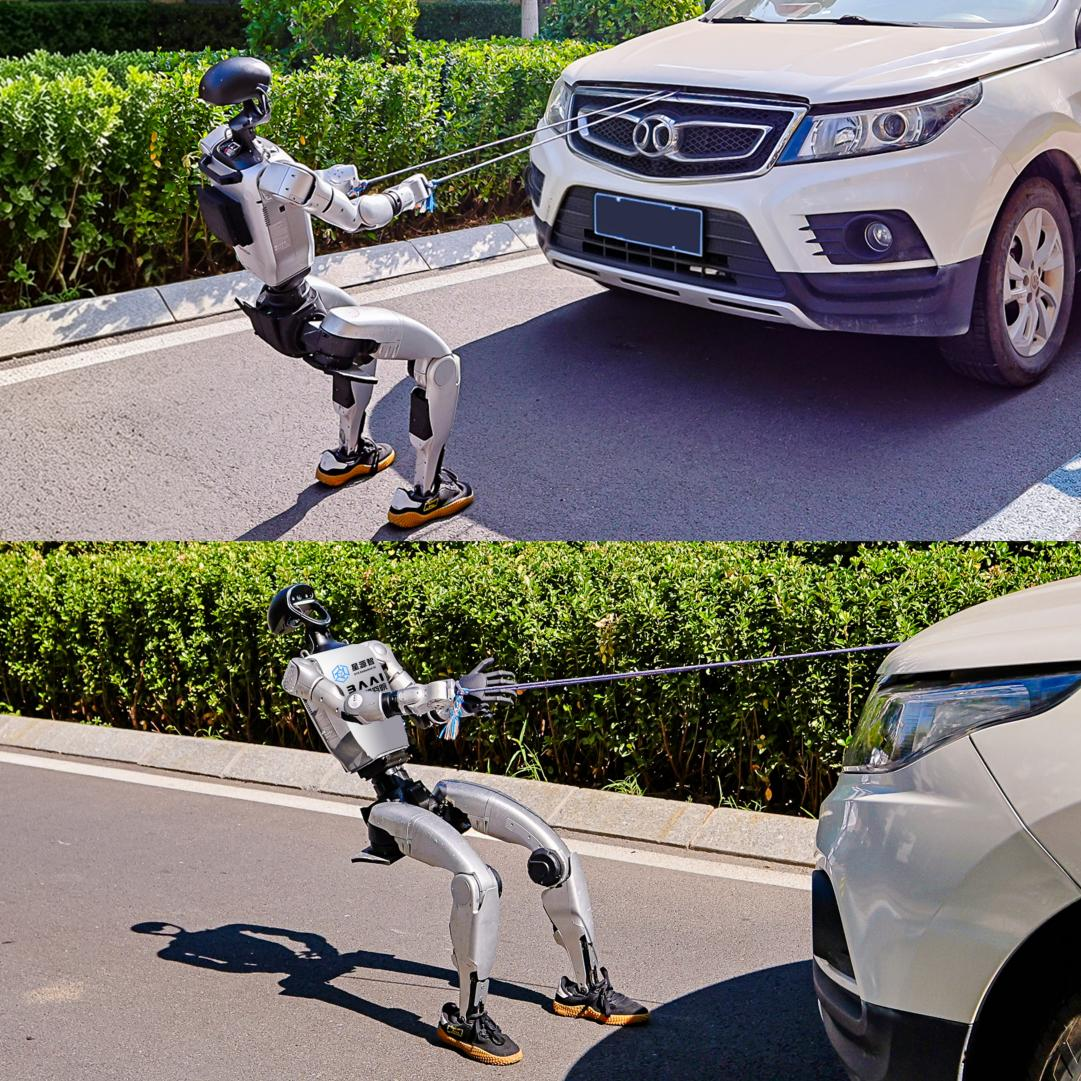
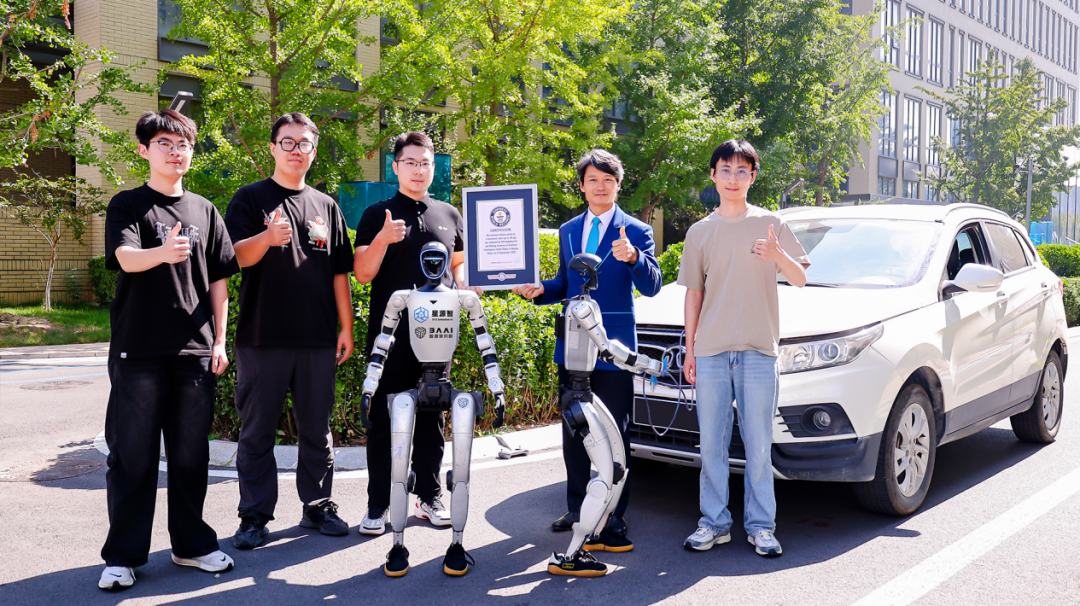
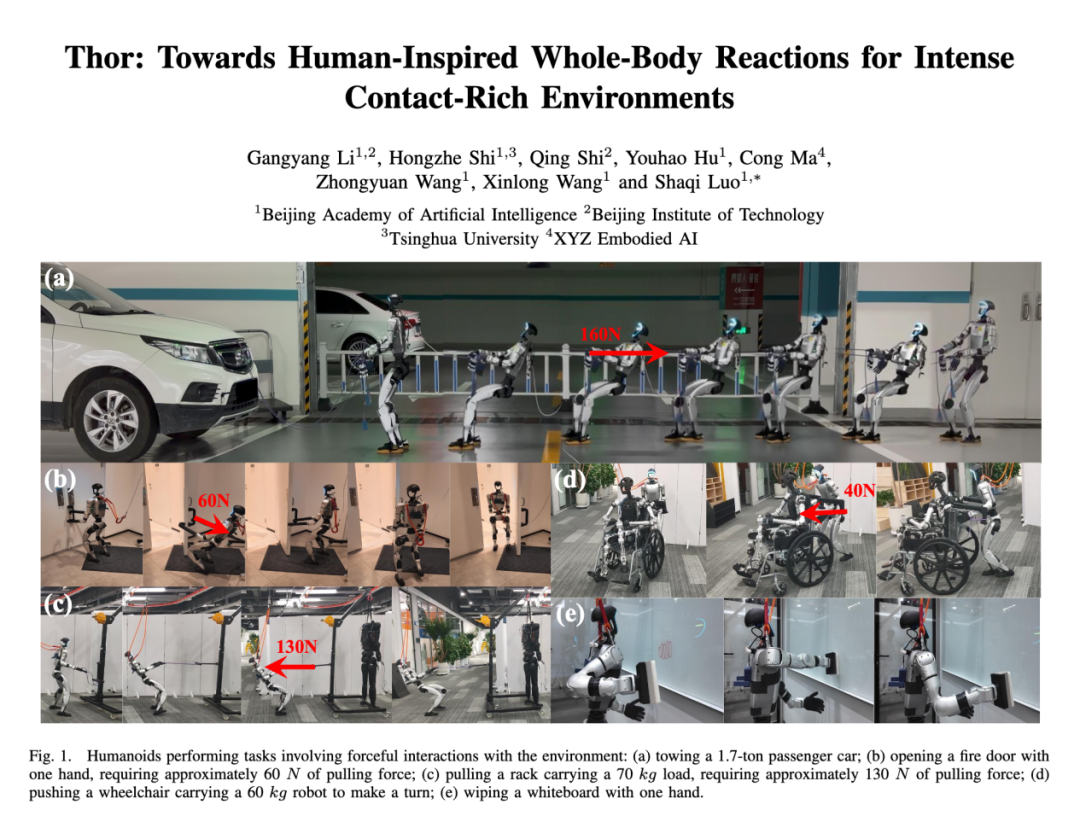
A humanoid robot weighing under 40 kg has pulled a car weighing 1.4 tonnes, roughly 40 times its own mass, for nearly ten metres. The stunt happened in Beijing’s Yizhuang district, where Xingyuan Zhi, working with the Beijing Academy of Artificial Intelligence (Zhiyuan), used its Thor whole-body control model to drive a 37.15 kg humanoid that dragged a 1,434 kg vehicle 9.92 metres on two feet, setting a Guinness World Record for the heaviest car pulled by a humanoid under 40 kg.
Why a 40-fold load test matters
At first glance a robot pulling a car looks like theatre, and in an era of robots running, jumping and tumbling, such challenges are easy to dismiss as parameter contests. Look closer and the test is not about brute force. The real problem is keeping the body coordinated, balanced and continuously powerful while absorbing a large reverse external force.
Over the past few years humanoid mobility has improved visibly, but that does not mean robots can already do real physical labour. A large share of work in production and service environments comes with reaction forces. How to keep a robot stable while it is under continuous load remains an unsolved problem.
How the robot broke through strong-interaction control
Pulling a car is a strong-interaction task: the robot must exchange force with the outside world while walking. Its own motion and manipulation change the contact force, which in turn shifts posture and gait, creating a more complex dynamic coupling. By contrast, running, jumping and dancing already involve whole-body coordination and ground-contact control, but pushing, pulling, dragging and door opening must fold continuously changing external forces into whole-body control while coordinating end-effector contact, body posture and centre-of-mass shifts.
At start-up, as the tow rope tightens, the robot actively tilts its torso and shifts its centre of mass toward the direction of travel, building a stable posture while bearing the car’s reverse force. During the moving phase, traction resistance, body load and walking state keep changing, so the robot must re-adjust torso posture, leg support and step rhythm on the move.
Thor borrows from how a person drags a heavy object, actively adjusting body tilt and centre of mass with the force. It introduces a FAT2 (Force-adaptive Torso-tilt) reward built on quasi-static torque balance, using hand contact force and its lever arm to construct a load-varying reference for horizontal centre-of-mass offset, training the leg policy to learn the corresponding posture adjustment. The model uses a Body-Part-Factorized Policy Architecture, with separate leg, waist and arm policies handling walking and force adaptation, waist posture regulation, and arm motion tracking, sharing whole-body observations and trained jointly.
In real-machine tests Thor’s peak pull reached 167.7 N, about 48 per cent of its own weight, with overall performance up 68.9 per cent over the baseline. The team found the FAT2 reward delivered an 80 to 90 per cent performance gain.
From limit test to real productivity
Thor has since moved beyond car pulling to other real tasks: autonomously opening a roughly 60 N fire door, dragging an 85 kg hanging frame, and whiteboard wiping. Opening a fire door is a single-arm asymmetric force task where the door’s reaction can tip the whole robot, demanding instant correction from the opposite side, waist and legs.
For the industry, a Guinness record is visually striking and shows the boundary of capability. But what decides commercial value is whether these abilities become reusable, sustainable labour that lets robots take on the dirty, heavy and dangerous work people hope to hand off, while staying stable against continuous force contact.
Editor’s note: This is an adapted translation of the original Zhidx report. It has been trimmed and restructured for readability for an international business audience. The full original (in Chinese) is at https://www.zhidx.com/p/597705.html.