On 28 September, AMD said it would buy World Labs for about USD 8.2 billion in stock. It is the second-largest acquisition in AMD’s history, behind the roughly USD 50 billion paid for Xilinx in 2022. Xilinx was a chip company more than thirty years old. World Labs is two.
The obvious reading is that Lisa Su is buying a ticket into physical AI, matching Nvidia’s Cosmos and its robotics stack. That reading is correct and incomplete. Fei-Fei Li is also making a bet, and she is staking more than the company on it.

Three questions, three different seats
Li’s reputation rests on setting problems rather than solving them, and the distinction has mattered every time.
The first question was ImageNet. Around 2007, as a junior professor at Princeton, she concluded that computer vision’s problem was not algorithms but data. Senior colleagues told her the project was too ambitious. Federal funding applications were rejected repeatedly. One reviewer called the work a disgrace to Princeton. She put her tenure at risk on the bet that a dataset solving no algorithmic problem could still change the field, because it would settle the question of how visual intelligence gets measured.
Published in 2009, it landed almost silently. It took until 2012, when Hinton and Krizhevsky’s AlexNet demolished the ImageNet challenge, for the deep learning era to ignite. Li had built the foundation. She was the person who set the exam, not the person who passed it.
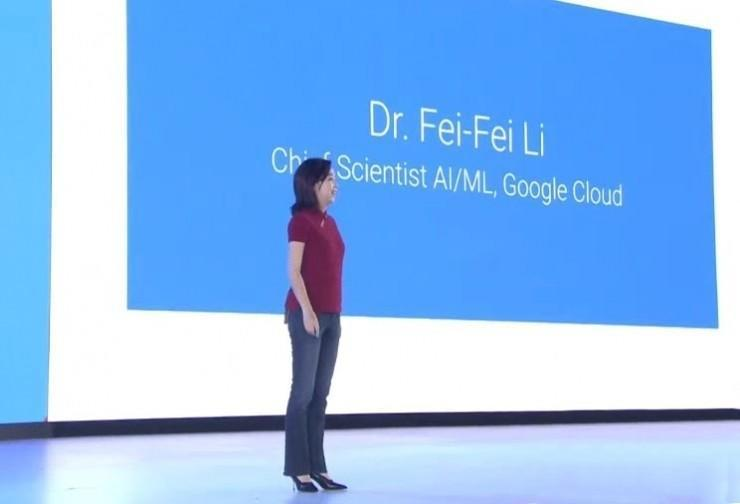
The second question was AI democratisation. She joined Google Cloud as chief scientist at the end of 2016, and the programme was real: Kaggle acquired in March 2017, AutoML to market, a Google AI China Centre in Beijing. Then Project Maven surfaced, and an internal email in which she urged colleagues to avoid any mention of AI in communications became public. A scientist who had arrived to democratise AI was pushed out by an argument about AI ethics. She had set the question and wanted to answer it, but she did not control the paper, the invigilator or the marking.
The third question, and the ammunition
World Labs was founded in April 2024 with Justin Johnson, Ben Mildenhall, the first author of NeRF, and Christoph Lassner, a core NeRF researcher. The advisory bench includes Jiajun Wu of Stanford and Angjoo Kanazawa of Berkeley. The argument is one Li has repeated on stage for years: the universe is not made of text. A language model does not understand occlusion, gravity, or that a cup falls and breaks.
The funding followed fast. A seed round at about USD 200 million valuation led by a16z and Radical Ventures. On 18 February 2026, a USD 1 billion Series C led by Autodesk with AMD, Nvidia, Emerson Collective and Fidelity, at roughly USD 5.4 billion post-money. From USD 200 million to USD 5.4 billion in under two years.
The product line moved with it. LWM in December 2024, generating an interactive 3D world from a single image. Marble, the first commercial product, in November 2025. The acquisition of robot-simulation company SceniX in July 2026, pulling world models into a reinforcement-learning loop. Atlas on 2 September 2026, a multimodal world model with pixel-level camera control, sparse-view 3D reconstruction and robot pre-training.
Why hardware, and why now
Each product step demanded a different shape of compute. Real-time inference on a single GPU. Large-scale training of a multimodal autoregressive diffusion transformer. Then the memory bandwidth, parallelism and low latency that robot simulation requires.
Li has been explicit that spatial intelligence is unusually compute-hungry. Reconstructing a 3D scene from one to dozens of photographs, or generating a minute of 1440p video, involves heavy geometric computation and sparse reconstruction, and general-purpose GPU architecture is not efficient at it.
She moved toward AMD early. At CES in January 2026, Su brought her on stage, where she showed Marble running more than four times faster on an MI325X after optimisation.
But when a model team and a chip team sit at the same table, the structural problem shows up. World Labs was on the side asking for things. AMD was on the side deciding what to build. Between them sit pricing, prioritisation and cross-company negotiation, and what a model team most wants is not always what a chip team most needs to ship.
The deal is the answer to that
In the all-stock transaction, World Labs goes in as a relatively independent research unit rather than being absorbed. Johnson and Mildenhall keep leading model development. Li reports directly to Su.
In her open letter, titled To Seek a Newer World, she gave the reason: the work needs to scale in both research and impact, and needs to be much more tightly coupled to hardware. Without dedicated hardware investment, efficiency and scale stay capped, and the goal remains trapped in the digital world.
Su’s version was equally direct. Building a computing platform for the next generation of AI requires understanding how models will evolve, and the World Labs team brings that model expertise in-house.
How this gets judged
Not by citations. By whether MI450 ships with architecture choices that a world model asked for.
The specification is public. MI450 on CDNA 5 delivers 40 PFLOP at FP4 and 20 PFLOP at FP8, double the MI350 generation, with memory moving from 288GB of HBM3e to 432GB of HBM4 at 19.6 TB/s, a 2.45-fold bandwidth increase. Volume delivery begins in the second half of 2026.
If Atlas and Marble hold the four-fold improvement curve on MI450, the argument that model requirements can define silicon holds. If MI450 is a straightforward process upgrade with no accommodation for sparse computation, multi-view geometry or camera-conditioned video generation, the thesis is half-finished: the model team got in the building, but not into the design review.
The second test is the ecosystem. A model that runs beautifully on AMD hardware and nowhere else is a custom optimisation. Success looks like other spatial-intelligence and embodied teams choosing AMD because the models run better there. Li has committed to keeping World Labs models open and cross-platform, which puts the burden on AMD to widen the ecosystem rather than narrow it.
If everyone watches the keynote and keeps buying Nvidia, USD 8.2 billion bought an invitation, not a position.
Editor’s note: This is an adapted translation of the original Leiphone report. It has been trimmed and restructured for readability for an international business audience. The full original (in Chinese) is at https://www.leiphone.com/category/academic/oi5NEt93WcuWwFr8.html.