For years the artificial-intelligence race was read through the chip designers. In 2026 the bottleneck has moved upstream, to the machines that make the chips. The equipment makers now control the most certain share of the AI cycle.
The old cycle no longer fits
For decades semiconductor equipment followed a three-to-four-year rhythm. Consumer demand rose, fabs expanded, orders peaked, then capital spending contracted. AI has broken that pattern. The current demand rests on long-term data-centre construction, not a one-off handset upgrade, and it is structural rather than cyclical.
Order visibility shows the shift. Equipment makers used to work with about twelve months of backlog. Leading suppliers now see two to three years, and some tools are booked into 2028 or beyond. SEMI forecasts global chip-equipment sales of USD 165.9 billion in 2026, up 23.2 per cent, and more than USD 229.5 billion by 2028. Morgan Stanley lifted its 2027 wafer-equipment forecast to USD 223 billion, a cumulative 54 per cent raise on its late-2025 estimate.
The race is spreading across the whole chain. According to Korean outlet ETNEWS, the five largest front-end suppliers, Applied Materials, ASML, Lam Research, Tokyo Electron and KLA, have largely finished talks on 2028 supply contracts, with some fabs already opening discussions for 2029 delivery. ASML confirmed that certain customers have expressed intent to buy tools for 2029 and even 2030, a phenomenon almost unheard of in the industry.
Buyers lose the pricing power
Procurement rules have inverted. Equipment used to be a buyer’s market where fabs compared bids and pushed prices down. Now capacity allocation matters more than cost. A fab that fails to lock a slot loses the initiative in the AI capacity race, so buyers start negotiations a year or two early and sign three-year deals. Suppliers allocate scarce output by customer depth, order size and strategic value. Money alone no longer buys a tool.
Pricing has changed with it. ASML chief financial officer Roger Dassen confirmed a value-based pricing model agreed with major customers, with some lithography tools rising in price. Analysts expect the average selling price of extreme-ultraviolet systems to climb about 5 per cent by 2028. Expedite premiums are becoming routine as buyers pay to jump the queue.
What the equipment bosses say
ASML president Christophe Fouquet said that even after raising low-NA EUV and immersion DUV capacity by roughly 30 per cent in 2027 and 2028, supply will still fall short. The company is weighing a further increase above 30 per cent in 2028. EUV revenue is set to grow more than 45 per cent this year, installed-base services about 50 per cent. Its installed-base management business booked EUR 3.3 billion in the third quarter, well above guidance, as customers upgrade existing tools rather than wait for new ones.
Applied Materials chief executive Gary Dickerson called this a multi-year growth cycle. Advanced logic, DRAM and advanced packaging together should account for roughly 80 per cent of wafer-equipment growth, with advanced packaging revenue rising more than 70 per cent in 2026. More than 37,000 process chambers are now connected to the company’s AI platform. Tokyo Electron posted a 33.3 per cent revenue rise and 39.5 per cent net-profit rise in fiscal 2027 first quarter, a clear sign of operating leverage.
China’s window, and its ceiling
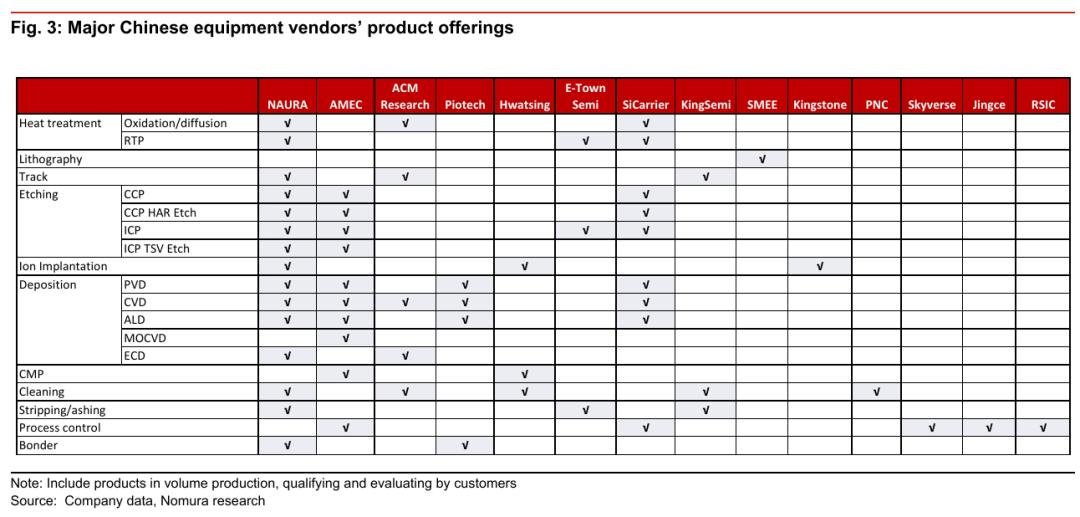
Long overseas lead times have accelerated validation of domestic tools. In the first three quarters, NAURA order growth exceeded 60 per cent, Piotech more than doubled, AMEC rose over 50 per cent and ACM Research Shanghai saw new orders climb 147 per cent. Nomura estimates storage and advanced logic each make up about 40 per cent of NAURA’s orders, and Yangtze Memory’s third phase crossed 50 per cent domestic equipment procurement for the first time. Vendors are shifting from single tools to platform portfolios across etch, deposition, cleaning and metrology.
Delivery, not demand, is the constraint. NAURA’s third-quarter revenue grew just 1.31 per cent and Piotech’s 1.84 per cent, a stark gap to order growth. Electrostatic chucks, mass-flow controllers, vacuum valves and pumps remain import-dependent, and a single missing part can hold a whole tool. Nomura expects deliveries to improve from the fourth quarter and 2027 to become the year domestic backlogs convert to revenue. NAURA says its AI-assisted development has cut product cycles by 70 per cent and raised tuning accuracy to 98 per cent.
Lithography localisation is still below 1 per cent and high-end metrology under 5 per cent. The old cycle is over, but the deepest parts of the supply chain remain a long way from substitution.
Editor’s note: This is an adapted translation of the original 36Kr report. It has been trimmed and restructured for readability for an international business audience. The full original (in Chinese) is at https://m.36kr.com/p/4076064207639680.