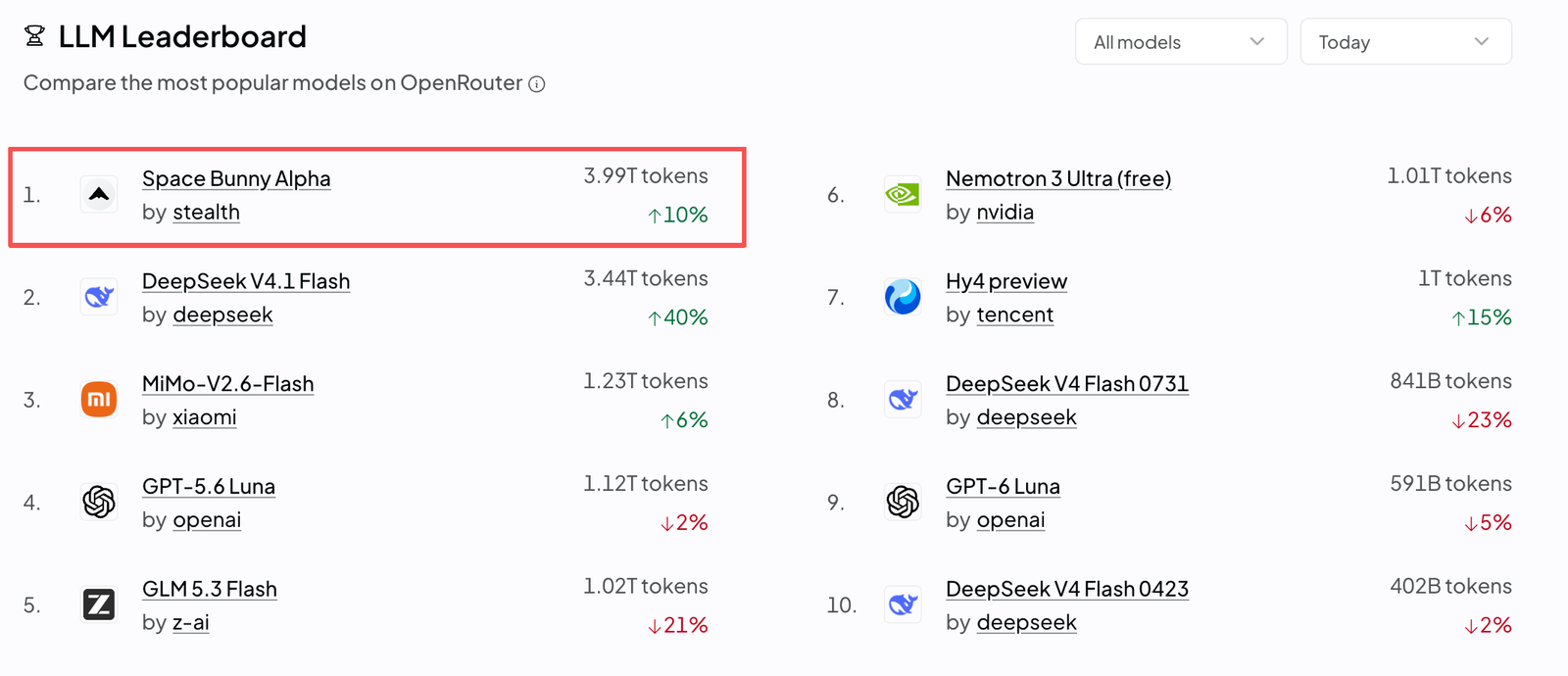
Recently an anonymous model called Space Bunny has stirred debate among developers. Since its 23 September launch it has held second place on the OpenCode usage chart and at one point topped the OpenRouter usage chart, earning the nickname ‘space bunny’.
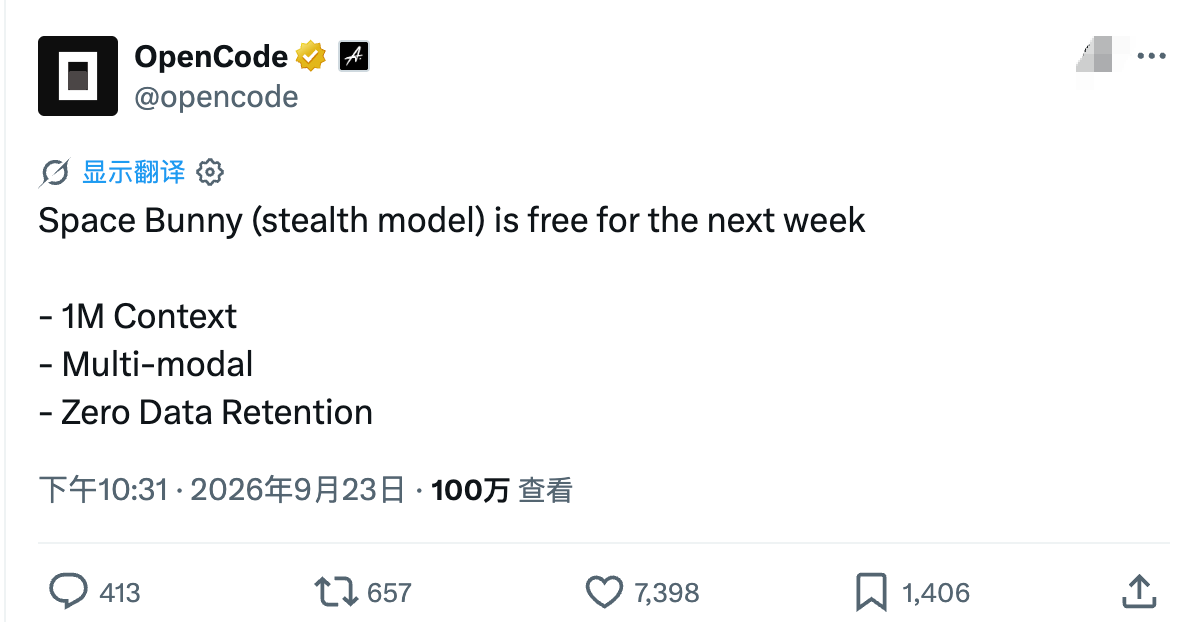
The model is free to use on OpenCode, offers a one million token context and multimodal ability, and retains no user data during its anonymous period. The official OpenCode post has passed one million views.
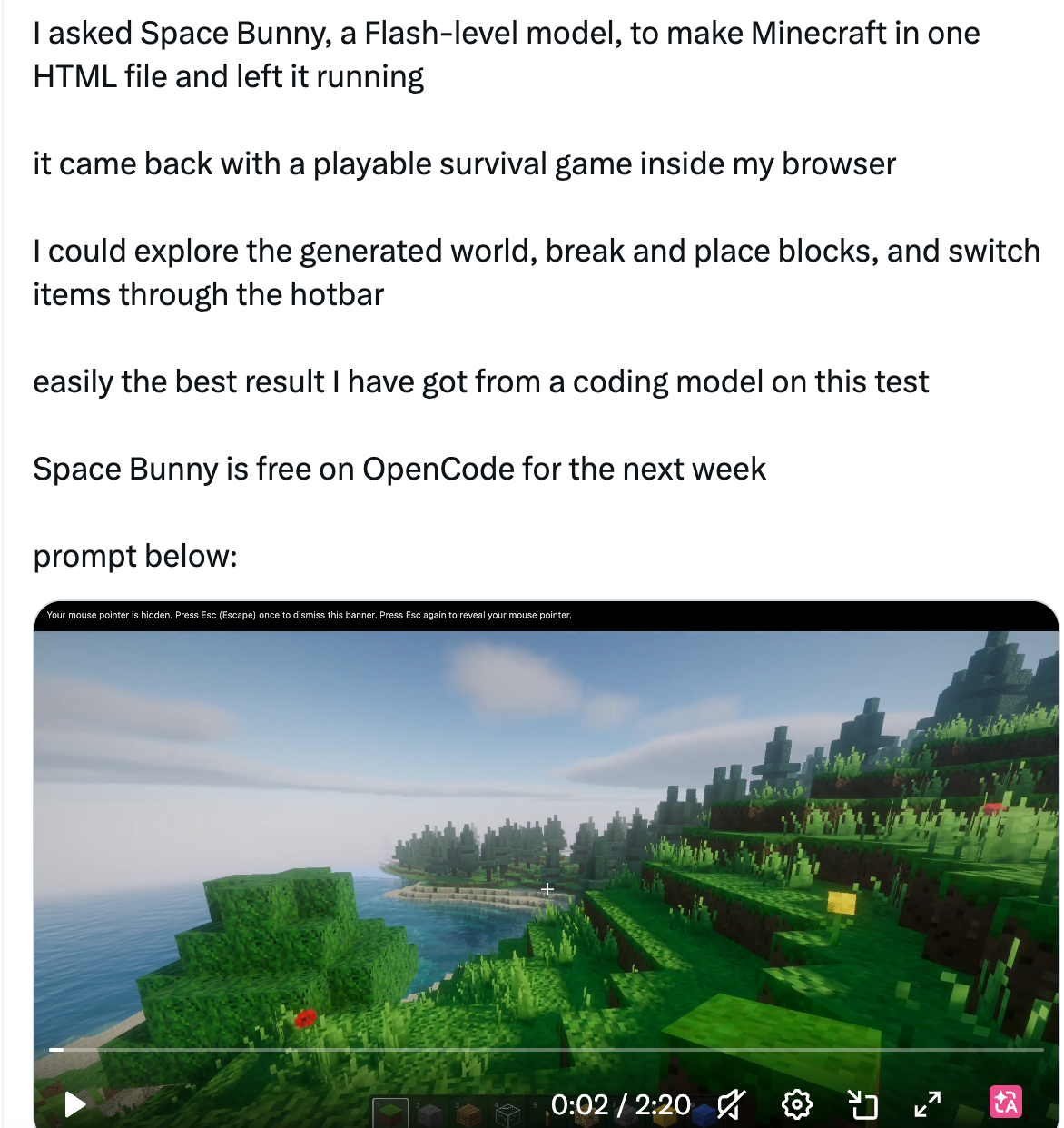
Based on developer testing, Space Bunny is most likely a Flash-class model, and most users report it is very fast and strong at 3D output. One developer built a simple version of Minecraft in about forty minutes from a single simple prompt, able to break and place blocks and switch items via a hotbar, though the tester said it took many revisions and is not fully representative.
Other developers argued it was not that good and, using the same prompt, produced quite different results. We collected interesting developer tests and ran our own through OpenCode to see real performance.
Rocket launch, voxel garden: on par with Astra and Opus 5
In one comparison a user built a rocket-launch scene at the highest reasoning level with Claude Opus 5, GPT-6 Sol and Gemini 3.8 Flash against Space Bunny. The user said Space Bunny took only three minutes and its result rivalled Opus 5 while clearly beating the other two, and was far faster. The rocket’s colour, clouds and flames looked realistic and the launch was smooth, with only minor steam-range and support-connection issues.
In a post with 100,000 views, a developer compared GPT-6 Astra with Space Bunny using the same prompt in one shot. Astra’s voxel garden had flawless texture and harmonious layout, with fish, a flying dragon and smooth dark-mode lighting. Surprisingly, Space Bunny’s result was also very good, with little visible gap at a distance, though its peach tree, pool and some details were less refined.
Astra was again compared on a lighthouse-storm scene; Space Bunny had more atmosphere while Astra was more physically accurate, but neither was stunning.
One sentence built an HTML black hole; front-end design exploded
Space Bunny’s most impressive showings were in front-end design. One developer asked it to build a GPU fluid simulation in a single HTML file using WebGL from scratch with no external libraries, dragging the mouse to push coloured dye with a soft glow. Space Bunny generated 1,564 lines of code in one shot, no hand-written line, no third-party library.
Another built a black-hole showcase page that flexes elastically as the user clicks. Its motion-design work won near-universal praise. A solar-system observatory and a pelican-riding-a-bike SVG animation also landed well.
On a flight-sim game, Space Bunny produced a genuinely playable low-poly third-person sim in 94 minutes, with light take-off and graceful air rolls, though fine angle control had issues. A racing game ‘crashed’ with clipping and reversed controls even after multiple fixes. A truck model in 85 minutes looked like a blackened Optimus Prime, faithful to the prompt.
Throughout testing Space Bunny impressed on 3D but showed many detail flaws, and its speed was lower than expected under usage spikes. Since launch, speculation about its owner has never stopped, with guesses ranging from Moonshot’s new Kimi to MiniMax, but nothing is confirmed.
Editor’s note: This is an adapted translation of the original Zhidx report. It has been trimmed and restructured for readability for an international business audience. The full original (in Chinese) is at https://www.zhidx.com/p/597636.html.