The further AI walks into the physical world, the more China’s manufacturing base weighs in the competition. Getting a machine to understand an instruction is only one part of the product. Getting it to do the work at a cost the customer will accept, and to keep running reliably across different sites over time, pulls supply chains, engineering teams and service networks into the contest together. China’s accumulated strength in these layers could become the resource the next phase of AI adoption needs.
That means the entry points for Chinese companies into AI competition are multiplying. Some supply components and complete machines. Some bolt intelligence into existing products. Others join model development through real business operations. The question worth asking is how much of the value Chinese firms actually capture. Equipment orders are only the starting point. Whether they can help define the product, keep the customer, and turn field experience into reusable technology is what decides how far this advantage runs.
Supply chains are entering the AI research process
China’s manufacturing advantage has usually been described as a mass-production story that begins once a technology matures. Physical AI is pulling that advantage forward. To train a single action, researchers first need hardware that can collect data, execute motions and survive repeated trials. How much of that off-the-shelf hardware solves determines how much energy a team can spend on the model itself.
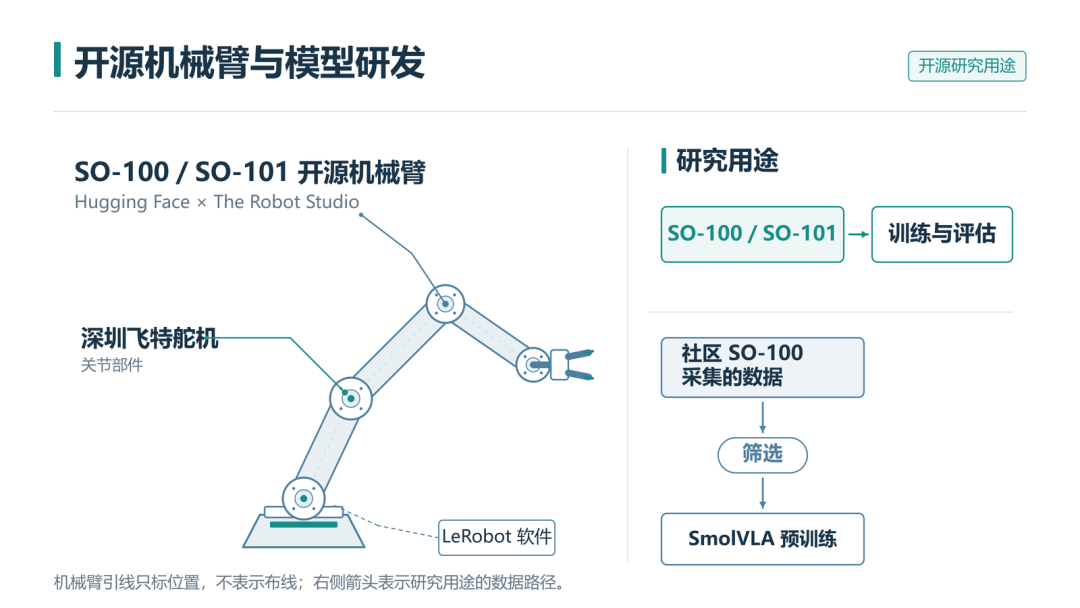
The open-source SO-100 and SO-101 arms, a Hugging Face and The Robot Studio collaboration, are a concrete case. Developers can buy parts from a public bill of materials, print the structural pieces and connect them to the LeRobot software stack. The arms use servos from a Shenzhen supplier. The SO-101 also simplifies wiring and assembly and retunes the lead arm motor for easier human control.
Those choices have already entered model development. When Hugging Face released SmolVLA in 2025, it explicitly framed low-cost open hardware as part of lowering the barrier to research, using the SO-100 and SO-101 for training and evaluation. The team also filtered and curated data collected by the community on the SO-100 for model pretraining.
From buying parts and assembling a machine to collecting motion data and training a model, this path links suppliers, hardware designers, the open-source community and model teams. Chinese component makers are participating in the hardware supply that AI research depends on without first becoming model companies. Development teams can reuse existing actuators and assembly schemes and push the work forward into tasks and models. Manufacturing capability is gaining a new kind of value. It now shapes who gets to do research and how that research is organised.
The same shift is visible in complete machines. Lens Technology disclosed in its half-year report that products related to robotic dexterous hands, joint modules and full-machine assembly had reached batch delivery, drawing on precision manufacturing and systems integration built over years of serving consumer electronics and smart-car clients. New products can reuse existing teams, processes and production systems, so entrants do not have to build every manufacturing capability from scratch.
A device company’s relative advantage shows up here. The more varied the products AI enters, the more scattered the materials, components, processing and assembly know-how becomes. An industrial system that serves many product categories at once can offer more ready-made combinations. Model research still needs investment, but when a device maker tries a new intelligent feature, existing products and supply chains give it a head start.
Entering the physical world can start from an existing business
Focusing only on humanoids makes it easy to underestimate the value of such starting points. Plenty of physical equipment already has a defined task and paying customers. Intelligence can work its way in one concrete problem at a time, and commercialisation does not have to wait for a general-purpose machine that can do everything.
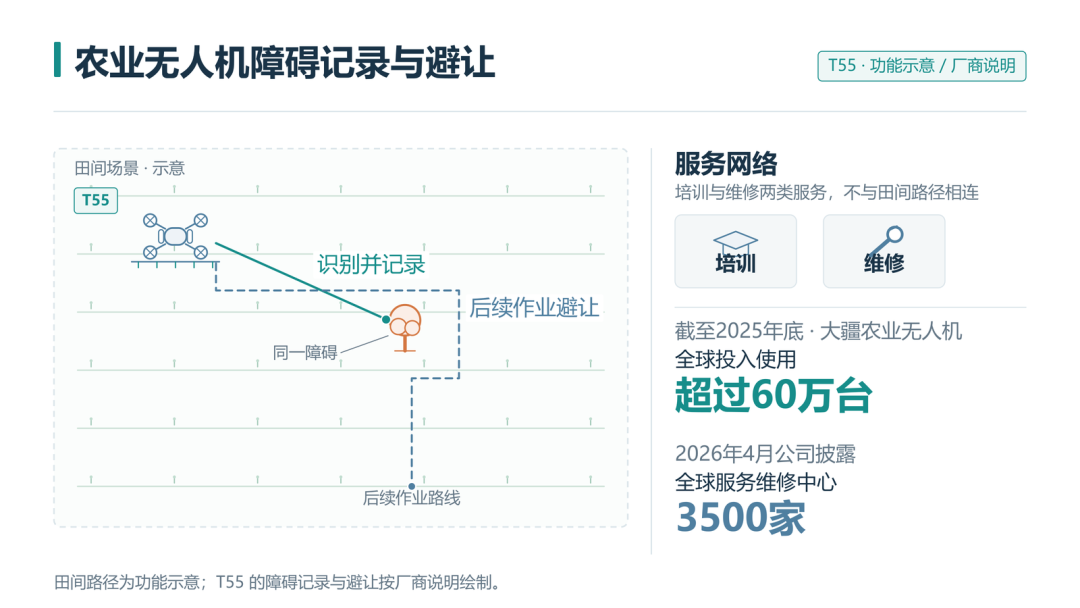
Agricultural drones have already travelled the path from delivering equipment to expanding its use. By the end of 2025, more than 600,000 DJI agricultural drones were in service worldwide, according to a report the company published in April. The same report put its global service and repair network at 3,500 centres. Operator training and local service capability grew up alongside the machines.
The value of that installed base is that new features have a ready-made entry point. The T55, launched in July, combines radar, vision and algorithms. Obstacles it identifies can be logged for avoidance in later passes, according to DJI’s product description. The research faces concrete field problems, and customers can judge for themselves whether intelligence reduced their workload. Existing sales and service relationships let the company keep delivering upgrades, handling failures, and avoid rebuilding a customer network for every new capability.
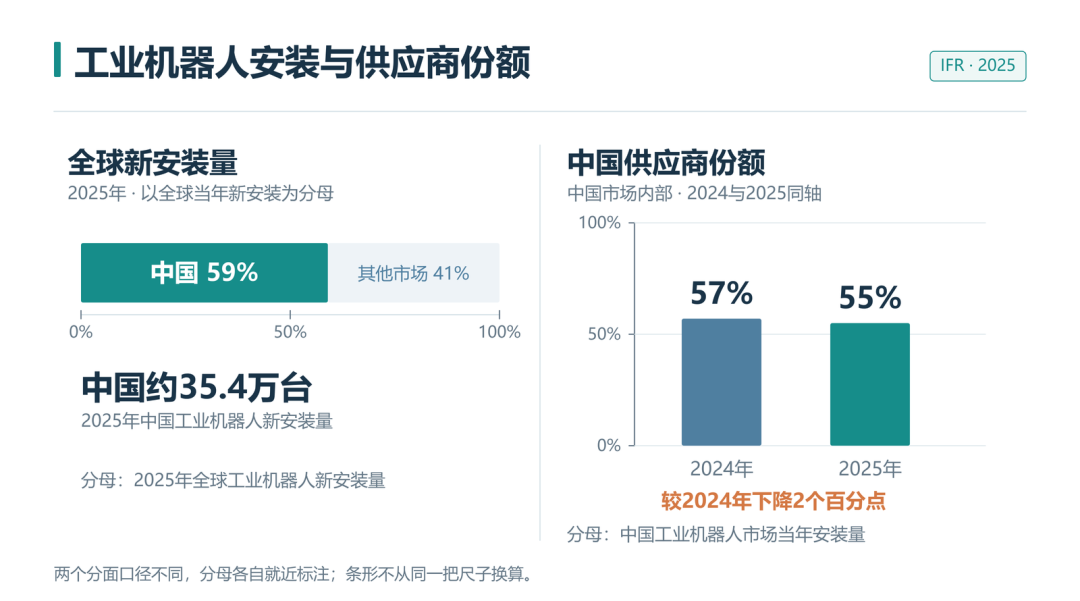
Factory floors offer a different starting point. The International Federation of Robotics puts China’s industrial robot installations in 2025 at roughly 354,000 units, or 59 per cent of the global total. At that scale, a large number of companies already have to manage how robots coordinate with processes, people and incoming materials. New AI capabilities can find tasks inside those existing problems.
Going from production experience to model capability still needs someone to frame the problem into work that can be trained and verified. When Google DeepMind released Gemini Robotics 2.5 in November, it described proof-of-concept work with Apptronik and Mercedes-Benz. The Apollo 2 robot organised car parts into containers used on the production line. DeepMind reported a task-specific success rate of 96 per cent. It remains a pilot, but it shows how deep the collaboration has to go. Model teams, equipment suppliers and factories must jointly define the action and the acceptance criteria.
China’s broad field base creates the next opportunity inside that kind of collaboration. People who know production can propose valuable tasks, equipment companies adapt the hardware, and model teams join the refinement. The number of machines already on a factory floor does not turn directly into trainable data. Turning experience into reusable capability takes sustained investment. Only firms that can organise that work and put the improvements back into their products will capture a longer-term advantage from the customer’s site.
Beyond orders, who keeps the value
Hardware entering global AI research now has a clearer shape. Nvidia’s humanoid reference design, published in May, pairs a Unitree body with a Sharpa dexterous hand and Nvidia’s own compute and software platform, giving researchers the conditions to collect data, train and deploy. The plan at the time was to ship by year end. Chinese body makers are now part of the supply side of an international research platform.
That collaboration also draws an important boundary. Nvidia’s announcement states explicitly that researchers retain control of robot data, training data, telemetry and logs. Who manufactures the machine and who owns the data it generates are two separate arrangements. High unit sales first produce a supply business. Whether the manufacturer joins the later research depends on how it works with the customer.
Unitree is extending its own capability. In September it released UnifoLM-WLA-1.0-Base along with fine-tuning code, and its open-source page offers frameworks for data collection, training and real-machine deployment adapted to its own robots and arms. A body maker shipping models and tools can shape more deeply how developers use the hardware and what the next generation needs to change.
Along this path, the value Chinese firms compete for shifts. Manufacturing alone means winning orders on delivery and cost. Sustained participation in task development and product refinement gives a firm more influence over the customer’s choice, plus follow-on service and upgrade revenue. The real thing to watch is whether these companies move from making to someone else’s design toward jointly deciding with customers what the machine should do and how.
A huge domestic market also attracts competitors. The same IFR data shows Chinese suppliers held 55 per cent of the domestic industrial robot market in 2025, down from 57 per cent in 2024. A growing market did not deliver every incremental order to local vendors. The manufacturing base buys an entry ticket. Customers still choose the product that solves their problem.
So the basis for saying China’s odds improve as physical AI approaches is that the industrial capabilities AI must mobilise are multiplying, and China’s existing accumulation can play a role in more of them. The more meaningful results ahead should come from Chinese firms using that base to define new products, run long-term customer relationships and feed manufacturing experience back into their own research. At that point, the supply chain catches not just a round of new orders, but a position in the next division of labour.
Editor’s note: This is an adapted translation of the original 36Kr report. It has been trimmed and restructured for readability for an international business audience. The full original (in Chinese) is at https://36kr.com/p/4079173001959297.
The author’s views are their own and do not necessarily reflect the publisher’s position or constitute investment advice.