At ICCAD-Expo 2026 in November, the Beijing Open Source Chip Research Institute showed a RISC-V server carrying SpacemiT’s V100 CPU. The V100 is the industry’s first computing chip fully compliant with the RISC-V server specification, a sign that RISC-V is moving into data centre markets where deployment and scale actually matter. The chip integrates 46 high-performance RISC-V cores. Six come from the open-source XiangShan project and take part directly in general computing, sharing server workloads with 40 SpacemiT-designed X100 cores. The key point is that choosing open computing cores was not a technology demonstration. It was a careful decision aimed at commercial deployment.
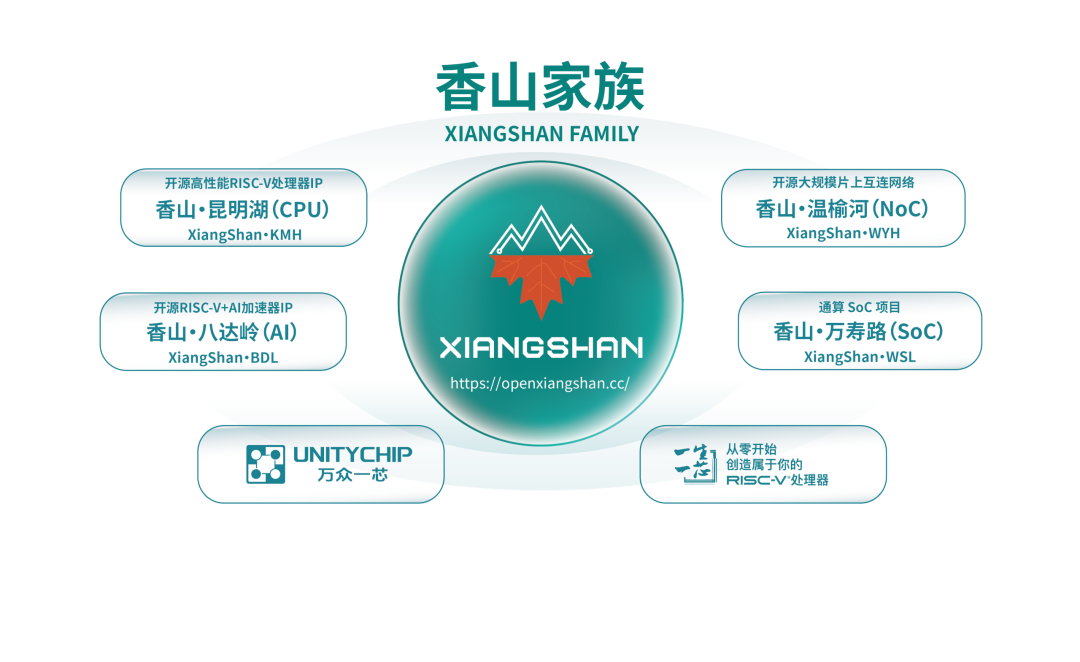
That is also how XiangShan was discussed at this year’s sixth RISC-V China Summit. It is not a chip sample in a display case. It is a set of processor core designs already integrated into shipping products. In March, the XiangShan open high-performance RISC-V processor system was released alongside Ruyi, a native RISC-V operating system. October’s summit offered a clearer vantage point. Commercial chips were starting to work, the software toolchain was filling gaps, and AI computing was adding new demand. In the same month, ESWIN Computing listed on the Hong Kong exchange, called the first RISC-V stock by some media. In November, the XiangShan family appeared again at ICCAD-Expo 2026, showing the potential of the open high-performance RISC-V route across the full integrated-circuit chain.
Attention in the track keeps rising, but the question worth more than the first listing is this. Open source has become the calling card of Chinese large models, putting them alongside international commercial closed models. In chips, can the open route produce high-performance, high-reliability processors that meet commercial standards?
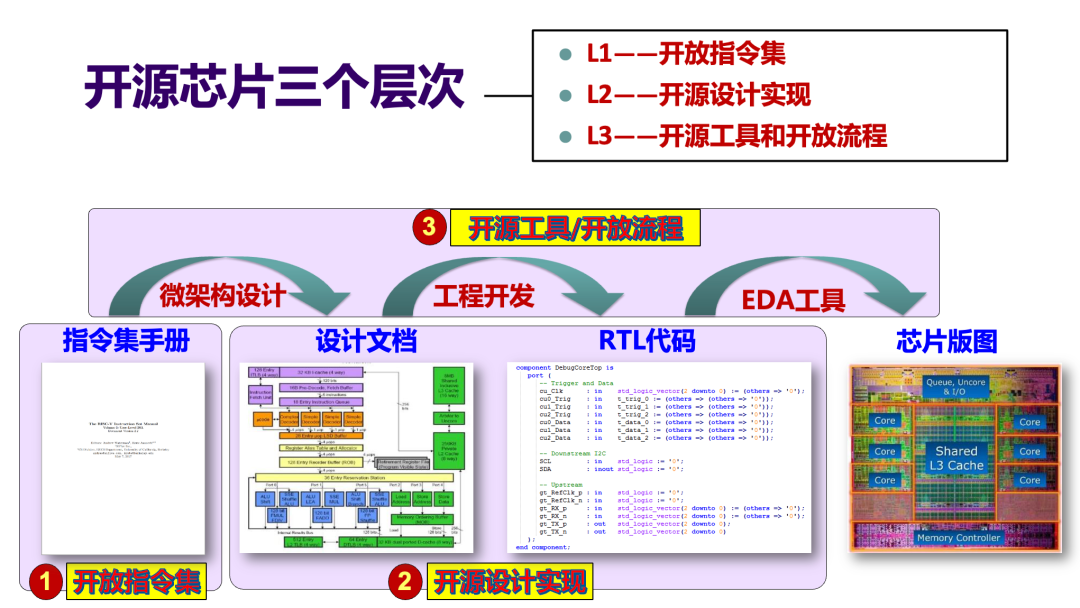
XiangShan is the sample to watch. Outside the industry it is still an unfamiliar name. Inside the RISC-V community it is discussed as a reusable public foundation. To understand it, sort out a chain of relationships. RISC-V is the language rules. The RISC-V manual is the dictionary. XiangShan is the draft. A company’s chip is the finished work. The complete machine is the product for sale.
Not a chip, a modifiable draft
For a chip to work, it must understand a language called an instruction set. For decades, global CPU instruction sets were dominated by x86 and Arm. Both are powerful with large ecosystems, but both are closed, licensed and paid for. RISC-V offers another possibility. The instruction set is open, free to use and open to customisation by scenario.
RISC-V itself is not code and not a chip. It is closer to a set of language rules, and the manual describing its instruction set is like a dictionary. XiangShan is an open high-performance processor core written on top of those rules, like a draft anyone can modify. A company integrates the XiangShan core and other functional blocks into a system-on-chip, completing its own work on that draft. A machine maker then puts the chip into a server or industrial controller and produces the final purchasable product.
XiangShan is built jointly by the Institute of Computing Technology of the Chinese Academy of Sciences and the Beijing Open Source Chip Research Institute. Since 2020 it has moved through three versions, Yanqi Lake, Nanhu and Kunming Lake, covering data centres, intelligent computing and terminal scenarios. In public tests, the single-core performance of Kunming Lake sits firmly in the top tier of RISC-V processor cores worldwide.
Open source and high performance are not an either-or choice
Most companies do not need to build a CPU from nothing. They need a stable, reliable core to embed in their own products. There are two traditional paths. Build a base core from scratch, with heavy investment and expensive trial and error. Or buy closed-source IP, mature and reliable, but with rigid licence and royalty costs and limited room to change the architecture. Closed commercial IP became the mainstream choice for years. Companies bought verified results, at the price of continuous payment and restricted freedom. A question grew harder to ignore. If every firm re-invests in similar generic cores, or pays licensing cost forever for the same foundation, where does industry-wide innovation efficiency come from?
XiangShan’s answer is to turn the lowest, most general and most expensive layer of processor core into a public industry foundation. Companies no longer need to reinvent the wheel and can focus resources on the scenarios they understand best. Server makers optimise multi-core interconnects and memory bandwidth. Endpoint chip makers refine power and integration. AI chip makers design data paths around the compute core.
The open route is not easy. The first hurdle is whether open source can deliver high performance. Open source means low performance and low quality was a fixed industry impression. Early RISC-V landed heavily in appliances and sensors, reinforcing the label of low-power control only. Unlike lightweight IoT cores, an open processor core chasing peak performance needs large-scale verification regression, back-end timing closure, process adaptation and deep software stack tuning, all recognised as extremely hard work. An open community is distributed. Keeping architecture stable and goals aligned is hard enough, and sustained long-cycle, high-cost closed-loop verification makes it harder.
Hard is not the same as impossible. At the sixth RISC-V China Summit, XiangShan laid out its answer on open high performance more fully. The third-generation Kunming Lake core scored 22 points per GHz on SPECint2006, comparable in performance to advanced Arm processors.
Beyond the benchmark numbers, it fits into servers, cloud computing and AI inference, all scenarios with demanding compute requirements. For large-model inference, XiangShan introduced two intelligent-compute IP blocks focused on throughput and latency, Badaling and Xianglu Peak. From a single CPU core to AI acceleration and open on-chip interconnect, the XiangShan family keeps expanding. At the ICCAD-Expo 2026 summit, Bao Yungang, deputy director of the Institute of Computing Technology and chief scientist at the institute, spoke on building a RISC-V ecosystem for the AI era. XiangShan has built a full open-source stack from processor IP to AI-native software systems, supporting endpoint, edge and cloud compute. Its competitiveness is no longer just benchmark performance. It is the ecosystem of IP, toolchains, software stacks and application scenarios built together.
Technical usability only means a prototype can run a demo. The real test is whether a company dares to put XiangShan into its own product. Mass production is expensive and engineering tolerance is thin, so choices are cautious. XiangShan’s industrial adoption is the direct proof of its product competitiveness. Two chips taped out successfully in 2025 and five are expected in 2026, including SpacemiT’s V100. That scale is rare among open high-performance RISC-V cores and uncommon even among commercial high-performance RISC-V cores. Industry players voted with real projects, which means XiangShan has passed the harsh test of product-grade delivery and crossed from technical verification to industrial deployment.
Open source does not mean free, costless or without a business model. XiangShan uses the Mulan Permissive License version 2, opening source code, design documents and the infrastructure and tools supporting development. Companies can modify and commercialise it directly, and third parties can offer chip design services based on it. The open-source chip community has started to operate through working groups and technical proposals. In May 2026 the first working group, on simultaneous multithreading, was formed, with ZTE Micro and Alibaba DAMO Academy as founding members alongside the institute, agreeing to joint SMT development based on Kunming Lake V3. Open source lowers the research barrier. Validation, tape-out and mass production still require company investment. Open source is a starting point, not an end point.
A closed loop from technical foundation to real business
By August 2026, the institute’s ecosystem had more than 100 partners, spanning research institutes, chip design, complete systems, base software and application vendors. It forms a loop of shared foundation, company development, software support and application validation.
On the foundation side, the Institute of Computing Technology and the research institute lead architecture research and community operations. Alibaba DAMO Academy, ZTE Micro, ESWIN and Sophgo joined architecture definition early, pushing shared development with real needs and high quality. Moore Threads, Innoforce and SpacemiT defined products, integrated chips and tuned processes around Nanhu and Kunming Lake cores for GPUs, intelligent compute and servers. On the same foundation, the competition is over who understands the scenario best and who can differentiate. Hardware cannot land without a synchronised software system. The Institute of Software worked closely with the XiangShan team from the research stage, releasing the Ruyi native RISC-V operating system and the RuyiSDK toolset so that hardware performance is released in real systems rather than left on a benchmark slide. What turns the loop is application validation under real business loads. Once chips run real workloads, defects and performance bottlenecks found in industry flow back up to the architecture side.
The loop persists because all sides win. Research institutes carry architecture research and community operations in exchange for large-scale validation in real scenarios, letting technology refine itself on industrial feedback. Companies joining architecture definition early bring business pain points into the starting point, gaining influence over the foundation and fewer adaptation detours later. Chip makers define products, do back-end design and reach mass production on an open foundation, avoiding high closed-IP licence fees, shortening cycles and focusing resources on their own track. Software teams polish operating systems and toolchains, building reusable RISC-V software stacks on a common hardware base. Application partners open their workloads for testing and keep reporting issues, in exchange for a foundation that keeps fitting their needs. Each turn makes the base steadier and the products more reliable, lifting XiangShan beyond a single team’s result into a public foundation shared by all contributors.
The loop’s value also reaches the talent pool. The One Chip for Life programme, started in 2019, takes students through the full flow of processor design, tape-out and running an operating system. More than 25,000 people have signed up across over 1,400 universities and research institutes worldwide, and graduates have joined HiSilicon, Loongson and Moore Threads. For XiangShan, an ecosystem is not just companies and code, but a steady flow of people entering the industry.
From China’s XiangShan to the world’s
Today XiangShan is one of the most closely watched high-performance open-source hardware projects internationally. It has more than 7,400 stars and 985 forks on GitHub. Duke University, Ohio State and EPFL use it as an experimental platform. Some overseas companies are exploring products and validating solutions on it. Its influence is spreading from academia into industry.
XiangShan and Ruyi are also leading a Chinese-led open-source root community, giving China more say in setting global open-source technical standards.
Those numbers describe not just attention but a way of collaborating around open RISC-V CPU IP that researchers in different regions are using and testing. XiangShan’s significance is not displacing the market map held by Arm and x86. It is exploring another path for processor core design, where high-performance CPU IP based on the open RISC-V instruction set is not provided only through closed development and commercial licensing, but can keep evolving through open source and multi-party collaboration. What it advances is a model of building processor cores like open-source software, jointly maintained and validated in real use.
Research teams around the world no longer have to carry the huge investment and trial risk of building CPU IP from zero. They can stand on this public foundation and customise a chip solution of their own. That is the landing point of the institute’s idea of open chips for a shared world. Open source is not only opening code. It is handing the starting point of chip innovation back to every participant worldwide.
Editor’s note: This is an adapted translation of the original 36Kr report. It has been trimmed and restructured for readability for an international business audience. The full original (in Chinese) is at https://36kr.com/p/4077826450658440.
The author’s views are their own and do not necessarily reflect the publisher’s position or constitute investment advice.