Morgan Stanley expects the humanoid robot market to reach USD 5 trillion by 2050. BMW, Renault, Mercedes-Benz and Tesla are already testing the machines in their factories, and Hyundai, Mitsubishi and XPeng are moving in too.
Carmakers move into pilot mode
Tesla has stopped production of the Model S and Model X and shifted the Fremont plant space those models used to Optimus. Elon Musk says Optimus assembly could start this year, though he has called progress ‘painfully slow’ because so much of the tech and parts are new. Renault plans to deploy 350 humanoids by 2027, Mercedes-Benz wants them on assembly lines by 2030, and Hyundai, Mitsubishi and XPeng are also competing for a position.
Accenture’s global robotics lead Christian Souche argues that success depends on carmakers integrating the robot with AI, digital twins and factory systems, not treating it as a standalone device. Gartner vice president Pedro Pacheco expects the market heat to cool over the next few years as the technical limits surface, noting that even today’s better products are not suited to replacing people across broad tasks.
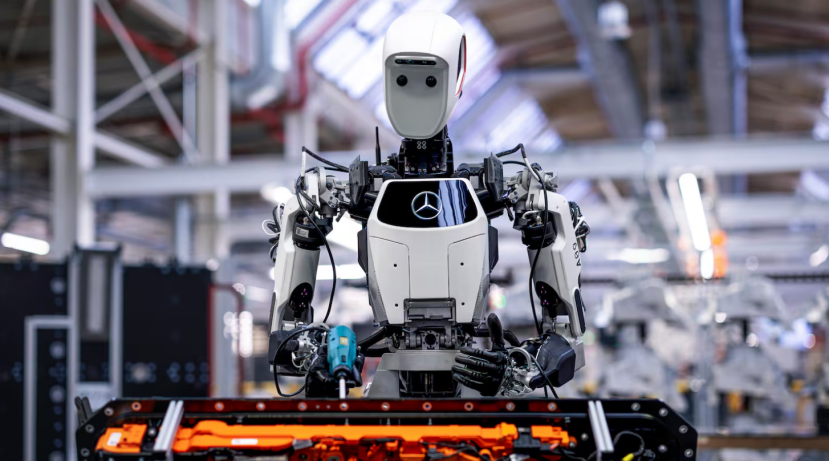
The humanoid shape is not natural for every station
Car lines run on tight cycle times, and the robot must act continuously and accurately within the window. Pacheco points out that today’s humanoids are generally slower than people at assembly and their grip has not reached human level, so a polished demo does not prove they can hold a mass-production line. Endurance is a direct limit: a humanoid under hard work often needs charging after a few hours and cannot cover a full eight-hour shift, and a firm that keeps backup robots on rotation could see its initial kit cost double.
Fixed six-axis arms carry none of those burdens. Souche notes many industrial jobs do not need legs, and an upper-body humanoid can deliver most functions at lower cost and complexity. For carmakers, the nearer-term route is likely to pick the robot form per station rather than chase one general-purpose humanoid.
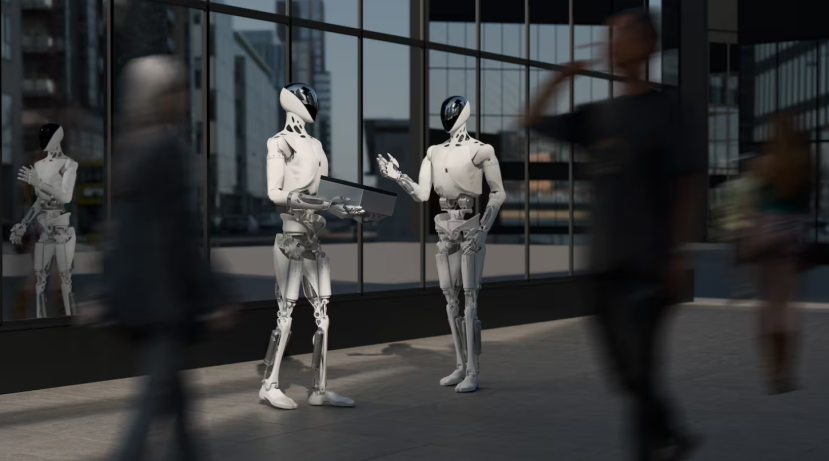
Purchase price is only part of the cost
Souche puts today’s humanoid prices at roughly USD 20,000 to USD 200,000, with heavy-lift models at the top of the range. The sticker does not show the full bill: firms must also cost task training, system tuning, daily maintenance and backup units, and judge whether one robot can be reused across stations. Pacheco adds that no one has yet proven these machines run reliably for years under daily hard use, and training a robot for one task adds cost and system complexity.
Safety rules are still thin. Roland Berger and IDTechEx note humanoids still face overheating, weak battery energy density and precision parts that struggle with factory loads, and there is no dedicated safety standard for bipedal robots yet. That means rollout speed depends as much on safety rules as on hardware and algorithms. Scale only makes sense once the flexibility payoff covers these extra costs, so carmakers must weigh utilisation, charge time, maintenance frequency and cross-station reuse, not just robot price against wages.
Editor’s note: This is an adapted translation of the original Gasgoo report. It has been trimmed and restructured for readability for an international business audience.
Translated and adapted from Gasgoo (https://www.gasgoo.com/apps/50640d4b55d5cba175fb84f15d679f19/robot/news/70471708-%E8%BD%A6%E4%BC%81%E4%BA%89%E6%8A%A2%E4%BA%BA%E5%BD%A2%E6%9C%BA%E5%99%A8%E4%BA%BA-%E5%85%88%E6%92%9E%E4%B8%8A%E7%BB%AD%E8%88%AA%E6%88%90%E6%9C%AC%E4%B8%8E%E6%95%B0%E5%AD%97%E5%8C%96%E9%97%A8%E6%A7%9B/).