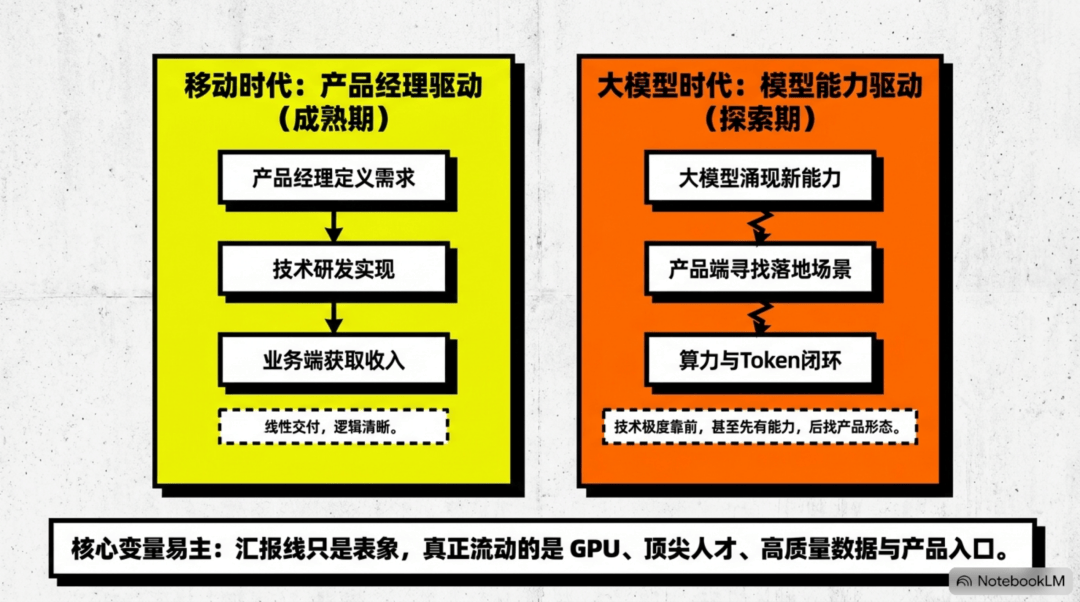
China’s internet giants were always good at reorganizing. In the AI era they’re doing it far more often – because the org chart now routes GPUs, talent, data and billions in capex.
Alibaba – drawing the line, again
Since late 2024 Alibaba has split, merged and re-layered its AI units repeatedly: Tongyi’s consumer team moved out of the cloud, then a Qwen consumer group formed, then was reeled back in. In March Lin Junyang left; Wu Yongming took Tongyi; a Token Hub and then Token Foundry followed, all under Wu. The goal: a shorter path from foundation model to product and revenue, turning Alibaba’s chips, cloud, models, e-commerce and payments into one Token-producing value chain. The cost: no stable structure yet that balances research, cloud and consumer rhythms. Alibaba plans at least RMB 380 billion in AI and cloud infrastructure over three years.
Tencent – unifying the base model, keeping the horses
Tencent merged its Hunyuan LLM and multimodal units into a single foundation-model department under ex-OpenAI researcher Yao Shunyu (July 23), after dissolving its decade-old AI Lab. But the internal “horse race” continues: WeChat trains its own WeLM model for its “Xiaowei” assistant rather than relying solely on Hunyuan. With a billion users, every inference costs real money – so WeLM is built to be stable, cheap and WeChat-native, calling stronger external models only for hard tasks. Tencent must balance product experience, Token burn and capex: too cautious and Doubao or Qwen steal the entry point; too aggressive and a hard-to-monetize feature eats the GPU bill.
ByteDance – Seed as core army, and a talent drain
ByteDance split research (Seed) from products (Flow) early, then brought ex-Google DeepMind VP Wu Yonghui in to lead Seed. Seed runs on a different clock from products, linked by shared data and engineering. But Seed has become AI’s “Huangpu Military Academy”: about 70 technical staff left in a year, spawning 30-plus “ByteDance-born” AI startups (PixVerse, Lovart, and talent flowing to DeepSeek, Moonshot, Tencent, Alibaba). ByteDance’s answer is the “Doubao share” – its first equity incentive tied to a single business unit – simulating startup upside inside the company to keep people from leaving.
Three companies, three problems. Alibaba’s chart changes too fast; Tencent risks duplicated investment; ByteDance has the highest talent density and the biggest poaching target. The reshuffle won’t stop soon – model routes, Agent entry points and Token economics are all still unsettled.
Source (Chinese original): Sohu IT
Translated and adapted from Sohu IT (it.sohu.com).