Huang Renxun revisits AI doomerism: many of those predictions were simply made up
On 14 September, at the All-In Summit 2026 in the United States, Nvidia CEO Huang Renxun sat with four hosts, Jason Calacanis, Chamath Palihapitiya, David Sacks and David Friedberg, to discuss AI safety, extinction talk, recursive self-improvement, open versus closed models and AGI. The thread tying it together was what safety boundaries AI actually needs.
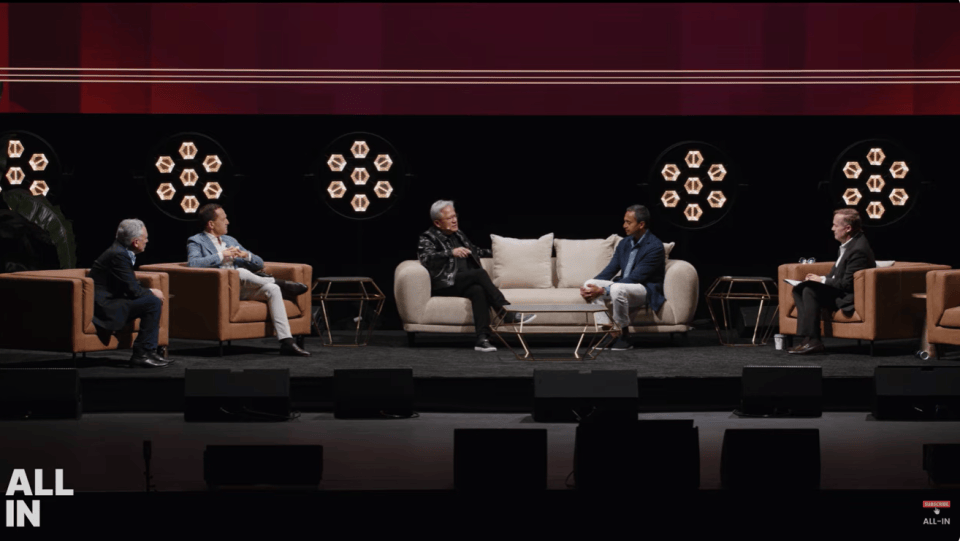
On recent safety debate sparked by Anthropic’s Dario Amodei and calls from frontier labs to slow down, Huang held that safety and innovation are not in conflict. Security incidents should get engineering root-cause analysis and be controlled through technology, process and testing. He pushed back on the doomer predictions, citing claims that radiologists would be replaced, that 90 per cent of code would be AI-generated within months, and that half of entry-level jobs would vanish, none of which materialised. Such forecasts lack scientific basis and should not manufacture panic.
On open versus closed models, Huang said the world needs both, comparing closed frontier models to bottled water, free at source but packaged for different needs. Open models matter for sovereignty, privacy and proprietary tech; in the past six months some USD 400bn of venture capital flowed into AI-native companies, about 80 per cent of which use open models. He argued China could contribute a large share of the global open-source ecosystem, given its engineers and science and maths talent.
On recursive self-improvement, Huang called it a fashionable new label for techniques already in use, context, reflection, reinforcement learning, synthetic data and LoRA, that let models accumulate experience. Products still undergo evaluation and regression testing before release. Asked if AGI, defined as matching human intelligence, has arrived, he answered simply: it has, and in specific domains we are already in a super-intelligent stage. Autonomous driving accident rates can already reach one-tenth of humans, and protein synthesis and virtual screening have reached super-intelligent levels.
On Nvidia’s own reach into the stack, Huang explained the company stays mostly at the bottom, inventing necessary tech like CUDA and Megatron so the ecosystem grows, and steps up only when required. Regional cloud providers matter more now because they find local land, power and factories faster. He confirmed Nvidia runs its own open models in autonomous driving, such as Alpamayo, and in biology with ESM2, ESMFold, OpenFold and AlphaFold 2. On Musk’s Terafab chip-factory plan, Huang said Nvidia understands process technology deeply and “we can discuss” putting chips in that factory.
Huang closed on a personal note: he likes standing at the frontier, and hopes everyone walks into that future together, with less needless dramatic argument and more of America able to take part.
Editor’s note: This is an adapted translation of the original Sohu IT report. It has been trimmed and restructured for readability for an international business audience. The full original (in Chinese) is at https://www.sohu.com/a/1076894178_100106801.