Chinese dexterous hand sales reached about 19,200 units in 2025, up 236.84 per cent year on year, and GGII expects 70,200 units in 2026. The volume is real. The deployment is not.
Most of that volume is three-finger, six degree of freedom hardware sold into research laboratories and data collection operations. The share actually holding a production station and working to a takt time remains small. Between a hand that demonstrably works and a hand that is actually working there is a gap the industry has been slow to close.
Three reasons the gap persists
There is no shared benchmark, so a hand is judged on scattered demo videos. Service life claims of two to three weeks have circulated for too long without independent verification. And yield and consistency remain uncertain enough that production managers will not hand over a station.
Critical Point, a nine month old Chinese hand maker, chose its October 29 AI Day to attack the problem directly rather than add another demo. It has shipped 15,000 units cumulatively and used the event to launch a data glove and to run a live link to a working production cell.
The data problem is a tactile problem
Embodied models are short of data that preserves physical contact. First person ego video is cheap and abundant but cannot record where a finger touched an object, how hard, whether it slipped, or how the contact changed. For pick and place that hardly matters. For pinching a small part, adjusting a tool or driving a screw, it is the whole task.
Teleoperation produces better data and costs far more per hour, because it needs rigs, floor space and trained operators. The industry is therefore stuck between data that scales and data that means something.
Critical Point’s answer is a fabric glove rather than a rigid exoskeleton. OmniGlove Pro combines electromagnetic field tracking with inertial measurement and adds tactile sensing at the fingertips, reaching 0.1 mm positional accuracy, 746 tactile points and 3 mm tactile spatial resolution. The chief embodied scientist Huang Bidan argues that beyond a million hours of human manipulation data, adding hours yields diminishing returns, and the next gain has to come from precision and completeness, particularly touch.
What a production station actually demands
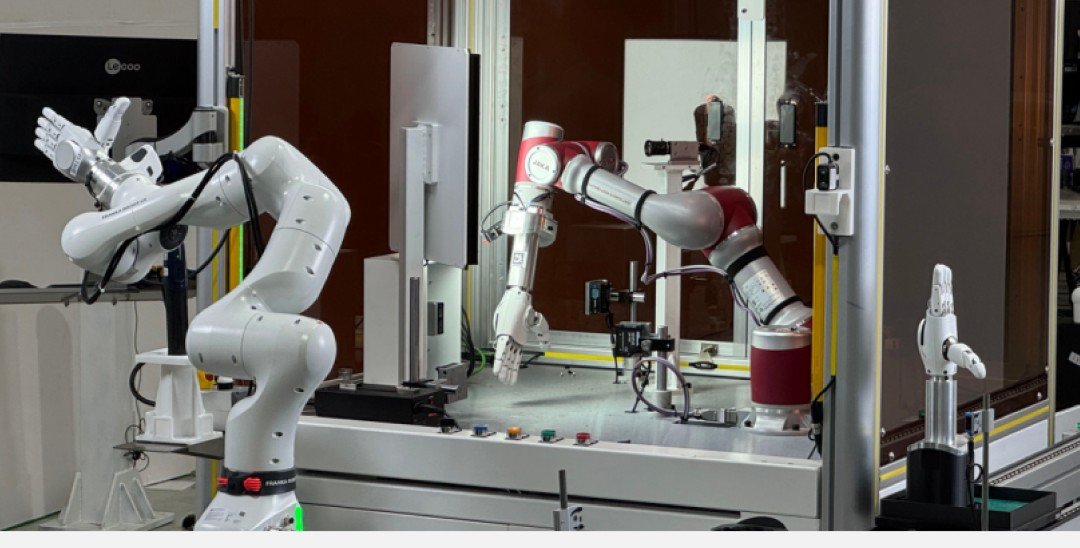
The live link ran to a Wolong joint manufacturing base in Shaoxing, where one OmniHand tested another before shipment. The sequence covered 72 steps from loading and scanning through clamping, screw driving, test initiation, screw removal and unloading, all autonomous.
It succeeded 98 per cent of the time, in 8.5 minutes per cycle against about 8 minutes for a skilled worker, and can run eight hours without a break. Screw fastening was the hardest step, because screw wobble of a millimetre, the weight of the driver, cable pull and torque reaction all displace the grip. The team also pushed the arm mid-task, moved the fixture to shift the hole position and changed the lighting. The robot corrected through vision and touch, and when a screw failed to seat it identified the fault, traced back and re-aligned.
Reinforcement learning on real hardware made the relevant skills two to three times faster than teleoperation, and the failure rate on installed units fell from close to 10 per cent to under 0.5 per cent.
Fifteen thousand units is a manufacturing milestone. It is not yet a deployment milestone, and the company says as much. The next test is whether the same station still runs in a year, at a maintenance cost a plant manager will accept.
Editor’s note: This is an adapted translation of the original OFweek report. It has been trimmed and restructured for readability for an international business audience. The full original (in Chinese) is at https://robot.ofweek.com/2026-11/ART-8321201-8140-30709783.html.