UBTech, the Shenzhen company that carries the label of Hong Kong’s first listed humanoid maker, has taken its most expensive hardware layer in-house. Its controlled subsidiary Fenglong has established a wholly owned company, New Fenglong, which will build the joints, hands and thermal systems that UBTech previously bought or developed project by project.
The new entity is not aimed at assembling complete humanoids. It is aimed at the component bill of materials, which is where the cost fight is actually being decided.
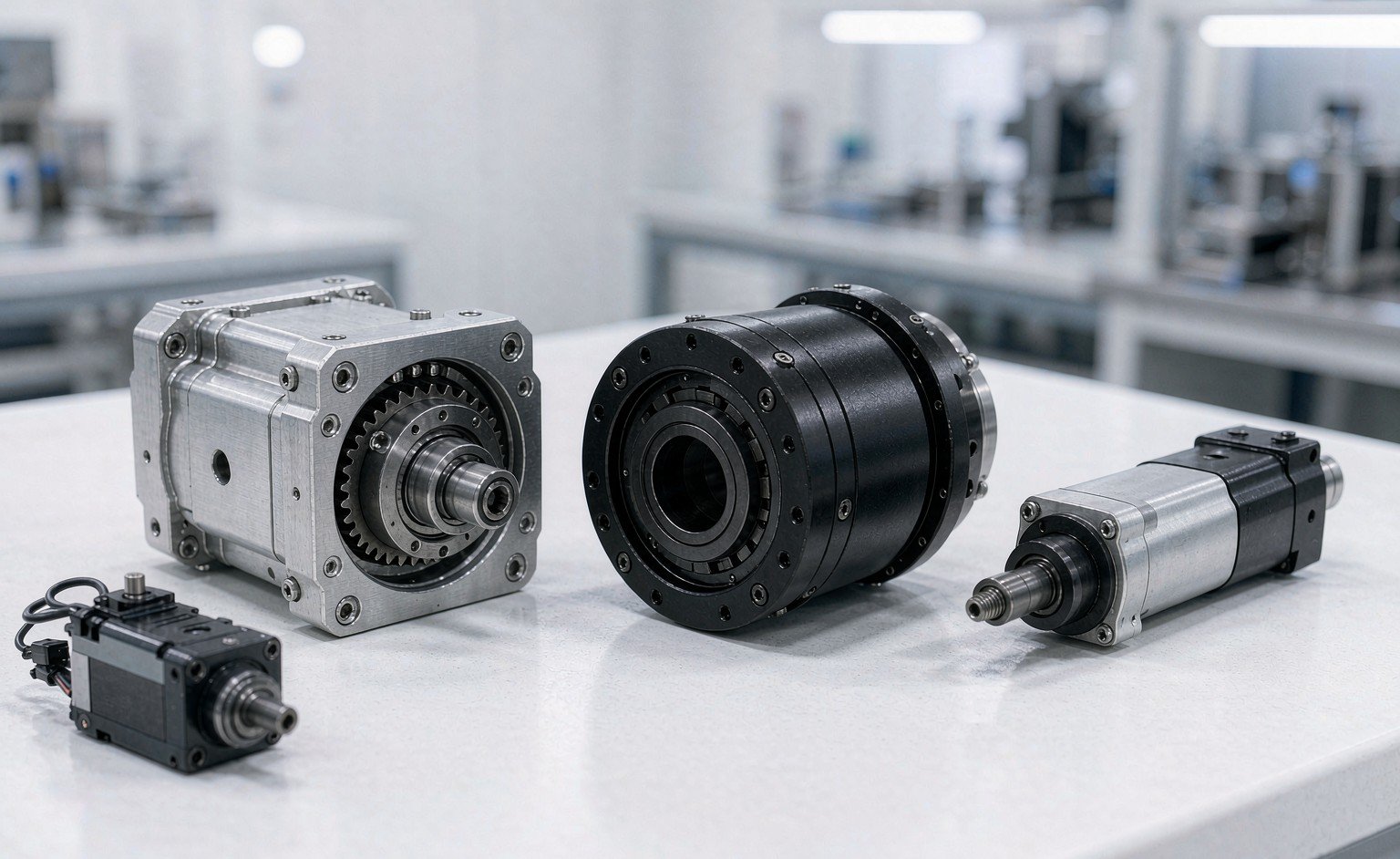
Three product matrices, one supply chain
Core components cover bionic facial servos, high density servos in planetary, harmonic, cycloidal and linear formats, cooling modules and electronic skin. End effectors cover two-finger grippers, dexterous hands and human-like bionic arms. Peripherals cover battery swap cabinets and charging stands.
The published specifications are specific enough to place the products. The planetary joint module peaks at 300 Nm with torque density up to 200 Nm per kilogram and supports hollow routing, aimed at service humanoids and mobile robots. The harmonic module reaches absolute positional accuracy of plus or minus 0.2 degrees, relative accuracy of 0.05 degrees and a reduction ratio up to 161, aimed at light humanoids and precision industrial work. The linear module integrates screw, drive and encoder at up to 100 N of push-pull force and plus or minus 0.05 mm, built for dexterous hands and arms. The facial micro servo weighs under 40 grams, delivers 6 kgf cm, rotates a full 360 degrees and speaks CAN.
The schedule is already public
Two-finger grippers and facial servos are in mass production today. High power density servos, dexterous hands and bionic arms are scheduled for 2027, with liquid cooling and electronic skin still in development.
New Fenglong will also absorb UBTech’s consumer brand Youshijie and its medical line Youyiliao, which extends the remit from components into household and clinical robots. Li Yongjun, who holds a doctorate and spent more than twenty years on motors and motor control at Johnson Electric, Jinba Intelligent, Tuopu and Midea, runs the company. Motor and control engineering is precisely the gap UBTech needed closed.
Why a hardware subsidiary in 2026
Humanoid makers in China are converging on the same realisation that China’s car industry reached a decade ago: the integrator margin sits with whoever controls the actuator. Joint modules are the single largest cost block in a humanoid, and the market currently buys them from specialists who serve every competitor equally.
Building that capability internally, and then selling the resulting modules to the rest of the industry, converts a cost centre into a revenue line. It also makes UBTech a supplier to companies it competes with, which is an unusual position but not a new one in Chinese manufacturing. CATL supplies battery packs to carmakers that compete with its own customers, and Huawei sells drive units to OEMs that fight it in showrooms.
The risk is focus. Running a component business demands different discipline from running a robot brand: yield, consistency and delivery schedules matter more than demonstrations, and customers will audit a supplier far more aggressively than they audit a rival. UBTech has given itself until 2027 to prove the volumes. What it has not said is who, outside its own assembly line, has signed up.
Editor’s note: This is an adapted translation of the original OFweek report. It has been trimmed and restructured for readability for an international business audience. The full original (in Chinese) is at https://robot.ofweek.com/2026-11/ART-898890-8120-30709670.html.