China Mobile has finished evaluating its 2026-2027 procurement of next-generation artificial intelligence supernode equipment, and the result is a single-country supply chain. The tender closed on 2 November with a total of 20,480 accelerator cards, 448 RoCE switches and 82 storage systems split between five bidders. The headline value is RMB 58.2 billion.
The five winners are Huakun Zhenyu, Baode, Huaqi Zhihui (a subsidiary of Dahua Technology), Baixin and ShenkunTai, the computing unit of Digital China. Every one of them builds on Huawei’s Ascend ecosystem.
What ShenkunTai actually won
Digital China disclosed on the evening of 30 October that its controlled subsidiary Beijing ShenkunTai had been named the fifth candidate in the China Mobile tender, with a bid of RMB 11.666 billion excluding tax and an allocated share of 2,048 cards. The public notice period ended on 2 November. No formal acceptance letter has been issued, and the group has flagged that the final value remains uncertain.
On volume, ShenkunTai holds 10 per cent of the programme and sits last among the five. Its price per card lands near RMB 5.7 million, close to three times the roughly RMB 1.9 million implied by the leading bid from Huakun Zhenyu. The company attributes the gap to product form: it quoted liquid-cooled supernodes rather than standard racks.
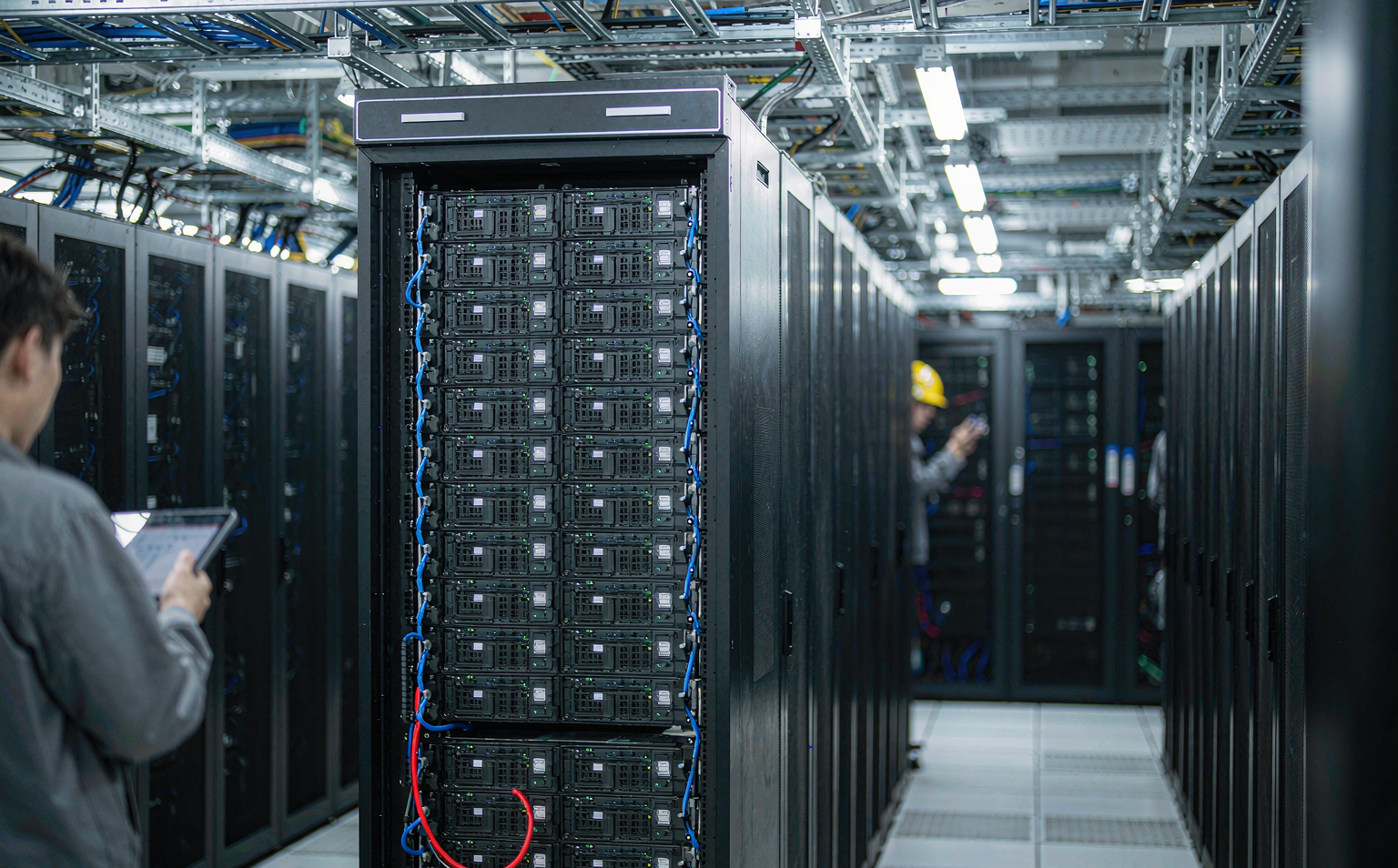
Its KunTai PoD2000 A5 platform supports cluster deployment of up to 1,024 cards with 256TB of unified memory addressing, paired with an in-house Muxi liquid-cooled switch rated at 102.4Tbps of switching capacity. In late October the same unit signed a separate RMB 870 million contract for liquid-cooled supernodes built on Ascend 950DT, the part Huawei positions as the only domestic accelerator supporting low-precision FP4 inference and the Lingqu 2.0 interconnect for ten-thousand-card clusters.
A distributor discovering its own margin
Put the contract next to Digital China’s own accounts. Revenue for the first nine months reached RMB 136.726 billion, up 33.57 per cent, with net profit attributable to shareholders of RMB 780 million, up 16.41 per cent. Net margin is under 1 per cent.
IT distribution still carries the bulk of that revenue. The own-brand computing infrastructure business, however, is the fast line: RMB 6.57 billion in the first half, up 111.7 per cent, with AI-related business including cloud services and software at RMB 8.30 billion, up 74.9 per cent. A single RMB 11.666 billion pre-award is roughly 1.8 times half a year of own-brand infrastructure revenue.
Hardware integration rarely carries thick margins. AI server builders in China generally sit in the single digits on net income. Digital China’s argument is that its HICA and HISO software platforms cut inference latency and accelerator consumption enough to make an integrated bid defensible at a high unit price.
The strategic signal sits above the P&L. A state carrier buying 20,480 domestic accelerators in one order is not a commercial preference, it is capacity planning for a supply chain that cannot be interrupted from outside. The five-vendor structure spreads the risk of any single builder failing to deliver.
What the sector has not yet demonstrated is whether domestic AI infrastructure can be delivered at a profit. Three years of domestic compute rhetoric now meet a delivery schedule and a gross margin line.
Editor’s note: This is an adapted translation of the original OFweek report. It has been trimmed and restructured for readability for an international business audience. The full original (in Chinese) is at https://www.ofweek.com/ai/2026-11/ART-201714-8120-30709940.html.