Two stories landed within a day of each other this week, neither dramatic on its own, and together they say more about logistics robotics than either does alone.
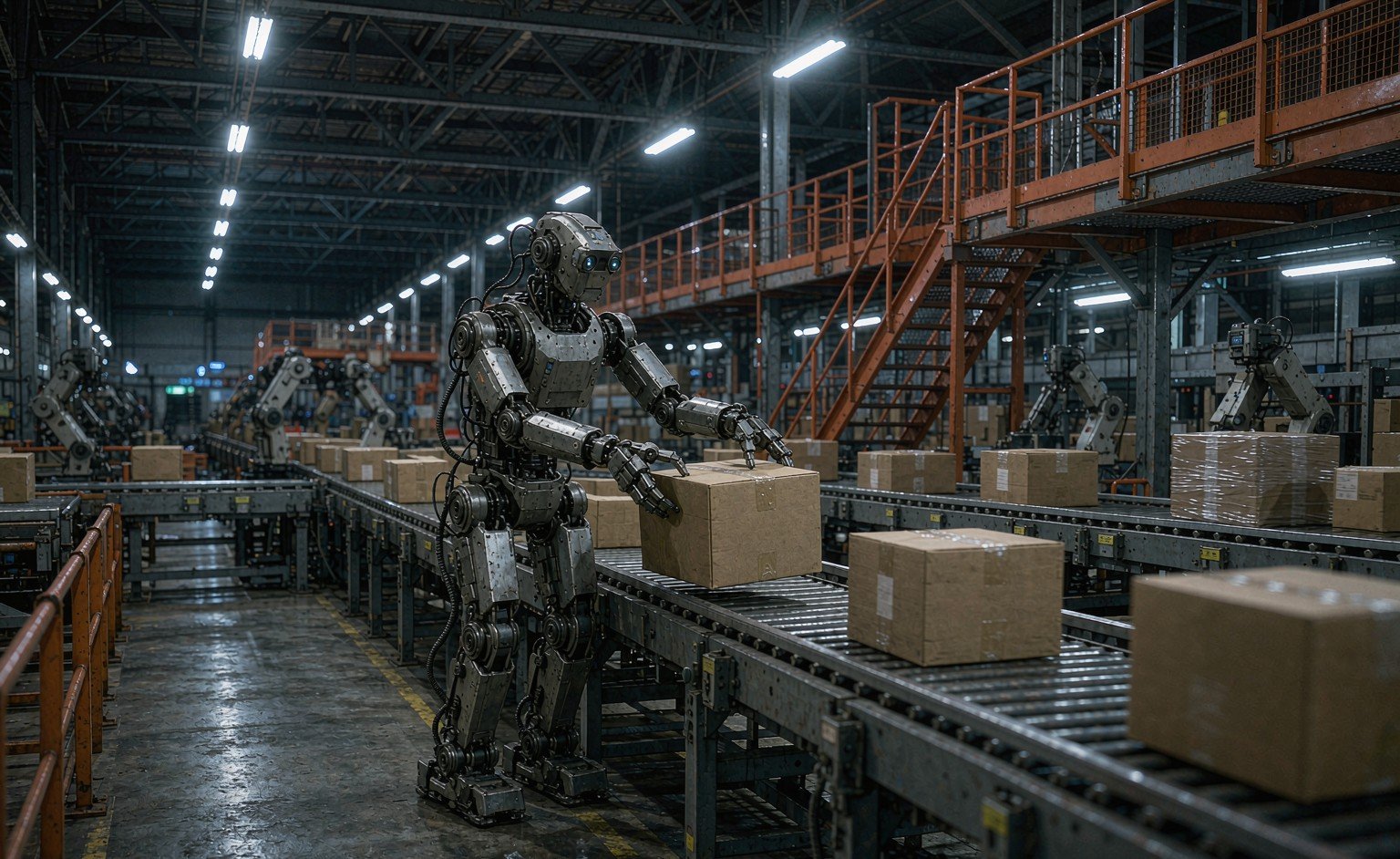
On 15 November CCTV Finance reported that China Post’s Shenzhen mail processing centre had put three embodied robots on the night shift. The numbers are good: each handles 1,000 to 1,200 parcels an hour, feeding accuracy above 95 per cent, and each can pull damaged parcels and bad labels for humans to handle.
A day earlier, at a session during the import expo, logistics equipment leader Demag Technology said it is running a proof of concept for a top overseas e-commerce customer. Demand is real, it said, cost is not the core obstacle, and payback is viable. The bottleneck is a shortage of real operational data, and the honest admission that the model still cannot really do the work.
Where the 95 per cent is measured
The China Post deployment comes from Wo Neng Embodied and uses a general end-to-end model. An overhead camera identifies parcel type and position, feeds a decision layer that chooses one hand or two and whether to flip, and the hands execute. The model was trained by capturing data continuously for a week to build a base, then iterating on the motions that failed.
The 95 per cent deserves a closer look at task granularity. Most of the gain sits in parcel feeding, the upstream end of the sorting line where parcels arrive from the unloading dock with relatively clustered characteristics and a clear engineering fallback: the system identifies exceptions itself and hands them to people. Errors get caught downstream by humans. Precision requirements are comparatively forgiving.
Where the cold water lands
Demag’s objection is about the long tail. Its customer runs a full-category warehouse: tens of thousands of SKUs, packaging in every shape, reflective tape, soft bags, crushed and warped cartons, and light that changes through the shift.
Read together, the two stories draw the line. China Post shows a model holding up inside a specific task distribution. Demag shows generalisation failing in an open one. Hitting 95 per cent in a controlled distribution is an engineering problem. Holding 95 per cent across tens of thousands of SKUs without human rescue is a research problem in generalisation.
The stage and the capital logic diverge
The detail about a week of continuous capture gives away the current stage. This is still project-based deployment. Every site, every line and often every customer’s parcel mix requires fresh data and a fresh fine-tune. That is a long way from a product that replicates. Data sharing solves transfer between machines on the same site, not generalisation across sites and customers.
At this stage, investors should discount the narrative metrics. Signing proof of concept deals with a dozen logistics majors only proves you got a ticket to the room. The number that can anchor a valuation is composite success rate and how often a human has to take over. If a robot needs intervention every ten minutes through a night shift, the 95 per cent is fiction to the customer paying for it.
So the real question is not whether a robot can reach 95 per cent. Three units at China Post have shown it can, in a narrow slice. The question is whether that 95 per cent survives a customer’s own warehouse, its SKU tail and its crushed packaging without human rescue, without trimming the scene, and without re-collecting data every week.
Demag and its overseas customer are still waiting for the industry to cross the gap between demonstration and delivery.
Editor’s note: This is an adapted translation of the original OFweek report. It has been trimmed and restructured for readability for an international business audience. The full original (in Chinese) is at https://robot.ofweek.com/2026-11/ART-8321202-8420-30712078.html.