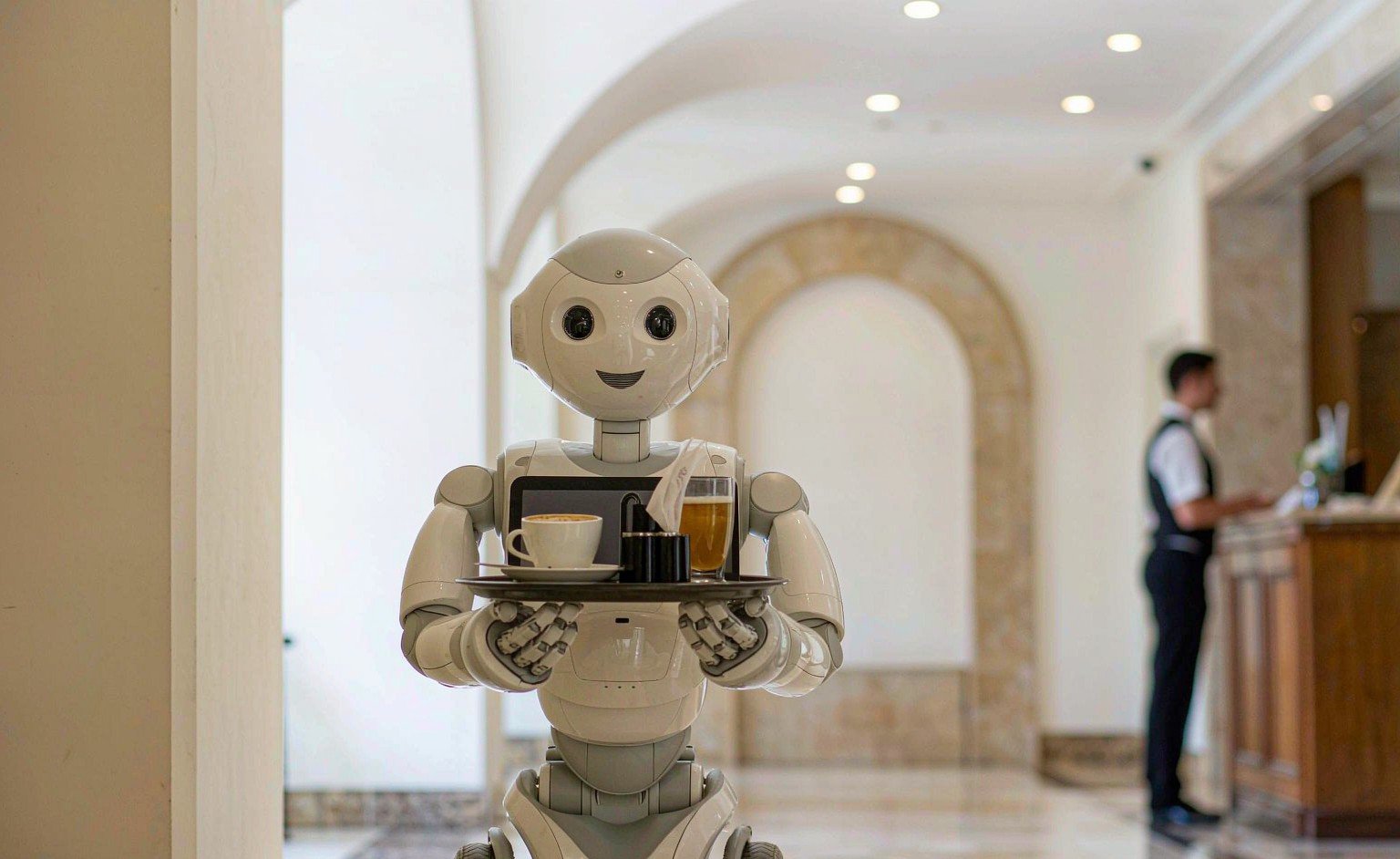
A wheeled humanoid stops at a display case inside the 140th Canton Fair, turns, adjusts its angle and begins describing the exhibit to a visitor. Its counterparts work other positions nearby, some delivering coffee, some running retail counters.
At almost the same time, similar machines were making coffee and ice cream and greeting guests at a Guangzhou hotel, a Xi’an night market street and a Hong Kong temple. Put those scenes together and a different picture of the industry appears: robots have stopped performing on stage and started entering spaces with foot traffic, orders and a service process.
The company behind them is Guangdong Zhidong Weilai Technology, founded three years ago, which has just closed a Pre-A+ round in the hundreds of millions of RMB.
How a fourth round happened in three years
The round was led by the China-US Green Fund, with Nanxi Ventures co-leading and existing shareholder Haizhu Urban Development adding capital. The China-US Green Fund was initiated by the Central Financial and Economic Affairs Office and the Paulson Institute, backed by institutions from both countries, and operates as a market-driven private equity fund.
This is the fourth round. Before it came a MiraclePlus seed, an angel led by a supply-chain shareholder with MiraclePlus following, and a Haizhu Urban Development-led Pre-A that was oversubscribed. Cumulative equity funding has reached several hundred million RMB.
Funding announcements are easy to stuff with figures. The more scarce signal here is the behaviour of the investors. New entrants suggest a hot sector. Existing shareholders following into the next round suggest the previous round’s promises were partly delivered.
Proceeds go to raising output at a new Guangzhou line, to scaled deployment in exhibition, hotel, tourism and retail settings, and to continued work on a particle-based differentiable world model.
One more move is worth recording. The company was founded in Singapore at the end of 2023 and has now moved its headquarters back to China, to Haizhu in Guangzhou, with the new line entering production at the same time. While many teams chase overseas valuations, this one pulled research, production and market focus back in, which is a vote for supply-chain density and scenario variety rather than nostalgia.
What the world model does differently
Founder, chief executive and chief technology officer Chen Siwei was first author at RSS 2021 and CVPR 2023 and a co-first author on DaXBench, a deformable object manipulation benchmark accepted at ICLR 2023. In September 2026 he previewed Zhizi World, a particle-based differentiable world model.
Most world models this year predict the next frame. That looks impressive and answers nothing about how far to tilt a cup so the water lands inside it. Zhizi World reconstructs scenes from multi-view video and represents geometry and physical state with particles. Engineers can change position, material, mass and friction, watch the consequences of different actions, and back-propagate the error between prediction and target into action optimisation. Reconstruction, object-level editing, physical roll-out and action optimisation sit in one model.
The company pairs it with a vision-language-action model and uses low-latency public-network 3D streaming to collect real machine data on demand.
The external evidence, with limits
A Berkeley paper called SuperMimic offers a quantifiable reference for the differentiable route. In whole-body humanoid motion tracking it trained for about three hours on a single H100 and beat a SONIC baseline trained for seven days on 128 L40 cards, using less than a thousandth of the GPU hours.
Those numbers do not transfer. SuperMimic studies a robot’s own whole-body control, while Zhizi World targets interaction with external objects, contact, deformation and re-planning after environmental change. The two are different problems, so the former is peripheral evidence for the approach rather than a result the company owns. The hardware and data scales also differ, and the efficiency figures are self-reported without independent replication.
How the machines actually perform
In JD’s Singles Day intelligent robot sales ranking, Zhidong Weilai placed sixth by sales value and eighth by units. During the Canton Fair, multiple Xiaozhi S3 units handled guided tours, coffee delivery and retail across the venue, and service robots were among the most visited categories. Media reports put the robots in a Shenzhen robot restaurant, a Guangzhou hotel, the Xi’an night market street and a Hong Kong temple, covering exhibition, catering, tourism and retail.
Deployments span Guangzhou, Shenzhen, Xi’an, Changsha, Singapore, Indonesia and Malaysia. The company says a 6,000 square metre production base is under construction, that it employs more than 130 engineers and PhDs, and that publicly reported orders have reached several hundred units.
The bar for a service robot is moving from whether it can perform to whether it can run stably and repeatedly in a real setting. A company relocating its headquarters from Singapore to Guangzhou says something about where that repetition is cheapest to find.
Editor’s note: This is an adapted translation of the original OFweek report. It has been trimmed and restructured for readability for an international business audience. The full original (in Chinese) is at https://robot.ofweek.com/2026-11/ART-8321203-8420-30712096.html.