Beijing published a policy on artificial intelligence and employment on 23 October. The document never uses the phrase embodied intelligence, and the speciality robotics industry read it as an instruction anyway.
The reasoning is straightforward. The robots that are actually being deployed in volume are not competing with office workers. They are going into live high-voltage substations, explosive zones in chemical plants, 1,100 degree fires, ship hulls tens of metres up and seabed trenches kilometres down, places where recruitment is difficult and the work can kill.
Where the purchase orders are
Power inspection is moving fastest. Shenshu Intelligent won State Grid packages in October, including a category for quadruped robots in complex environments with its Fumo unit, a legged machine carrying an arm. The company’s Fu’an humanoid, built for live-line work, was already the first domestic product delivered in that scenario.
Fumo exists because the legacy cable tunnel problem is specific. More than 60 per cent of China’s cable tunnels are old builds with no power, no network and no fixed monitoring, and they are narrow, poorly ventilated, wet and uneven. Conventional quadrupeds can read gauges in them. They cannot pick up a tool.
Fire and emergency work is a certification business. Guoxing Intelligent released 11 products at the end of September, including a heat-resistant firefighting robot rated for 30 minutes of continuous operation inside a 1,100 degree fire, and a heavy-duty explosion-proof embodied robot with more than 100 kilograms of single-arm payload. At the October Canton Fair it showed an explosion-proof inspection robot with full Ex rating, dual-band cameras and gas detection that had already obtained EU certification, meaning it can be exported directly.
The chemical plant milestone
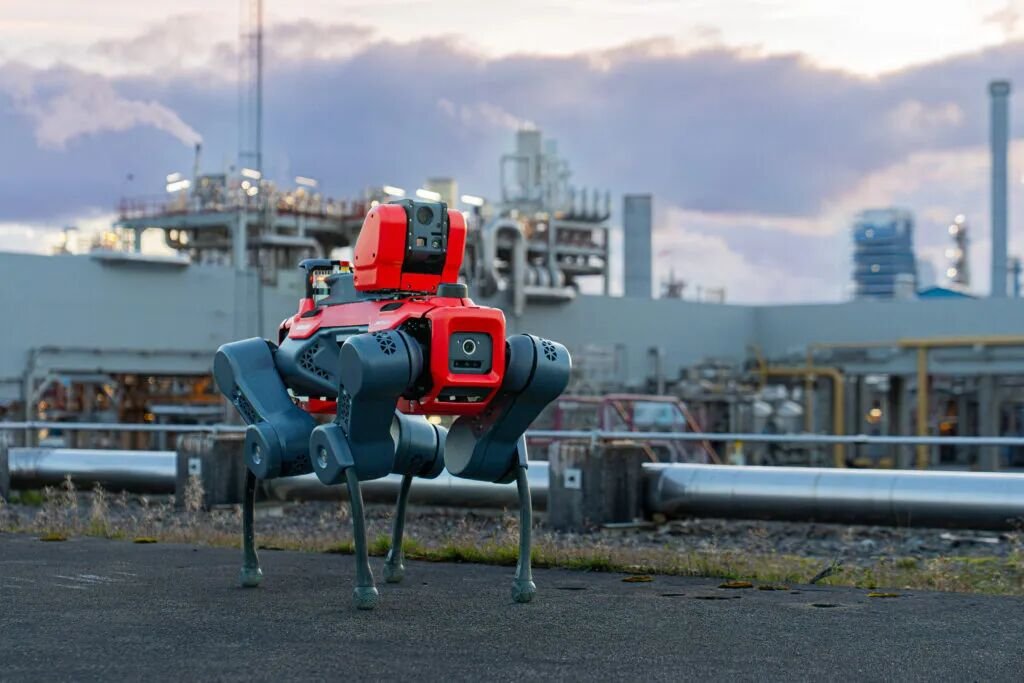
The symbolic event of the month was commercial rather than technical. ANYbotics delivered ANYmal X on 27 October, describing it as the world’s first legged inspection robot for explosive environments, with Equinor and DSM-Firmenich as customers and BP, Shell and BASF involved in earlier testing.
A Chinese competitor is close behind. Qiten Robotics released an explosion-proof quadruped, the X5, and a wheeled L3 platform in September alongside an application-level embodied intelligence platform for industrial inspection.
Subsea and hull work are further from the headlines and closer to revenue. CRRC Times Electric launched a heavy-duty subsea chain trencher at the October ocean expo, rated to 3,000 metres with 690 kilopascals of cutting force for hard seabed, plus a 6,000 metre ROV with 150 horsepower and 250 kilograms of payload. Shihe Robotics holds 70 to 80 per cent of China’s ship-derusting robot market, has worked on more than 10,000 cargo ships and has cut dry-dock cycles from six or seven days to about three, with payback inside six to twelve months. Its EM10 wall-climbing humanoid entered volume use at a large shipyard in the same month.
The quietest segment is the one with the highest stakes. Fukushima’s decommissioning work continued in October with remote manipulators investigating melted fuel debris inside the containment vessel. Minerva Humanoids, whose Roger humanoid is designed for explosive ordnance disposal and hazardous material handling, closed a pre-seed round of about USD 10 million, built around shared autonomy in which an operator intervenes through virtual reality at key decisions.
Why the tiers look so different
Each segment is defined by what it costs to send a person in.
Power inspection replaces frequent, measurable, standardised work. The motions are fixed, the environment is semi-structured and performance can be scored in numbers, which is why the replacement arithmetic closes first and why hardware specifications matter less than getting into the procurement catalogue.
Chemical plants and fires replace work where a person may not come back. The barrier is not the robot. It is certification and trust. Standard machines are banned from process areas and tank farms, and a robot needs Ex certification, sensor calibration and integration with the customer’s existing maintenance systems. Buyers in this segment rarely switch suppliers for a feature. They want equipment that has already run inside a plant like theirs.
That makes the sales cycle slower and the contracts larger, and it means the Chinese entrants winning EU certification now are building an export route that does not depend on price.
Editor’s note: This is an adapted translation of the original OFweek report. It has been trimmed and restructured for readability for an international business audience. The full original (in Chinese) is at https://robot.ofweek.com/2026-11/ART-8321204-8420-30710161.html.