Geek+ has spent a decade selling autonomous mobile robots that move shelves. Its new plan is to sell a warehouse that decides what to do next without anyone scheduling it.
The company calls it the 24/7 Autonomous Intelligent Warehouse Programme, and the structure is three steps: hand the complex manual operations to embodied AI, let the AI move from detecting problems to making decisions, then replicate the whole thing across its installed base. Geek+ has deployed more than 81,000 robots across 40-plus countries and says it has held the top AMR market share for seven consecutive years.
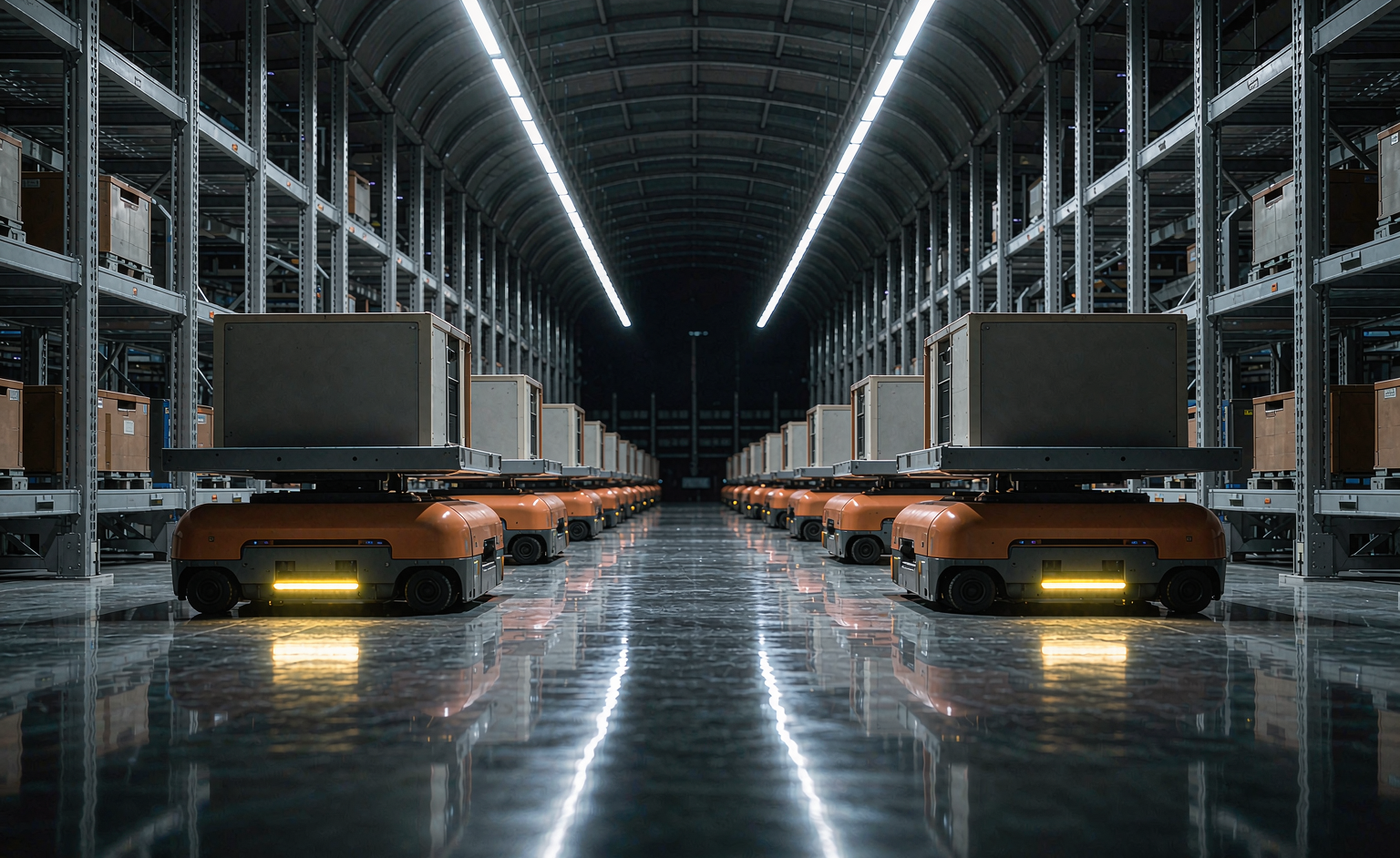
The bottleneck that AMRs did not solve
Warehouse automation has a strange failure mode. The more the standardised work gets automated, the more the remaining manual work concentrates in the hardest tasks. AMRs made transport and storage flow, and goods can now find people. Complex picking is different: thousands of SKUs, packaging that changes, items placed differently every time.
Geek+ is addressing that with two layers. Gravity, its unified embodied AI framework, handles task understanding and motion planning. Gravity 4D, an embodied world model, handles geometry, contact forces and how objects behave. Together the company claims cross-task generalisation to unfamiliar objects without per-object training, tolerance for objects that move or get occluded mid-task, long-horizon task decomposition, and correction by natural language instruction instead of reprogramming.
The commercial evidence is thin but concrete. At Schneider Electric’s Shanghai logistics centre, Geek+ ran an unmanned picking workstation and reported twice the picking efficiency of manual labour with accuracy above 99.99 per cent. Its Gino 1 humanoid handles picking and box moving and co-ordinates with mobile robots on continuous picking runs.
The control layer is the harder half
A robot that can pick is not a warehouse that can run. When several hundred machines work at once, the constraint moves from manipulation to scheduling.
Geek+ describes the problem plainly: the scheduling system optimises robot paths, the business system optimises order execution, the data platform produces reports, and each has its own objective function. None of them optimises the building. Its answer is a warehouse brain that puts orders, inventory, robots, arms and workstations into one operating state, supported underneath by RMS for robot scheduling, WES for business execution and IOP for operational analysis.
On top of that sit three AI agents: one that detects anomalies, one that traces causes and proposes fixes, one that adjusts parameters and executes. Tan Wenzhe, the company’s vice president for systems platform, says a scheduling adjustment can now happen in minutes while a change to overall operating strategy accumulates from daily data. The stated objective is not autonomy for its own sake. It is removing night-shift supervision, which is the cost that makes 24-hour operation uneconomic for most customers.
What to watch
Geek+ has not published which customers have signed up for the programme, what the conversion rate from the installed base is, or how much of the picking claim depends on a single Schneider site.
The company’s own metrics for what counts as autonomous are reasonable: ability to handle exceptions unaided, throughput stability under complex conditions, continuous operating hours and recovery time after failure. Those are auditable. Whether the software layer delivers them across a thousand heterogeneous warehouses, rather than one European electrical manufacturer’s distribution centre, is the question that will decide whether this is a product or a pilot.
Editor’s note: This is an adapted translation of the original OFweek report. It has been trimmed and restructured for readability for an international business audience. The full original (in Chinese) is at https://robot.ofweek.com/2026-11/ART-8321202-8420-30710305.html.