At China Resources Trust, a bond trade can begin as a message in a chat group. Traders watch thousands of groups for instructions, extract the trade parameters and key them into the order system, then answer clients asking about positions and progress by querying the system and replying in the same thread. It is tedious and it tolerates no errors.
The firm now lets an agent into the group. It reads and decomposes the instruction, enters it into the system, queries positions and progress, and answers routine questions. According to Tencent Cloud, order-splitting accuracy rose from above 80 per cent initially to 98 per cent. At the approval step, a human still signs.
The number that explains the category
McKinsey’s global AI survey in August 2026 found that 80 per cent of respondents said AI had improved their personal productivity, while only 37 per cent believed it had contributed positively to company profit. In September the firm added an explanation: enterprises spend most of their time moving tasks between departments and systems, and waiting for them to be picked up.
That second finding is the one that matters commercially. A model that answers a question correctly and an enterprise that will let it act on the answer are separated by permissions, audit, rollback and liability. Those are not model capabilities. They are the parts of an organisation that no benchmark measures.
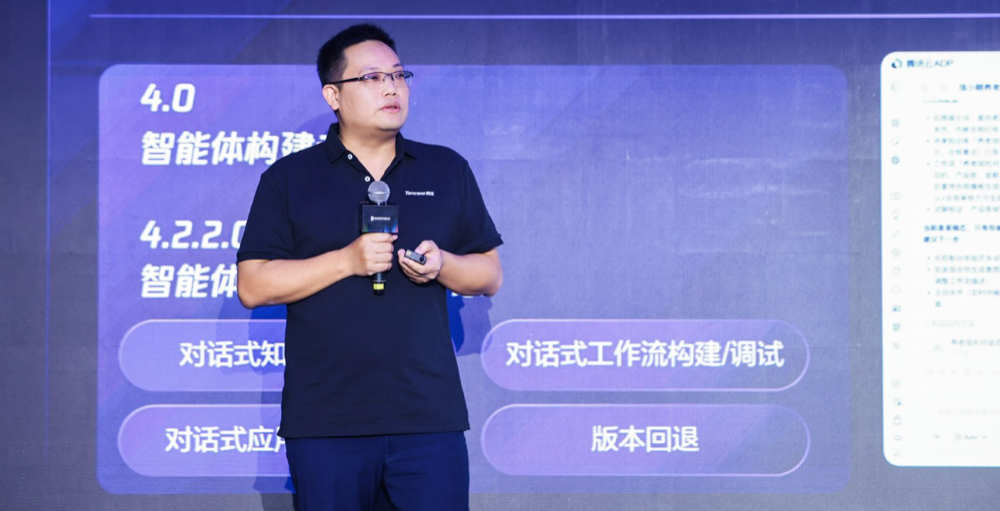
On 30 October, at its global digital ecosystem conference, Tencent Cloud upgraded its agent development platform and launched AgentPortal 2.0, along with a two-way integration with its WorkBuddy personal productivity tool. The positioning it chose is Service Agent: agents embedded in enterprise data and business processes rather than in individual workflows.
Permission before autonomy
The first problem is not intelligence, it is authority. A financial agent able to query client positions should not be able to see every client’s positions. An agent able to call a system interface should not thereby be able to complete every operation that interface allows. The upgrade adds private network connections and tenant and permission isolation so that individual agents access databases and ERP systems within defined boundaries, with connection capability exposed consistently to sandboxes, workflows, MCP and connectors.
At Yunnan Baiyao, staff need internal policies, drug information and medical literature, and each has a different audience. The company pushed permission management down to the employee ID. Staff ask a question through one entry point, the agent classifies it, routes to the appropriate knowledge base and returns only what that employee is entitled to see. To the user it is a question and an answer. Behind it are multiple knowledge bases and a rule set.
Tencent Cloud also offers four execution modes, covering autonomous planning, rule-bound workflow, multi-agent collaboration and standard execution, on the argument that a fixed-rule approval process and a cross-department analysis have opposite requirements. Gartner warned in May 2026 that applying one governance model to every agent produces both over-restriction of simple tasks and excessive authority for high-risk ones.
The handover tax
The more interesting claim is about where the value leaks. Personal AI arrived first in writing, analysis and other individual tasks, because those have clear boundaries and the user can judge the output. Enterprise work does not. A task passes through an owner, a regional team and frontline staff, across departments and systems, and if one link accelerates while the handovers do not, the gain is consumed by the queue.
McKinsey’s September study analysed the production process of a Fortune 500 industrial company and found most elapsed time was waiting for a task to enter the next stage, which it called the coordination interface tax. This is why AI usage can rise while enterprise-level efficiency and profit do not.
Tencent’s evidence for attacking that layer comes from Yili, the dairy group. Yili consolidated regional sales, promoter performance and market data, had agents analyse operating conditions and form strategy, then pushed the capability down to frontline promoters. WorkBuddy carried the analysis work and the platform’s promoter agent generated product recommendations and talking points for customers. Tencent Cloud reports guide team efficiency up more than 50 per cent, and a 26 per cent lift in orders during A/B testing.
The sprawl problem waiting on the other side
Lowering the cost of building an agent creates the software industry’s oldest problem at a new layer. Different departments build their own, each is individually useful, and nobody knows how many are running, who maintains them, which duplicate each other, or what permissions each holds. Gartner named the pattern Agent Sprawl in April 2026 and found only 13 per cent of surveyed organisations believed they had appropriate governance.
The vendor response is to pair a lower build barrier with a management layer. AgentPortal 2.0 consolidates agents from different departments into one entry point, supports third-party agents, distributes by function and controls publication and permission. Multiple agents can form a team under a coordinating project agent.
None of this settles whether the productivity claims hold at company level. What it does establish is where the next phase of competition sits. Model quality is converging. The scarce capability is making an agent accountable enough that a firm will let it touch the order book, and then proving in a P&L that the queue got shorter.
Editor’s note: This is an adapted translation of the original Zhidx report. It has been trimmed and restructured for readability for an international business audience. The full original (in Chinese) is at https://www.zhidx.com/p/606032.html.