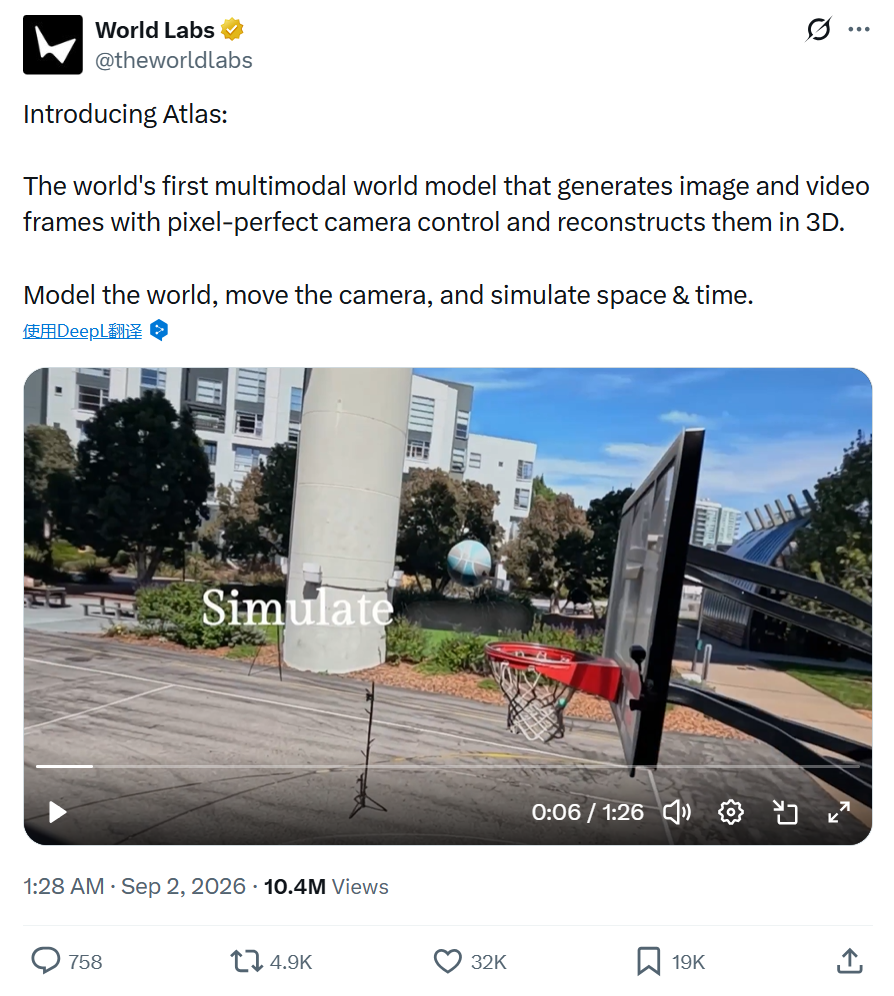
Fei-Fei Li’s World Labs released a model in September that turns a handful of ordinary photographs into a walkable three-dimensional scene and, in the company’s own demonstration, into a training ground for a robot. The cost it attacks is not compute. It is the weeks a team spends building a simulated world by hand.
Atlas is closed. It is being trialled with a small number of partners. Input is one to six reference images plus a camera trajectory, output is up to one minute of 1440p video with the camera placed where the user asked. Li called the release a milestone for the company.
The part of the pipeline it removes
Robot training data is expensive in a way that is easy to underestimate. According to a July report from EO Intelligence, real-robot operational data trades at RMB 500 to RMB 1,000 per hour on the marketplaces run by JD and Baidu. A teleoperation rig costs more than RMB 200,000. A data collector costs about RMB 300 a day. The industry has accumulated roughly 500,000 hours of high-quality real interaction data and needs at least 10 million hours to reach a usable state.
Simulation is the accepted answer, but simulation has its own labour cost. Someone has to build the scene, the materials, the lighting and the objects one at a time, and rebuild them whenever the environment or the robot model changes. A traditional point cloud or Gaussian splatting reconstruction means carrying equipment around a target for dozens of rotations and shooting hundreds or thousands of photographs.
Atlas targets exactly that segment. Its first claimed advance is camera control: video models accept text descriptions like a slow orbit and invent the rest, while Atlas accepts explicit camera positions and angles and renders the corresponding viewpoint. World Labs calls it pixel-level camera control and says the advantage widens as the camera path gets more complex. The second advance is the output format, which includes point clouds and 3D Gaussian splats that drop into a production or simulation pipeline rather than a finished clip.
In the demonstration, a Stanford main quad scene was rebuilt from two to twenty-five ground-level tourist photographs and extended into an aerial tour over the campus. On the robotics side, twenty-four frames from a phone video reconstructed a warehouse-sized space. A virtual robot walked through it while Atlas generated the view and depth data its own camera would see, with objects, lighting and background all swappable.
What it does not fix
Removing the construction step does not close the gap between simulation and reality. Stanford HAI’s 2026 AI Index puts embodied task success at 89.4 per cent in simulation and 12 per cent in the real world. The difference is mostly physical: in simulation the weight and surface friction of an object are assigned values, while in reality a cup may be full of water and a hand may be wet.
World Labs has published little on that side. Its materials concentrate on image generation and geometric reconstruction. How the model handles complex physics and what it costs at scale are not yet verifiable. Developers who have used it told reporters that once the camera moves into areas the source images never captured, the model falls back on priors, and wider viewpoint spans expose geometric drift, shape changes and texture flicker.
The competition is not standing still. Google DeepMind’s Genie 3, released in August 2025, generates explorable three-dimensional environments at 24 frames per second and was folded into the Google AI Ultra subscription as Project Genie in January 2026. Waymo built its own world model on Genie 3 in February to generate synchronised camera and lidar data for rare scenarios. NVIDIA’s advantage sits on the physics side: Omniverse can generate 780,000 synthetic trajectories in 11 hours, and Cosmos 3, released in June, ships with open weights on Hugging Face.
The valuation problem
World Labs was founded in 2024, has raised about USD 1.23 billion, and closed a USD 1 billion round in February 2026 with Autodesk putting in USD 200 million and taking an advisory role alongside NVIDIA and AMD. The company has not disclosed a valuation. Reports put the negotiated figure near USD 5 billion.
Revenue is a different order of magnitude. The only paid product is Marble, whose flagship tier costs USD 95 a month for 75 generations. The pattern is common in this layer: Yann LeCun’s AMI Labs raised a USD 1.03 billion seed at a pre-money valuation of USD 3.5 billion before shipping a product. Manycore listed in Hong Kong in April 2026 as the first listed spatial intelligence company, with its retail tranche 1,591 times oversubscribed and a market capitalisation that briefly touched HKD 63.65 billion, while its SpatialVerse business booked RMB 5.2 million in 2025, 0.6 per cent of group revenue, across 16 customers.
The one application that has proven it can be sold is autonomous driving simulation. SenseTime’s Kailwu generates synthetic data, Momenta’s R7 is in production vehicles, and the buyer is identifiable. Robotics has not reached that point. A 2026 industry report on embodied data argues that world models are data amplifiers rather than substitutes for real data, and that their value still has to be cleared by real tasks.
That makes the deciding variable the slope of the success-rate curve, not the current revenue line. World Labs says Atlas was pretrained from scratch and improves with training compute. The open question is whether the time it saves a customer is worth a separate invoice when NVIDIA gives the alternative away to sell hardware.
Editor’s note: This is an adapted translation of the original OFweek report. It has been trimmed and restructured for readability for an international business audience. The full original (in Chinese) is at https://robot.ofweek.com/2026-11/ART-8321205-8140-30710361.html.