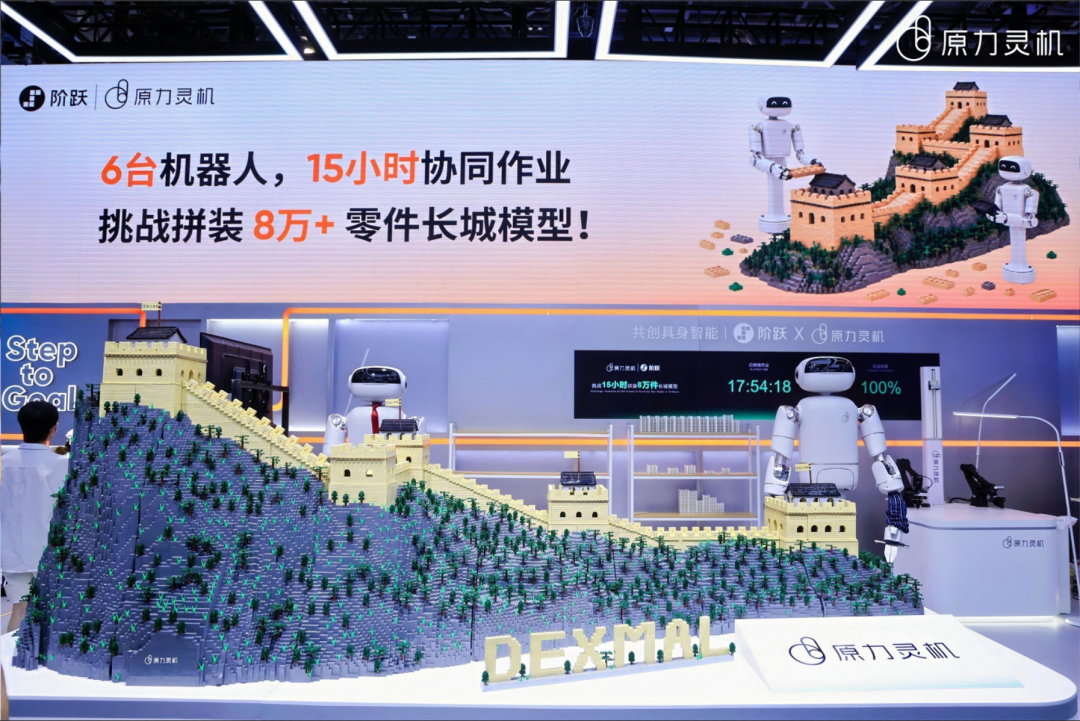
At WAIC 2026, a booth drawing some of the biggest crowds belonged to Force Machine, a startup that assembled a 3.5-metre-long model of the Great Wall from nearly 82,000 tiny Lego bricks, using four desktop arms and two wheeled Apex robots working for 15 hours straight. The smallest components were under a centimetre wide; the placement precision entered the sub-millimetre range, past the limit of human hand tremor.
It looked like a stunt. It was actually a production line in disguise.
Building a wall to prove a factory
Force Machine chose Lego precisely because everyone understands it. The workflow on the booth, feeding, assembly, inspection, unloading and exception recovery, mirrors a real factory cell. The point was to show that fine manipulation, error recovery and multi-robot coordination can run on one system for hours, not just for a press demo.
The harder problem was never precision. It was what happens when things go wrong. Force Machine’s founder, Tang Wenbin, is the former co-founder and CTO of Megvii; his team came out of Megvii’s core research group. Their argument is counterintuitive: a production line does not prize perfection, it prizes recovery. A few per cent scrap rate is tolerable; a line that stops is pure lost money. So the system is built to sense deviations, like a brick that flies off to a random spot, and correct itself.
Data is the moat
Underneath sits an embodied foundation model, DM0.5, which uses historical keyframes for minute-level task memory and hits 10 Hz inference on a single RTX 4090. Training data comes mostly from real teleoperation, with the company collecting tens of thousands of hours of genuine failure cases each month and reinforcing from them. A world model, DW0.5, acts as the post-training environment.
The company frames robot capability as atomic skills, pick, place, insert, pull, that recombine for new tasks without reprogramming. It deliberately targets the “messy ends” of a line, swapping empty trays, loading new material rolls, repacking different batches, jobs that fixed automation handles badly. With a friendly, rounded Apex design and pilots already in talks with brands including Walmart and Uniqlo, Force Machine is pushing from industrial cells toward commercial floors.
Read the original report (LeiPhone)
Translated and adapted from LeiPhone (leiphone.com).